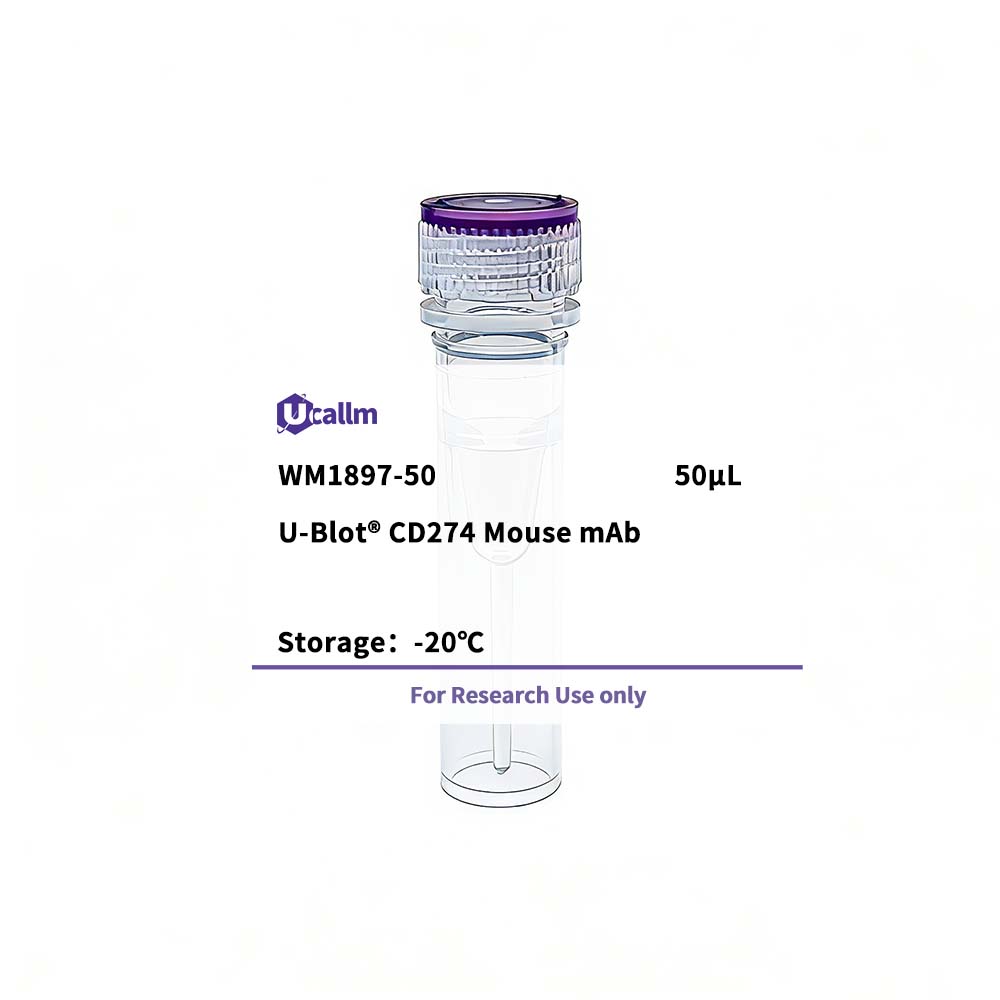
SKU: WM1897 Categories: ,

U-Blot® CD274 Mouse mAb

Price range: $268.00 through $328.00

SKU: WM1897-50
Enter the quantity you would like, or drag the panel to find the quantity and price that best for you
Bulk QuoteAuthorize OEM & ODM

Product details

Background:This gene encodes an immune inhibitory receptor ligand that is expressed by hematopoietic and non-hematopoietic cells, such as T cells and B cells and various types of tumor cells. The encoded protein is a type I transmembrane protein that has immunoglobulin V-like and C-like domains. Interaction of this ligand with its receptor inhibits T-cell activation and cytokine production. During infection or inflammation of normal tissue, this interaction is important for preventing autoimmunity by maintaining homeostasis of the immune response. In tumor microenvironments, this interaction provides an immune escape for tumor cells through cytotoxic T-cell inactivation. Expression of this gene in tumor cells is considered to be prognostic in many types of human malignancies, including colon cancer and renal cell carcinoma. Alternative splicing results in multiple transcript variants. [provided by RefSeq, Sep 2015],

Specifications

Size50μL/100μL
TargetCD274
ReactivityHuman
ApplicationsFC, IF
MW(Calculated)
MW(Observed)
Host SpeciesMouse
IsotypeMouse IgG1,Kappa
Conjugate/ModificationUnmodified
Recommended Dilution RatioIF 1:200-1:1000; FC:1 µg per million cells in 100 µl volume. For optimal results, the reagent should be titrated according to each specific application
FormulationPBS, pH 7.4
PurificationRecombinant Antibody expressed in animal component-free (ACF) media, purified via Protein A affinity chromatography.
StorageStore at 4°C short term. For long term storage, store at -20°C, avoiding freeze/thaw cycles.
Concentration0.5mg/ml
ClonalityMonoclonal
Clone NumberRMMF0122
ImmunogenThe specific immunogen used to produce this antibody is proprietary information.
SpecificityEndogenous
Gene NameCD274 B7H1 PDCD1L1 PDCD1LG1 PDL1
Protein NameProgrammed cell death 1 ligand 1 (PD-L1) (PDCD1 ligand 1) (Programmed death ligand 1) (B7 homolog 1) (B7-H1) (CD antigen CD274)
Other NameProgrammed cell death 1 ligand 1; / PD-L1; / PDCD1 ligand 1; / Programmed death ligand 1; / B7 homolog 1; / B7-H1; / CD antigen CD274
SpeciesHuman
Gene ID29126
UniprotQ9NZQ7,
Species.1Mouse
Gene ID.160533
Uniprot.1Q9EP73
Species.2
Gene ID.2
Uniprot.2
Cellular LocalizationCell membrane; Single-pass type I membrane protein . Early endosome membrane; Single-pass type I membrane protein . Recycling endosome membrane; Single-pass type I membrane protein . Associates with CMTM6 at recycling endosomes, where it is protected from being targeted for lysosomal degradation. .; [Isoform 1]: Cell membrane; Single-pass type I membrane protein .; [Isoform 2]: Endomembrane system; Single-pass type I membrane protein .
Tissue ExpressionHighly expressed in the heart, skeletal muscle, placenta and lung. Weakly expressed in the thymus, spleen, kidney and liver. Expressed on activated T- and B-cells, dendritic cells, keratinocytes and monocytes.
Signaling_pathwayHuman Diseases >> Cancer: overview >> PD-L1 expression and PD-1 checkpoint pathway in cancer;Environmental Information Processing >> Signaling molecules and interaction >> Cell adhesion molecules
Research Areas>>Cell adhesion molecules; / >>PD-L1 expression and PD-1 checkpoint pathway in cancer
FunctionFunction:Involved in the costimulatory signal, essential for T-cell proliferation and production of IL10 and IFNG, in an IL2-dependent and a PDCD1-independent manner. Interaction with PDCD1 inhibits T-cell proliferation and cytokine production.,induction:Up-regulated on T- and B-cells, dendritic cells, keratinocytes and monocytes after LPS and IFNG activation. Up-regulated in B-cells activated by surface Ig cross-linking.,similarity:Belongs to the immunoglobulin superfamily. BTN/MOG family.,similarity:Contains 1 Ig-like C2-type (immunoglobulin-like) domain.,similarity:Contains 1 Ig-like V-type (immunoglobulin-like) domain.,subunit:Interacts with PDCD1.,tissue specificity:Highly expressed in the heart, skeletal muscle, placenta and lung. Weakly expressed in the thymus, spleen, kidney and liver. Expressed on activated T- and B-cells, dendritic cells, keratinocytes and monocytes.,
Please login to post questions
Back to Top
Product has been added to your cart
