

U-Blot® CD54 Rabbit mAb
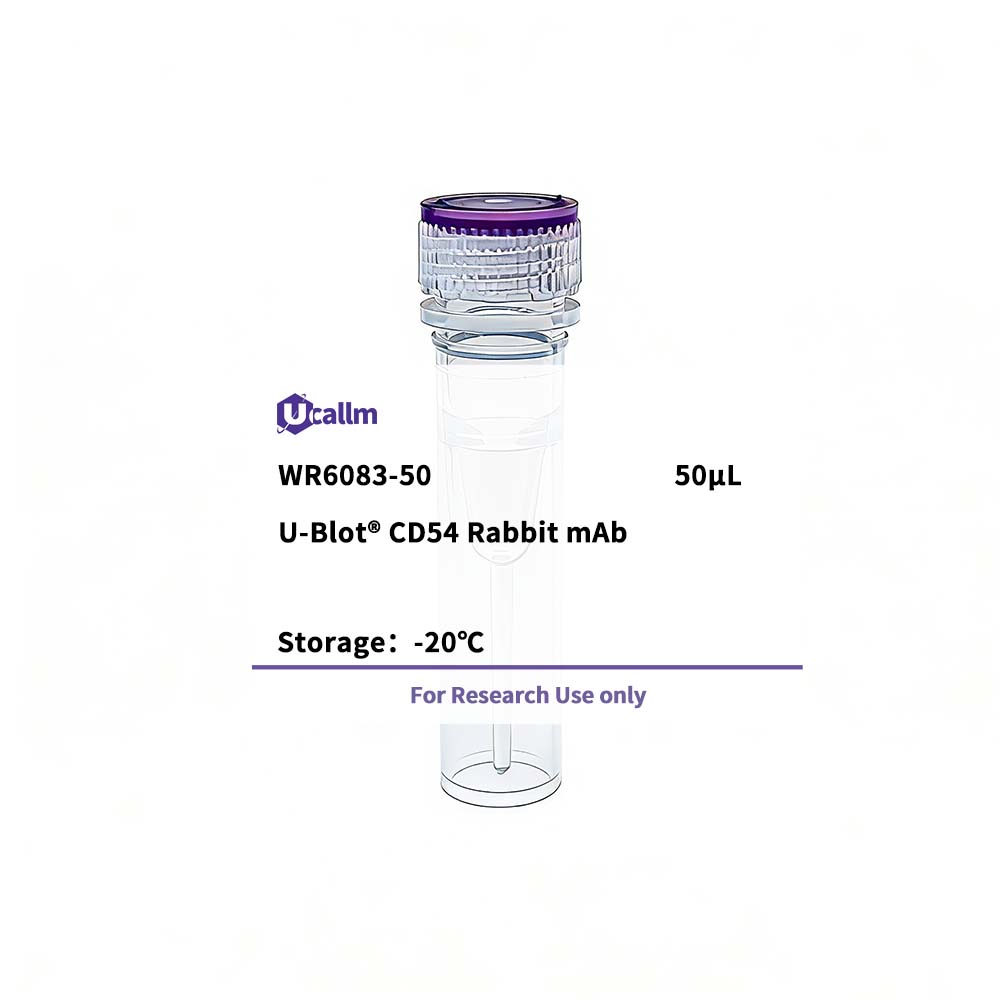
Ucallm_WR6083-50
Price range: $268.00 through $328.00
Product details
Background:
This gene encodes a cell surface glycoprotein which is typically expressed on endothelial cells and cells of the immune system. It binds to integrins of type CD11a / CD18 , or CD11b / CD18 and is also exploited by Rhinovirus as a receptor. [provided by RefSeq , Jul 2008] ,
Specifications
| Size | 50μL/100μL |
| Target | CD54 |
| Reactivity | Mouse |
| Applications | WB, IHC, IF, IP, ELISA |
| MW(Calculated) | 58kD |
| MW(Observed) | 95kD |
| Host Species | Rabbit |
| Isotype | IgG, Kappa |
| Conjugate/Modification | Unmodified |
| Recommended Dilution Ratio | IHC 1:200-1:1000; WB 1:2000-1:10000; IF 1:200-1:1000; ELISA 1:5000-1:20000; IP 1:50-1:200 / Note: For IHC, we suggest antigen retrieval with TE buffer pH 9.0 (Cat#WT1004) |
| Formulation | PBS, 50% glycerol, 0.05% Proclin 300, 0.05%BSA |
| Purification | Recombinant Antibody expressed in animal component-free (ACF) media, purified via Protein A affinity chromatography. |
| Storage | -15°C to -25°C/1 year (Do not lower than -25°C) |
| Concentration | |
| Clonality | Monoclonal |
| Clone Number | RM2226R |
| Immunogen | The specific immunogen used to produce this antibody is proprietary information. |
| Specificity | Endogenous |
| Gene Name | ICAM1 |
| Protein Name | Intercellular adhesion molecule 1 |
| Other Name | ICAM1; / Intercellular adhesion molecule 1; / ICAM-1; / Major group rhinovirus receptor; / CD antigen CD54 |
| Species | Human |
| Gene ID | 3383 |
| Uniprot | P05362 |
| Species.1 | |
| Gene ID.1 | |
| Uniprot.1 | |
| Species.2 | |
| Gene ID.2 | |
| Uniprot.2 | |
| Cellular Localization | Membranous |
| Tissue Expression | Blood ,Kidney ,Liver ,Melanoma ,Plasma , |
| Signaling_pathway | Organismal Systems >> Immune system >> Natural killer cell mediated cytotoxicity;Organismal Systems >> Immune system >> Leukocyte transendothelial migration;Human Diseases >> Immune disease >> Rheumatoid arthritis;Environmental Information Processing >> Signal transduction >> NF-kappa B signaling pathway;Environmental Information Processing >> Signal transduction >> TNF signaling pathway;Environmental Information Processing >> Signaling molecules and interaction >> Cell adhesion molecules |
| Research Areas | >>NF-kappa B signaling pathway; / >>Cell adhesion molecules; / >>Natural killer cell mediated cytotoxicity; / >>TNF signaling pathway; / >>Leukocyte transendothelial migration; / >>AGE-RAGE signaling pathway in diabetic complications; / >>African trypanosomiasis; / >>Malaria; / >>Staphylococcus aureus infection; / >>Influenza A; / >>Human T-cell leukemia virus 1 infection; / >>Kaposi sarcoma-associated herpesvirus infection; / >>Epstein-Barr virus infection; / >>Rheumatoid arthritis; / >>Viral myocarditis; / >>Lipid and atherosclerosis; / >>Fluid shear stress and atherosclerosis |
| Function | Function:ICAM proteins are ligands for the leukocyte adhesion protein LFA-1 (integrin alpha-L/beta-2) . During leukocyte trans-endothelial migration , ICAM1 engagement promotes the assembly of endothelial apical cups through SGEF and RHOG activation. In case of rhinovirus infection acts as a cellular receptor for the virus. ,online information:ICAM-1 ,online information:Icosahedral capsid structure ,online information:Intercellular adhesion molecule entry ,polymorphism:Homozygotes with ICAM1-Kalifi Met-56 seem to have an increased risk for cerebral malaria. ,PTM:Monoubiquitinated , which is promoted by MARCH9 and leads to endocytosis. ,similarity:Belongs to the immunoglobulin superfamily. ICAM family. ,similarity:Contains 5 Ig-like C2-type (immunoglobulin-like) domains. ,subunit:Homodimer (Probable) . Interacts with human herpesvirus 8 MIR2 protein (Probable) . Interacts with MUC1 and promotes cell aggregation in epithelial cells. Interacts with SGEF. Binds to coxsackievirus A21 capsid proteins and acts as a receptor for this virus. , |
Please login to post questions
Related products





