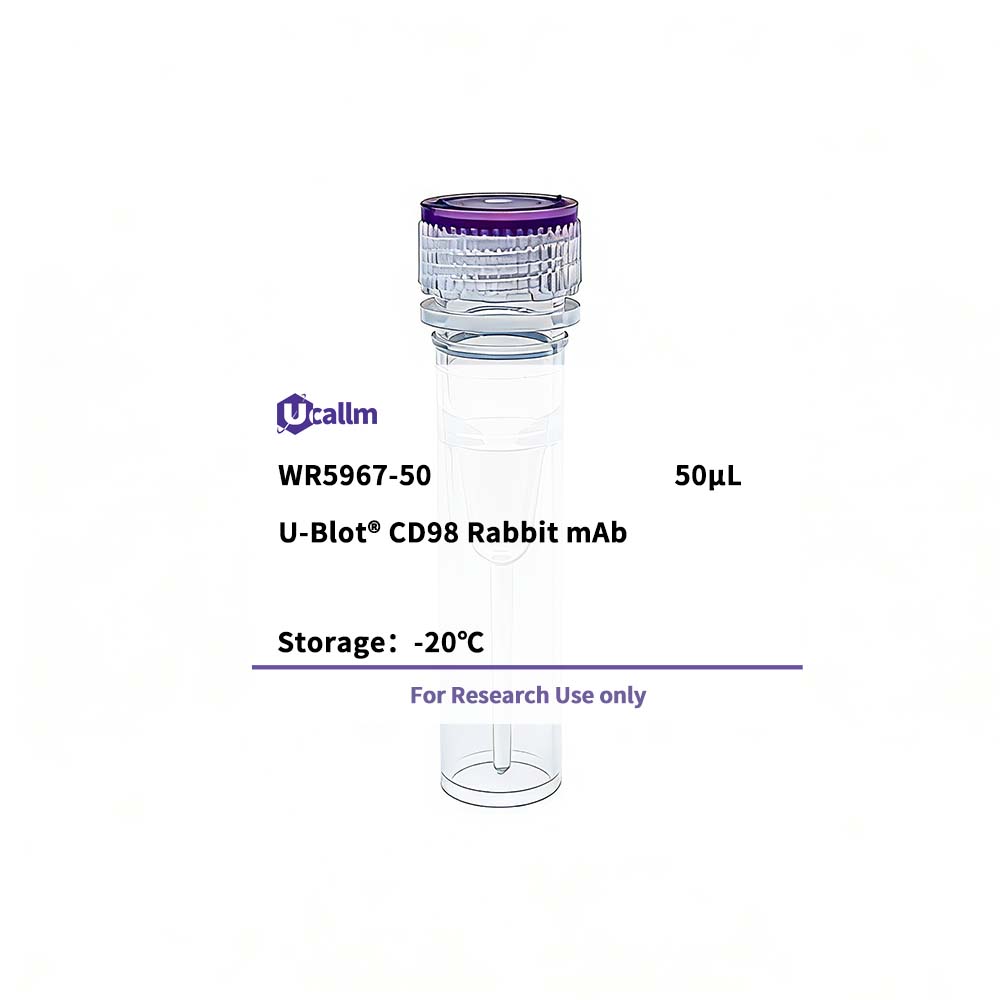
SKU: WR5967 Categories: ,

U-Blot® CD98 Rabbit mAb

Price range: $268.00 through $328.00

SKU: WR5967-50
Enter the quantity you would like, or drag the panel to find the quantity and price that best for you
Bulk QuoteAuthorize OEM & ODM

Product details

Background:
This gene is a member of the solute carrier family and encodes a cell surface , transmembrane protein. The protein exists as the heavy chain of a heterodimer , covalently bound through di-sulfide bonds to one of several possible light chains. The encoded transporter plays a role in regulation of intracellular calcium levels and transports L-type amino acids. Alternatively spliced transcript variants , encoding different isoforms , have been characterized. [provided by RefSeq , Nov 2010] ,


Specifications

Size50μL/100μL
TargetCD98
ReactivityHuman
ApplicationsWB, IHC, IF, IP, ELISA
MW(Calculated)68kD
MW(Observed)68kD
Host SpeciesRabbit
IsotypeIgG,Kappa
Conjugate/ModificationUnmodified
Recommended Dilution RatioIHC 1:200-1:1000; WB 1:500-1:2000; IF 1:200-1:1000; ELISA 1:5000-1:20000; IP 1:50-1:200; / Note: For IHC, we suggest antigen retrieval with TE buffer pH 9.0 (Cat#WT1004)
FormulationPBS, 50% glycerol, 0.05% Proclin 300, 0.05%BSA
PurificationRecombinant Antibody expressed in animal component-free (ACF) media, purified via Protein A affinity chromatography.
Storage-15°C to -25°C/1 year(Do not lower than -25°C)
Concentration
ClonalityMonoclonal
Clone NumberRM1867R
ImmunogenThe specific immunogen used to produce this antibody is proprietary information.
SpecificityEndogenous
Gene NameSLC3A2
Protein Name4F2 cell-surface antigen heavy chain
Other NameSLC3A2; / MDU1; / 4F2 cell-surface antigen heavy chain; / 4F2hc; / 4F2 heavy chain antigen; / Lymphocyte activation antigen 4F2 large subunit; / CD98
SpeciesHuman
Gene ID6520
UniprotP08195,
Species.1Mouse
Gene ID.117254
Uniprot.1P10852,
Species.2Rat
Gene ID.250567
Uniprot.2Q794F9
Cellular LocalizationApical cell membrane . Cell membrane; Single-pass type II membrane protein . Cell junction . Lysosome membrane . Melanosome . Localized at the plasma membrane when associated with SLC7A5/LAT1 or SLC7A8/LAT2 (PubMed:9751058, PubMed:11311135). Localized to the apical membrane of placental syncytiotrophoblastic cells (PubMed:11742812). Recruited to lysosomes by LAPTM4B (PubMed:25998567). Identified by mass spectrometry in melanosome fractions from stage I to stage IV (PubMed:17081065). Located selectively at cell-cell adhesion sites (By similarity). Colocalized with SLC7A8/LAT2 at the basolateral membrane of kidney proximal tubules and small intestine epithelia. Expressed in both luminal and abluminal membranes of brain capillary endothelial cells (By similarity). .
Tissue ExpressionExpressed ubiquitously in all tissues tested with highest levels detected in kidney, placenta and testis and weakest level in thymus. During gestation, expression in the placenta was significantly stronger at full-term than at the mid-trimester stage. Expressed in HUVECS and at low levels in resting peripheral blood T-lymphocytes and quiescent fibroblasts. Also expressed in fetal liver and in the astrocytic process of primary astrocytic gliomas. Expressed in retinal endothelial cells and in the intestinal epithelial cell line C2BBe1.
Signaling_pathwayCellular Processes >> Cell growth and death >> Ferroptosis;Environmental Information Processing >> Signal transduction >> mTOR signaling pathway
Research Areas>>mTOR signaling pathway; / >>Ferroptosis; / >>Protein digestion and absorption
FunctionFunction:Required for the function of light chain amino-acid transporters. Involved in sodium-independent, high-affinity transport of large neutral amino acids such as phenylalanine, tyrosine, leucine, arginine and tryptophan. Involved in guiding and targeting of LAT1 and LAT2 to the plasma membrane. When associated with SLC7A6 or SLC7A7 acts as an arginine/glutamine exchanger, following an antiport mechanism for amino acid transport, influencing arginine release in exchange for extracellular amino acids. Plays a role in nitric oxide synthesis in human umbilical vein endothelial cells (HUVECs) via transport of L-arginine. Required for normal and neoplastic cell growth. When associated with SLC7A5/LAT1, is also involved in the transport of L-DOPA across the blood-brain barrier, and that of thyroid hormones triiodothyronine (T3) and thyroxine (T4) across the cell membrane in tissues such as placenta. Involved in the uptake of methylmercury (MeHg) when administered as the L-cysteine or D,L-homocysteine complexes, and hence plays a role in metal ion homeostasis and toxicity. When associated with SLC7A5 or SLC7A8, involved in the cellular activity of small molecular weight nitrosothiols, via the stereoselective transport of L-nitrosocysteine (L-CNSO) across the transmembrane. Together with ICAM1, regulates the transport activity LAT2 in polarized intestinal cells, by generating and delivering intracellular signals. When associated with SLC7A5, plays an important role in transporting L-leucine from the circulating blood to the retina across the inner blood-retinal barrier.,induction:Expression is induced in resting peripheral blood T-lymphocytes following PHA stimulation. Expression increases at the time of maximal DNA synthesis, in fibroblasts stimulated to divide. Expression and the uptake of leucine is stimulated in mononuclear, cytotrophoblast-like choriocarcinoma cells by combined treatment with PMA and calcium ionophore.,mass spectrometry: PubMed:11840567,miscellaneous:Arginine uptake is inhibited by increasing concentrations of leucine in the presence of Na(+).,similarity:Belongs to the SLC3A transporter family.,subcellular location:Identified by mass spectrometry in melanosome fractions from stage I to stage IV. Localized to the plasma membrane when associated with SLC7A5 or SLC7A8. Localized to the placental apical membrane. Located selectively at cell-cell adhesion sites (By similarity). Colocalized with SLC7A8/LAT2 at the basolateral membrane of kidney proximal tubules and small intestine epithelia. Expressed in both luminal and abluminal membranes of brain capillary endothelial cells.,subunit:Disulfide-linked heterodimer of a glycosylated heavy chain and a non-glycosylated light chain (SLC7A5, SLC7A6, SLCA7A7, SLC7A8, SLC7A10 or SLCA7A11). Colocalizes with cadherins (By similarity). Interacts with FAM57A/CT120 and ICAM1. Constitutively and specifically associates with beta-1 integrins (alpha-2/beta-1, alpha-3/beta-1, alpha-5/beta-1 and alpha-6/beta-1), but minimally with alpha-4/beta-1.,tissue specificity:Expressed ubiquitously in all tissues tested with highest levels detected in kidney, placenta and testis and weakest level in thymus. During gestation, expression in the placenta was significantly stronger at full-term than at the mid-trimester stage. Expressed in HUVECS and at low levels in resting peripheral blood T-lymphocytes and quiescent fibroblasts. Also expressed in fetal liver and in the astrocytic process of primary astrocytic gliomas. Expressed in retinal endothelial cells and in the intestinal epithelial cell line Caco2-BBE.,
Please login to post questions
Back to Top
Product has been added to your cart