SKU: WR5398 Categories: ,

U-Blot® Crystallin-αB Rabbit mAb

Price range: $268.00 through $328.00

SKU: WR5398-50
Enter the quantity you would like, or drag the panel to find the quantity and price that best for you
Bulk QuoteAuthorize OEM & ODM

Product details

Background:Mammalian lens crystallins are divided into alpha, beta, and gamma families. Alpha crystallins are composed of two gene products: alpha-A and alpha-B, for acidic and basic, respectively. Alpha crystallins can be induced by heat shock and are members of the small heat shock protein (HSP20) family. They act as molecular chaperones although they do not renature proteins and release them in the fashion of a true chaperone; instead they hold them in large soluble aggregates. Post-translational modifications decrease the ability to chaperone. These heterogeneous aggregates consist of 30-40 subunits; the alpha-A and alpha-B subunits have a 3:1 ratio, respectively. Two additional functions of alpha crystallins are an autokinase activity and participation in the intracellular architecture. The encoded protein has been identified as a moonlighting protein based on its ability to perform mechanistically distin
Specifications

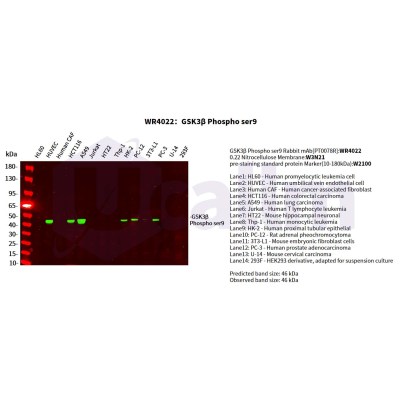
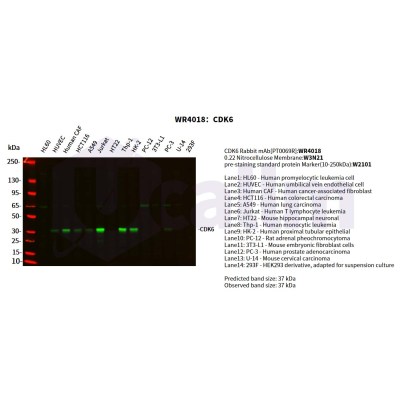
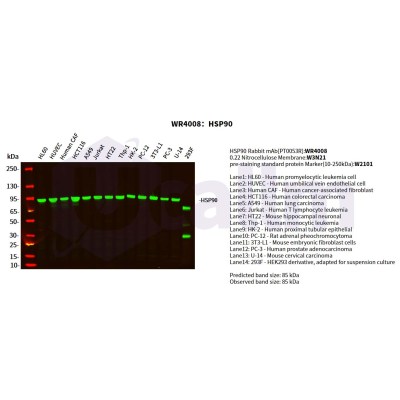
TargetCrystallin-αB
ReactivityHuman, Mouse, Rat
ApplicationsWB, IHC, IF, IP, ELISA
MW(Calculated)20kD
MW(Observed)22kD
Host SpeciesRabbit
IsotypeIgG,Kappa
Conjugate/ModificationUnmodified
Modification
Recommended Dilution RatioIHC 1:200-1:1000; WB 1:2000-1:10000; IF 1:200-1:1000; ELISA 1:5000-1:20000; IP 1:50-1:200; / Note: For IHC, we suggest antigen retrieval with TE buffer pH 9.0 (Cat#YS0004)
FormulationPBS, 50% glycerol, 0.05% Proclin 300, 0.05%BSA
Source
PurificationRecombinant Antibody expressed in animal component-free (ACF) media, purified via Protein A affinity chromatography.
Purity
Storage-15°C to -25°C/1 year(Do not lower than -25°C)
Concentration
ClonalityMonoclonal
Clone NumberPT1645R
ImmunogenThe specific immunogen used to produce this antibody is proprietary information.
Sequence
SpecificityEndogenous
Gene NameCRYAB
Protein NameAlpha-crystallin B chain
Other NameCRYAB; / CRYA2; / Alpha-crystallin B chain; / Alpha; / B; / -crystallin; / Heat shock protein beta-5; / HspB5; / Renal carcinoma antigen NY-REN-27; / Rosenthal fiber component
SpeciesHuman
Gene ID-11410
UniprotP02511,
Species.1Mouse
Gene ID-212955
Uniprot.1P23927,
Species.2Rat
Gene ID-325420
Uniprot.2P23928
Organism-4
Gene ID-4
SwissProt-4
BackgroundMammalian lens crystallins are divided into alpha, beta, and gamma families. Alpha crystallins are composed of two gene products: alpha-A and alpha-B, for acidic and basic, respectively. Alpha crystallins can be induced by heat shock and are members of the small heat shock protein (HSP20) family. They act as molecular chaperones although they do not renature proteins and release them in the fashion of a true chaperone; instead they hold them in large soluble aggregates. Post-translational modifications decrease the ability to chaperone. These heterogeneous aggregates consist of 30-40 subunits; the alpha-A and alpha-B subunits have a 3:1 ratio, respectively. Two additional functions of alpha crystallins are an autokinase activity and participation in the intracellular architecture. The encoded protein has been identified as a moonlighting protein based on its ability to perform mechanistically distin
Cellular LocalizationCytoplasm . Nucleus . Secreted . Lysosome . Translocates to the nucleus during heat shock and resides in sub-nuclear structures known as SC35 speckles or nuclear splicing speckles (PubMed:19464326). Localizes at the Z-bands and the intercalated disk in cardiomyocytes (PubMed:28493373). Can be secreted; the secretion is dependent on protein unfolding and facilitated by the cargo receptor TMED10; it results in protein translocation from the cytoplasm into the ERGIC (endoplasmic reticulum-Golgi intermediate compartment) followed by vesicle entry and secretion (PubMed:32272059). .
Tissue ExpressionLens as well as other tissues (PubMed:838078, PubMed:2387586). Expressed in myocardial tissue (PubMed:28493373).
Signaling_pathwayOrganismal Systems >> Aging >> Longevity regulating pathway - multiple species;Genetic Information Processing >> Folding, sorting and degradation >> Protein processing in endoplasmic reticulum
Research Areas>>Protein processing in endoplasmic reticulum; / >>Longevity regulating pathway - multiple species
FunctionDisease:Crystallins do not turn over as the lens ages, providing ample opportunity for post-translational modifications or oxidations. These modifications may change crystallin solubility properties and favor senile cataract.,Disease:Defects in CRYAB are the cause of alpha-B crystallinopathy [MIM:608810]. Alpha-B crystallinopathy is a an autosomal dominant form of desmin-related myopathy (DRM) that results in weakness of the proximal and distal limb muscle (including neck, velopharynx, and trunk muscles), signs of cardiomyopathy and cataract. Patients with progressive myopathy characterized by myofibrillar degeneration that commences at the Z-disk, have been described. Mutations truncate the essential C-terminal domain of the protein required for the chaperone function.,Disease:Seen as Rosenthal fiber protein in the brain tissue of patients with Alexander disease.,Function:May contribute to the transparency and refractive index of the lens.,mass spectrometry: PubMed:10930324,mass spectrometry: PubMed:8175657,mass spectrometry:With 1 phosphate group PubMed:10930324,mass spectrometry:With 1 phosphate group PubMed:8175657,mass spectrometry:With 2 phosphate groups PubMed:8175657,similarity:Belongs to the small heat shock protein (HSP20) family.,subunit:Aggregates with homologous proteins, including CRYAA and the small heat shock protein HSPB1, to form large heteromeric complexes. Interacts with HSPBAP1 and TTN/titin.,tissue specificity:Lens as well as other tissues.,
RRID
Please login to post questions
Back to Top
Product has been added to your cart