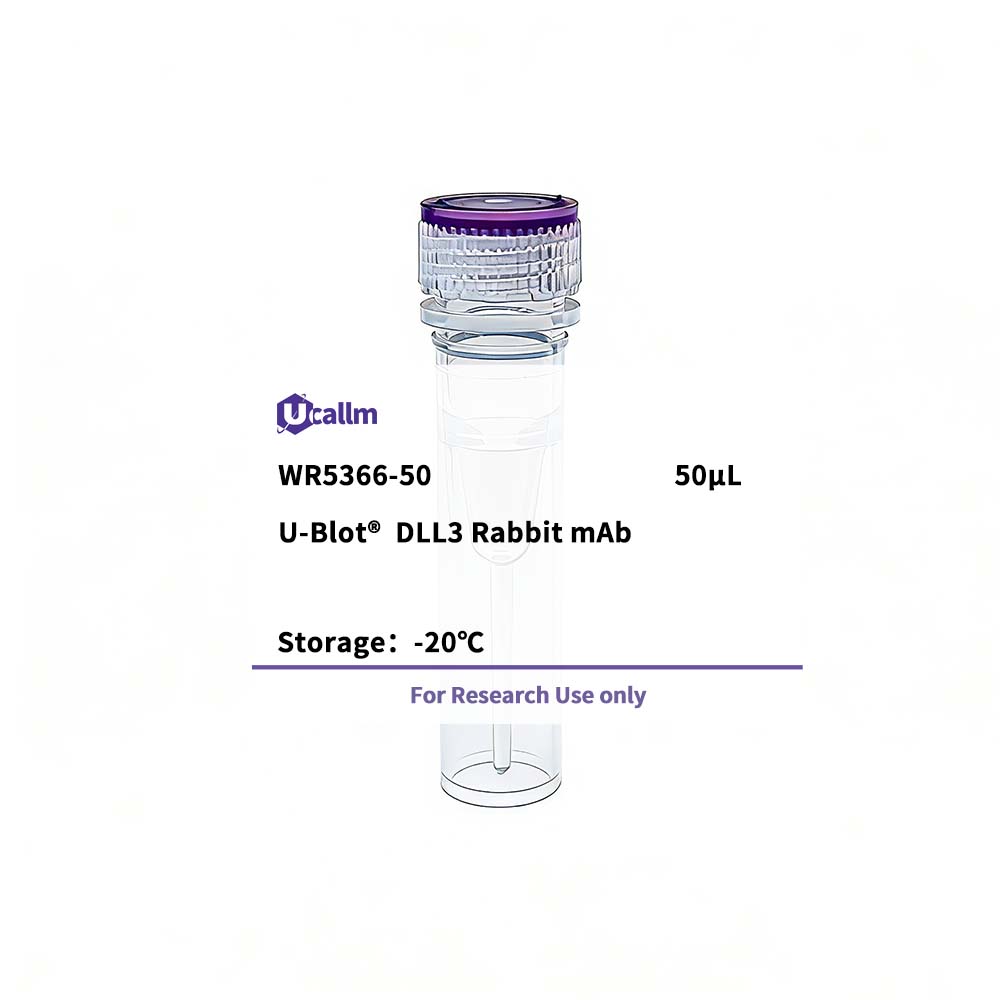
SKU: WR5366 Categories: ,

U-Blot® DLL3 Rabbit mAb

Price range: $268.00 through $328.00

SKU: WR5366-50
Enter the quantity you would like, or drag the panel to find the quantity and price that best for you
Bulk QuoteAuthorize OEM & ODM

Product details

Background:This gene encodes a member of the delta protein ligand family. This family functions as Notch ligands that are characterized by a DSL domain, EGF repeats, and a transmembrane domain. Mutations in this gene cause autosomal recessive spondylocostal dysostosis 1. Two transcript variants encoding distinct isoforms have been identified for this gene. [provided by RefSeq, Jul 2008],

Specifications

Size50μL/100μL
TargetDLL3
ReactivityHuman, Mouse
ApplicationsWB, IHC, IF, IP, ELISA
MW(Calculated)65kD
MW(Observed)65kD
Host SpeciesRabbit
IsotypeIgG,Kappa
Conjugate/ModificationUnmodified
Recommended Dilution RatioIHC 1:200-1:1000; WB 1:500-1:2000; IF 1:200-1:1000; ELISA 1:5000-1:20000; IP 1:50-1:200; / Note: For IHC, we suggest antigen retrieval with TE buffer pH 9.0 (Cat#WT1004)
FormulationPBS, 50% glycerol, 0.05% Proclin 300, 0.05%BSA
PurificationRecombinant Antibody expressed in animal component-free (ACF) media, purified via Protein A affinity chromatography.
Storage-15°C to -25°C/1 year(Do not lower than -25°C)
Concentration
ClonalityMonoclonal
Clone Number
ImmunogenThe specific immunogen used to produce this antibody is proprietary information.
SpecificityEndogenous
Gene NameDLL3
Protein NameDelta-like protein 3 (Drosophila Delta homolog 3) (Delta3)
Other Name
SpeciesHuman
Gene ID10683
UniprotQ9NYJ7,
Species.1Mouse
Gene ID.1
Uniprot.1O88516,
Species.2Rat
Gene ID.2
Uniprot.2O88671
Cellular LocalizationMembrane; Single-pass type I membrane protein .
Tissue ExpressionBrain,
Signaling_pathwayOrganismal Systems >> Immune system >> Th1 and Th2 cell differentiation;Human Diseases >> Cancer: overview >> Pathways in cancer;Human Diseases >> Cancer: specific types >> Breast cancer;Environmental Information Processing >> Signal transduction >> Notch signaling pathway
Research Areas>>Endocrine resistance; / >>Notch signaling pathway; / >>Th1 and Th2 cell differentiation; / >>Pathways in cancer; / >>Chemical carcinogenesis - receptor activation; / >>Breast cancer
FunctionDisease:Defects in DLL3 are the cause of spondylocostal dysostosis autosomal recessive type 1 (SCDO1) [MIM:277300]. Autosomal recessive spondylocostal dysostosis is a rare condition of variable severity associated with vertebral and rib segmentation defects. The main skeletal malformations include fusion of vertebrae, hemivertebrae, fusion of certain ribs, and other rib malformations. Deformity of the chest and spine (severe scoliosis, kyphoscoliosis and lordosis) is a natural consequence of the malformation and leads to a dwarf-like appearance. As the thorax is small, infants frequently have respiratory insufficiency and repeated respiratory infections resulting in life-threatening complications in the first year of life.,Domain:The DSL domain is required for binding to the Notch receptor.,Function:Inhibits primary neurogenesis. May be required to divert neurons along a specific differentiation pathway. Plays a role in the formation of somite boundaries during segmentation of the paraxial mesoderm.,PTM:Ubiquitinated by MIB (MIB1 or MIB2), leading to its endocytosis and subsequent degradation.,similarity:Contains 1 DSL domain.,similarity:Contains 6 EGF-like domains.,subunit:Can bind and activate Notch-1 or another Notch receptor.,
Please login to post questions
Back to Top
Product has been added to your cart
