SKU: WR5069 Categories: ,

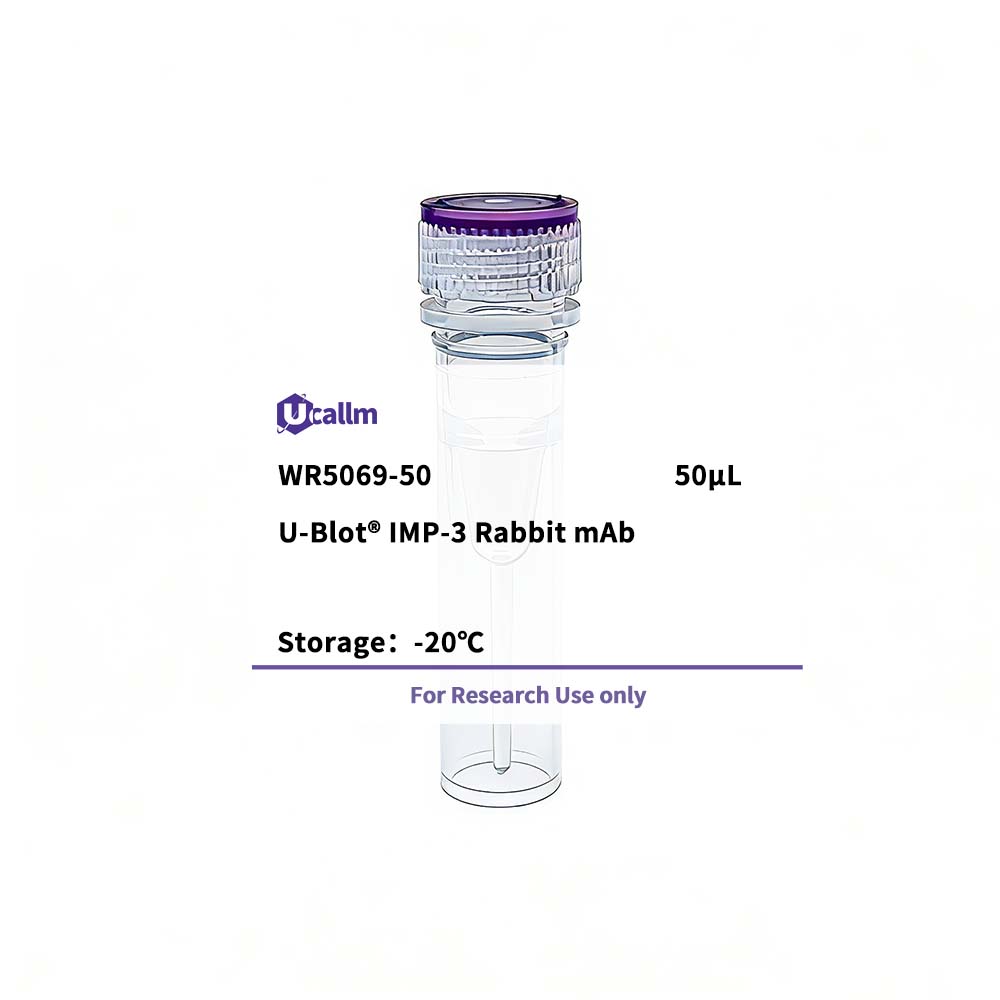
U-Blot® IMP-3 Rabbit mAb

Price range: $268.00 through $328.00

SKU: WR5069-100
Enter the quantity you would like, or drag the panel to find the quantity and price that best for you
Bulk QuoteAuthorize OEM & ODM

Product details

Background:The protein encoded by this gene is primarily found in the nucleolus, where it can bind to the 5' UTR of the insulin-like growth factor II leader 3 mRNA and may repress translation of insulin-like growth factor II during late development. The encoded protein contains several KH domains, which are important in RNA binding and are known to be involved in RNA synthesis and metabolism. A pseudogene exists on chromosome 7, and there are putative pseudogenes on other chromosomes. [provided by RefSeq, Jul 2008],


Specifications

Size50μL/100μL
TargetIMP-3
ReactivityHuman, Mouse, Rat
ApplicationsWB, IHC, IF, IP, ELISA
MW(Calculated)64kD
MW(Observed)64kD
Host SpeciesRabbit
IsotypeIgG,Kappa
Conjugate/ModificationUnmodified
Recommended Dilution RatioIHC 1:200-1:1000; WB 1:2000-1:10000; IF 1:200-1:1000; ELISA 1:5000-1:20000; IP 1:50-1:200; / Note: For IHC, we suggest antigen retrieval with TE buffer pH 9.0 (Cat#WT1004)
FormulationPBS, 50% glycerol, 0.05% Proclin 300, 0.05%BSA
PurificationRecombinant Antibody expressed in animal component-free (ACF) media, purified via Protein A affinity chromatography.
Storage-15°C to -25°C/1 year(Do not lower than -25°C)
Concentration
ClonalityMonoclonal
Clone NumberRM1304R
ImmunogenThe specific immunogen used to produce this antibody is proprietary information.
SpecificityEndogenous
Gene NameIGF2BP3
Protein NameInsulin-like growth factor 2 mRNA-binding protein 3
Other NameIGF2BP3; / IMP3; / KOC1; / VICKZ3; / Insulin-like growth factor 2 mRNA-binding protein 3; / IGF2 mRNA-binding protein 3; / IMP-3; / IGF-II mRNA-binding protein 3; / KH domain-containing protein overexpressed in cancer; / hKOC; / VICKZ family member 3
SpeciesHuman
Gene ID10643
UniprotO00425,
Species.1Mouse
Gene ID.1
Uniprot.1Q9CPN8
Species.2
Gene ID.2
Uniprot.2
Cellular LocalizationNucleus. Cytoplasm. Cytoplasm, P-body . Cytoplasm, Stress granule . Found in lamellipodia of the leading edge, in the perinuclear region, and beneath the plasma membrane. The subcytoplasmic localization is cell specific and regulated by cell contact and growth. Localized at the connecting piece and the tail of the spermatozoa. Colocalized with CD44 mRNA in RNP granules. In response to cellular stress, such as oxidative stress, recruited to stress granules.
Tissue ExpressionExpressed in fetal liver, fetal lung, fetal kidney, fetal thymus, fetal placenta, fetal follicles of ovary and gonocytes of testis, growing oocytes, spermatogonia and semen (at protein level). Expressed in cervix adenocarcinoma, in testicular, pancreatic and renal-cell carcinomas (at protein level). Expressed ubiquitously during fetal development at 8 and 14 weeks of gestation. Expressed in ovary, testis, brain, placenta, pancreatic cancer tissues and pancreatic cancer cell lines.
Signaling_pathway
Research Areas
FunctionDisease:Autoantibodies against IGF2BP3 are detected in sera from some patients with a variety of carcinomas.,Function:RNA-binding protein that act as a regulator of mRNA translation and stability. Binds to the 5'-UTR of the insulin-like growth factor 2 (IGF2) mRNAs. Binds to sequences in the 3'-UTR of CD44 mRNA.,similarity:Belongs to the RRM IMP/VICKZ family.,similarity:Contains 2 RRM (RNA recognition motif) domains.,similarity:Contains 4 KH domains.,subcellular location:Found in lamellipodia of the leading edge, in the perinuclear region, and beneath the plasma membrane. The subcytoplasmic localization is cell specific and regulated by cell contact and growth. Localized at the connecting piece and the tail of the spermatozoa. Colocalized with CD44 mRNA in RNP granules.,subunit:Homodimer and multimer.,tissue specificity:Expressed in fetal liver, fetal lung, fetal kidney, fetal thymus, fetal placenta, fetal follicles of ovary and gonocytes of testis, growing oocytes, spermatogonia and semen (at protein level). Expressed in cervix adenocarcinoma, in testicular, pancreatic and renal-cell carcinomas (at protein level). Expressed ubiquitously during fetal development at 8 and 14 weeks of gestation. Expressed in ovary, testis, brain, placenta, pancreatic cancer tissues and pancreatic cancer cell lines.,
Please login to post questions
Back to Top
Product has been added to your cart
