

U-Blot® Neuron-Specific Enolase(NSE) Rabbit mAb (Ready to Use)
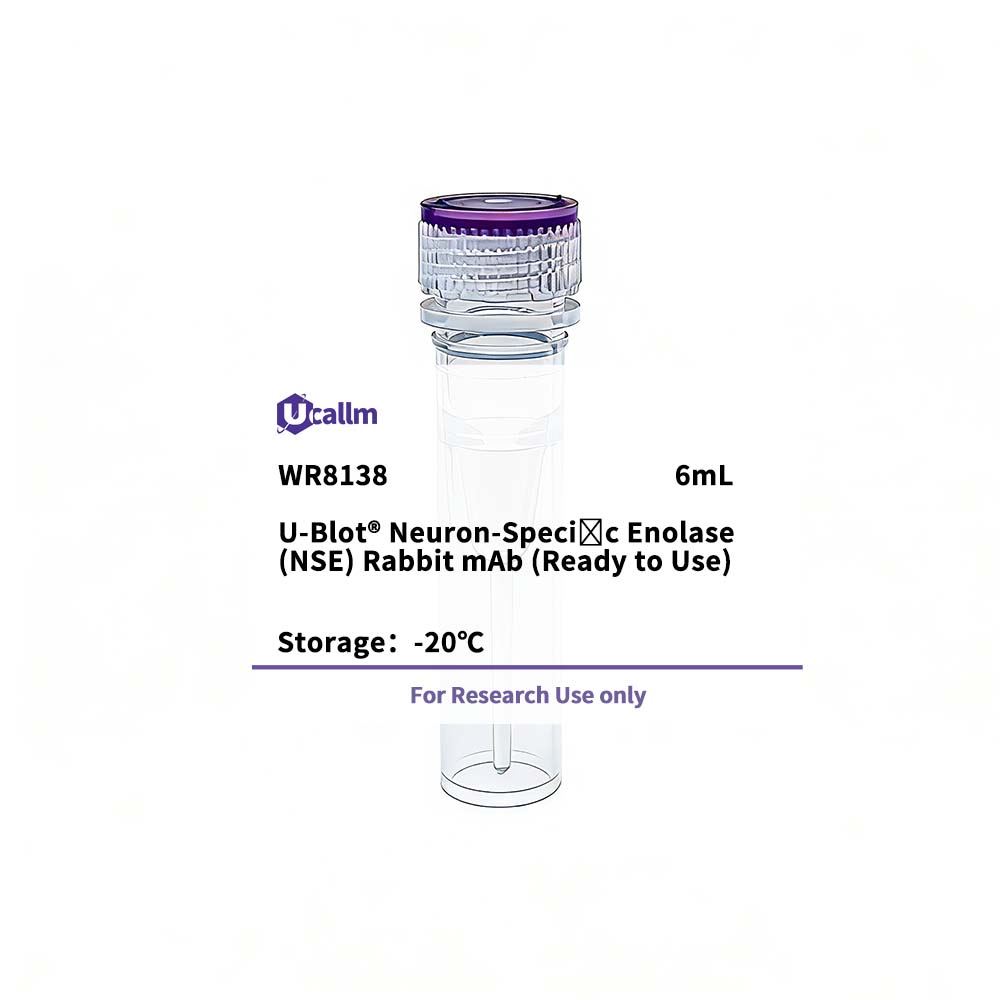
Ucallm_WR8138
$168.00
Product details
Background:
enolase 2(ENO2) Homo sapiens This gene encodes one of the three enolase isoenzymes found in mammals. This isoenzyme, a homodimer, is found in mature neurons and cells of neuronal origin. A switch from alpha enolase to gamma enolase occurs in neural tissue during development in rats and primates. [provided by RefSeq, Jul 2008],
Specifications
| Size | 6mL |
| Target | Enolase |
| Reactivity | Human, Mouse, Rat |
| Applications | IHC |
| MW(Calculated) | |
| MW(Observed) | |
| Host Species | Rabbit |
| Isotype | IgG1,Kappa |
| Conjugate/Modification | Unmodified |
| Recommended Dilution Ratio | Ready to use for IHC / Note: For IHC, we suggest antigen retrieval with TE buffer pH 9.0 (Cat#WT1004) |
| Formulation | The prediluted ready-to-use antibody is diluted in phosphate buffer saline containing stabilizing protein and 0.05% Proclin 300 |
| Purification | Recombinant Expression and Affinity purified |
| Storage | 2°C to 8°C/1 year,Ship by ice bag |
| Concentration | |
| Clonality | Monoclonal |
| Clone Number | RM47R |
| Immunogen | Synthesized peptide derived from human Neuron-Specific Enolase(NSE) AA range:300-434 |
| Specificity | This antibody detects endogenous levels of Enolase |
| Gene Name | ENO2 |
| Protein Name | Neuron-Specific Enolase(NSE) |
| Other Name | 2 phospho D glyceRate hydrolyase; / 2-phospho-D-glyceRate hydro-lyase; / Eno 2; / ENO2; / ENOG; / ENOG_HUMAN; / Enolase 2; / gamma, neuronal; / Enolase 2; / Enolase 2 gamma neuronal; / Enolase2; / Epididymis secretory protein Li 279; / Gamma enolase; / Gamma-enolase; / HEL S 279; / Neural enolase; / Neuron specific enolase; / Neuron specific gamma enolase; / Neuron-specific enolase; / neuronal enriched enolase; / Neurone specific enolase; / NSE |
| Species | Human |
| Gene ID | 2026 |
| Uniprot | P09104, |
| Species.1 | Mouse |
| Gene ID.1 | 13807 |
| Uniprot.1 | P17183, |
| Species.2 | Rat |
| Gene ID.2 | 24334 |
| Uniprot.2 | P07323 |
| Cellular Localization | Cytoplasmic |
| Tissue Expression | The alpha/alpha homodimer is expressed in embryo and in most adult tissues. The alpha/beta heterodimer and the beta/beta homodimer are found in striated muscle, and the alpha/gamma heterodimer and the gamma/gamma homodimer in neurons. |
| Signaling_pathway | Environmental Information Processing >> Signal transduction >> HIF-1 signaling pathway;Genetic Information Processing >> Folding, sorting and degradation >> RNA degradation |
| Research Areas | >>Glycolysis / Gluconeogenesis; / >>Metabolic pathways; / >>Carbon metabolism; / >>Biosynthesis of amino acids; / >>RNA degradation; / >>HIF-1 signaling pathway |
| Function | Catalytic activity:2-phospho-D-glycerate = phosphoenolpyruvate + H(2)O.,cofactor:Magnesium. Required for catalysis and for stabilizing the dimer.,developmental stage:During ontogenesis, there is a transition from the alpha/alpha homodimer to the alpha/beta heterodimer in striated muscle cells, and to the alpha/gamma heterodimer in nerve cells.,Function:Has neurotrophic and neuroprotective properties on a broad spectrum of central nervous system (CNS) neurons. Binds, in a calcium-dependent manner, to cultured neocortical neurons and promotes cell survival.,induction:Levels of ENO2 increase dramatically in cardiovascular accidents, cerebral trauma, brain tumors and Creutzfeldt-Jacob disease.,pathway:Carbohydrate degradation; glycolysis; pyruvate from D-glyceraldehyde 3-phosphate: step 4/5.,similarity:Belongs to the enolase family.,subcellular location:Can translocate to the plasma membrane in either the homodimeric (alpha/alpha) or heterodimeric (alpha/gamma) form.,subunit:Mammalian enolase is composed of 3 isozyme subunits, alpha, beta and gamma, which can form homodimers or heterodimers which are cell-type and development-specific.,tissue specificity:The alpha/alpha homodimer is expressed in embryo and in most adult tissues. The alpha/beta heterodimer and the beta/beta homodimer are found in striated muscle, and the alpha/gamma heterodimer and the gamma/gamma homodimer in neurons., |
Please login to post questions
Related products




