

U-Blot® Pan-L-Lactyllysine Rabbit pAb
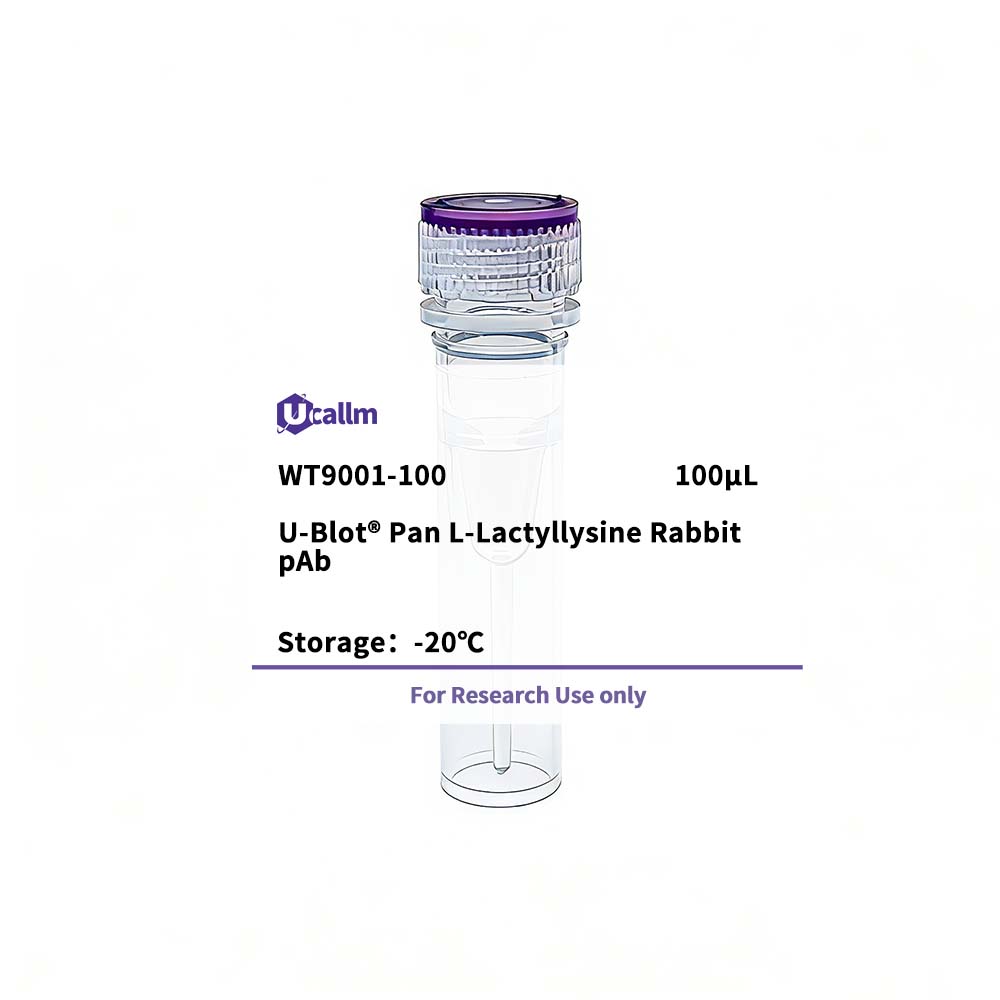
Ucallm_WT9001-100
Price range: $450.00 through $1,150.00
Product details
Background:L-Lactyllysine (abbreviated as Kla) is a novel lysine acylation-type post-translational modification. It is formed by the covalent attachment of an L-lactyl group to lysine residues, mainly mediated by lactoyl-CoA. Kla is widely distributed on both histone and non-histone proteins, and participates in chromatin remodeling, gene transcription regulation, cellular metabolism, and inflammatory responses. Studies have shown that L-lactylation is closely associated with tumor metabolic reprogramming, hypoxia stress, immune regulation, and various disease processes, serving as a key mechanism linking cellular metabolism and epigenetic regulation.
Specifications
| Target | L-Lactyllysine |
| Reactivity | Species Independent |
| Application | WB, IHC-P, ICC/IF, FC |
| MW(Calculated) | Multiple |
| MW(Observed) | Multiple |
| Host Species | Rabbit |
| Isotype | IgG |
| Conjugate | Unconjugated |
| Modification | Lysine lactylation |
| Modification Site | Lys(K) |
| Recommended dilution ratio | WB 1:1000-1:2000;IHC-P 1:100-1:200;ICC/IF 1:100-1:200;FC 1:100-1:200 |
| Composition | PBS, Glycerol, BSA,NaN3 |
| Purification process | Protein A |
| Storage | Store at -20°C. Avoid repeated freeze-thaw cycles |
| Stability | Stable for 12 months from date of receipt / reconstitution. |
| Concentration | |
| Clonal | Polyclonal |
| Clone Number | |
| Immunogen | polypeptide |
| Gene Name | |
| Protein Name | |
| Alternative name | KL-la |
| Organism-1 | |
| Gene ID | |
| SwissProt-1 | |
| Cellular Localization |
Please login to post questions
Related products




