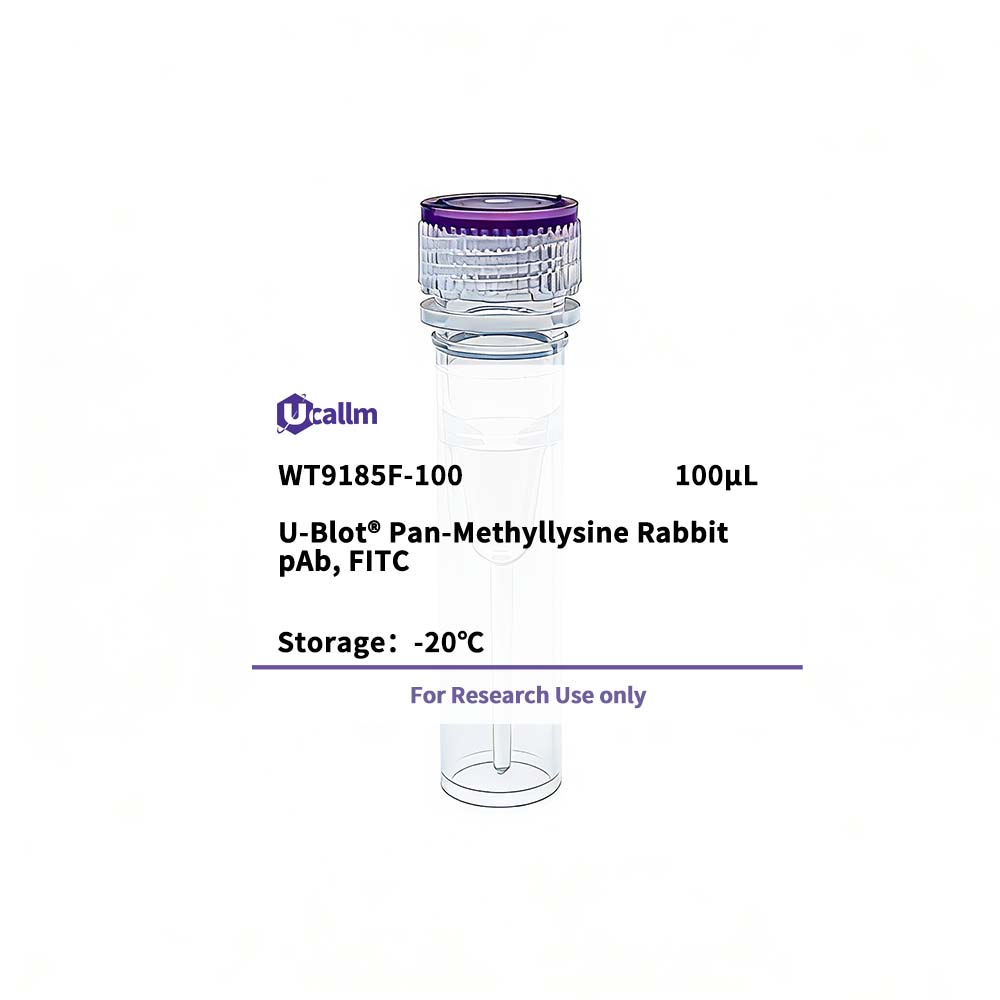
U-Blot® Pan-Methyllysine Rabbit pAb, FITC

$999.00

SKU: WT9185F-300
Enter the quantity you would like, or drag the panel to find the quantity and price that best for you
Bulk QuoteAuthorize OEM & ODM

Product details

Affinity purified rabbit polyclonal anti-methylated lysine antibody is developed using a methylated protein as the immunogen. The methyllysine specific antibodies are affinity purified with N-ε-mono-methyllysine and di-methyllysine on agarose as the affinity matrix. The purified antibody was conjugated to fluorescein. The conjugated antibody was tested to localize methylated proteins

Specifications

TargetMethyllysine
ReactivitySpecies Independent
ApplicationIF
MW(Calculated)
MW(Observed)
Host SpeciesRabbit
IsotypeIgG
ConjugateWith fluorescein isothiocyanate (FITC) FITC/Ab molar ratio - 10:1
ModificationMethylation
Modified site
Recommended dilution ratioIF 1:50 - 1:100
Composition250 ug/mL in PBS, 50% glycerol
Purification processN-e-mono-methyllysine and di-methyllysine on agarose
Purity
StorageProduct is stable for several weeks at 4°C. For extended storage, store product at –20ºC.
StabilityExpiration date is six months from date of shipping if properly stored.
ClonalPolyclonal
Clone Number
ImmunogenMethylated KLH conjugates
Sequence
Specificity
Gene name
Protein Name
Alternative name
Organism-1
GeneID-1
SwissProt-1
Organism-2
GeneID-2
SwissProt-2
Organism-3
GeneID-3
SwissProt-3
Organism-4
GeneID-4
SwissProt-4
BackgroundLysine methylation is a widespread and dynamically regulated post-translational modification. Methyl groups are covalently attached to the ε-amino group of lysine residues, forming mono-, di- and trimethylated lysine with distinct functional profiles. This modification does not alter protein charge, but changes steric hindrance and hydrophobicity, mediating interactions with downstream effector proteins. It is extensively involved in epigenetic regulation of chromatin structure and gene transcription, and also modulates protein stability, signal transduction and cell fate. Abnormal lysine methylation contributes to tumorigenesis, developmental defects and neurodegenerative diseases.
Cellular Localization
Please login to post questions
Back to Top
Product has been added to your cart
