SKU: WR5310 Categories: ,

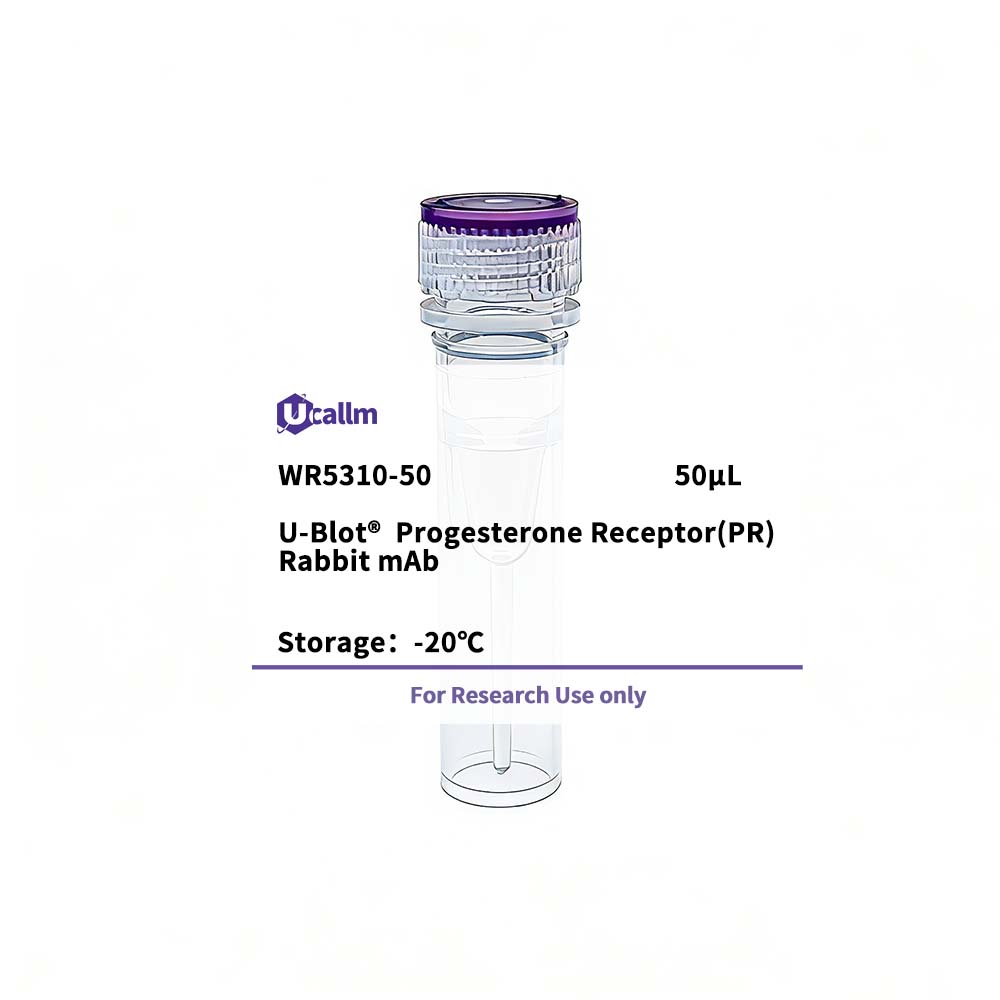
U-Blot® Progesterone Receptor(PR) Rabbit mAb

Price range: $268.00 through $328.00

SKU: WR5310-50
Enter the quantity you would like, or drag the panel to find the quantity and price that best for you
Bulk QuoteAuthorize OEM & ODM

Product details

Background:This gene encodes a member of the steroid receptor superfamily. The encoded protein mediates the physiological effects of progesterone, which plays a central role in reproductive events associated with the establishment and maintenance of pregnancy. This gene uses two distinct promotors and translation start sites in the first exon to produce several transcript variants, both protein coding and non-protein coding. Two of the isoforms (A and B) are identical except for an additional 165 amino acids found in the N-terminus of isoform B and mediate their own response genes and physiologic effects with little overlap. [provided by RefSeq, Sep 2015],


Specifications

Size50μL/100μL
TargetPR
ReactivityHuman
ApplicationsWB, IHC, IF, IP, ELISA
MW(Calculated)99kD
MW(Observed)118kD
Host SpeciesRabbit
IsotypeIgG,Kappa
Conjugate/ModificationUnmodified
Recommended Dilution RatioIHC 1:200-1:1000; WB 1:10000-1:50000; IF 1:200-1:1000; ELISA 1:5000-1:20000; IP 1:50-1:200; / Note: For IHC, we suggest antigen retrieval with TE buffer pH 9.0 (Cat#WT1004)
FormulationPBS, 50% glycerol, 0.05% Proclin 300, 0.05%BSA
PurificationRecombinant Antibody expressed in animal component-free (ACF) media, purified via Protein A affinity chromatography.
Storage-15°C to -25°C/1 year(Do not lower than -25°C)
Concentration
ClonalityMonoclonal
Clone NumberRM1536R
ImmunogenThe specific immunogen used to produce this antibody is proprietary information.
SpecificityEndogenous
Gene NamePGR; NR3C3
Protein NameProgesterone Receptor(PR)
Other NamePGR; / NR3C3; / Progesterone receptor; / PR; / Nuclear receptor subfamily 3 group C member 3
SpeciesHuman
Gene ID5241
UniprotP06401,
Species.1Mouse
Gene ID.1
Uniprot.1Q00175,
Species.2Rat
Gene ID.225154
Uniprot.2Q63449
Cellular LocalizationNucleus. Cytoplasm. Nucleoplasmic shuttling is both hormone- and cell cycle-dependent. On hormone stimulation, retained in the cytoplasm in the G(1) and G(2)/M phases.; [Isoform A]: Nucleus. Cytoplasm. Mainly nuclear.; [Isoform 4]: Mitochondrion outer membrane .
Tissue ExpressionIn reproductive tissues the expression of isoform A and isoform B varies as a consequence of developmental and hormonal status. Isoform A and isoform B are expressed in comparable levels in uterine glandular epithelium during the proliferative phase of the menstrual cycle. Expression of isoform B but not of isoform A persists in the glands during mid-secretory phase. In the stroma, isoform A is the predominant form throughout the cycle. Heterogeneous isoform expression between the glands of the endometrium basalis and functionalis is implying region-specific responses to hormonal stimuli.
Signaling_pathwayOrganismal Systems >> Endocrine system >> Estrogen signaling pathway;Human Diseases >> Cancer: specific types >> Breast cancer
Research Areas>>Oocyte meiosis; / >>Progesterone-mediated oocyte maturation; / >>Estrogen signaling pathway; / >>Chemical carcinogenesis - receptor activation; / >>Breast cancer
FunctionDomain:Composed of three domains: a modulating N-terminal domain, a DNA-binding domain and a C-terminal steroid-binding domain.,Function:Isoform A is inactive in stimulating c-Src/MAPK signaling on hormone stimulation.,Function:The steroid hormones and their receptors are involved in the regulation of eukaryotic gene expression and affect cellular proliferation and differentiation in target tissues. Progesterone receptor isoform B (PRB) is involved activation of c-SRC/MAPK signaling on hormone stimulation.,online information:Progesterone receptor entry,PTM:Phosphorylated on multiple serine sites. Several of these sites are hormone-dependent. Phosphorylation on Ser-294 occurs preferentially on isoform B, is highly hormone-dependent and modulates ubiquitination and sumoylation on Lys-388. Phosphorylation on Ser-102 and Ser-345 also requires induction by hormone. Basal phosphorylation on Ser-81, Ser-162, Ser-190 and Ser-400 is increased in response to progesterone and can be phosphorylated in vitro by the CDK2-A1 complex. Increased levels of phosphorylation on Ser-400 also in the presence of EGF, heregulin, IGF, PMA and FBS. Phosphorylation at this site by CDK2 is ligand-independent, and increases nuclear translocation and transcriptional activity. Phosphorylation at Ser-162 and Ser-294, but not at Ser-190, is impaired during the G(2)/M phase of the cell cycle. Phosphorylation on Ser-345 by ERK1/2 MAPK is required for interaction with SP1.,PTM:Sumoylation is hormone-dependent and represses transcriptional activity. Sumoylation on all three sites is enhanced by PIAS3. Desumoylated by SENP1. Sumoylation on Lys-388, the main site of sumoylation, is repressed by ubiquitination on the same site, and modulated by phosphorylation at Ser-294.,PTM:Ubiquitination is hormone-dependent and represses sumoylation on the same site. Promoted by MAPK-mediated phosphorylation on Ser-294.,similarity:Belongs to the nuclear hormone receptor family.,similarity:Belongs to the nuclear hormone receptor family. NR3 subfamily.,similarity:Contains 1 nuclear receptor DNA-binding domain.,subcellular location:Mainly nuclear.,subcellular location:Nucleoplasmic shuttling is both homone- and cell cycle-dependent. On hormone stimulation, retained in the cytoplasm in the G(1) and G(2)/M phases.,subunit:Interacts with SMARD1 and UNC45A. Interacts with CUEDC2; the interaction promotes ubiquitination, decreases sumoylation, and repesses transcriptional activity. Interacts with PIAS3; the interaction promotes sumoylation of PR in a hormone-dependent manner, inhibits DNA-binding, and alters nuclear export. Interacts with SP1; the interaction requires ligand-induced phosphorylation on Ser-345 by ERK1/2 MAPK.,
Please login to post questions
Back to Top
Product has been added to your cart

