SKU: WR5906 Categories: ,

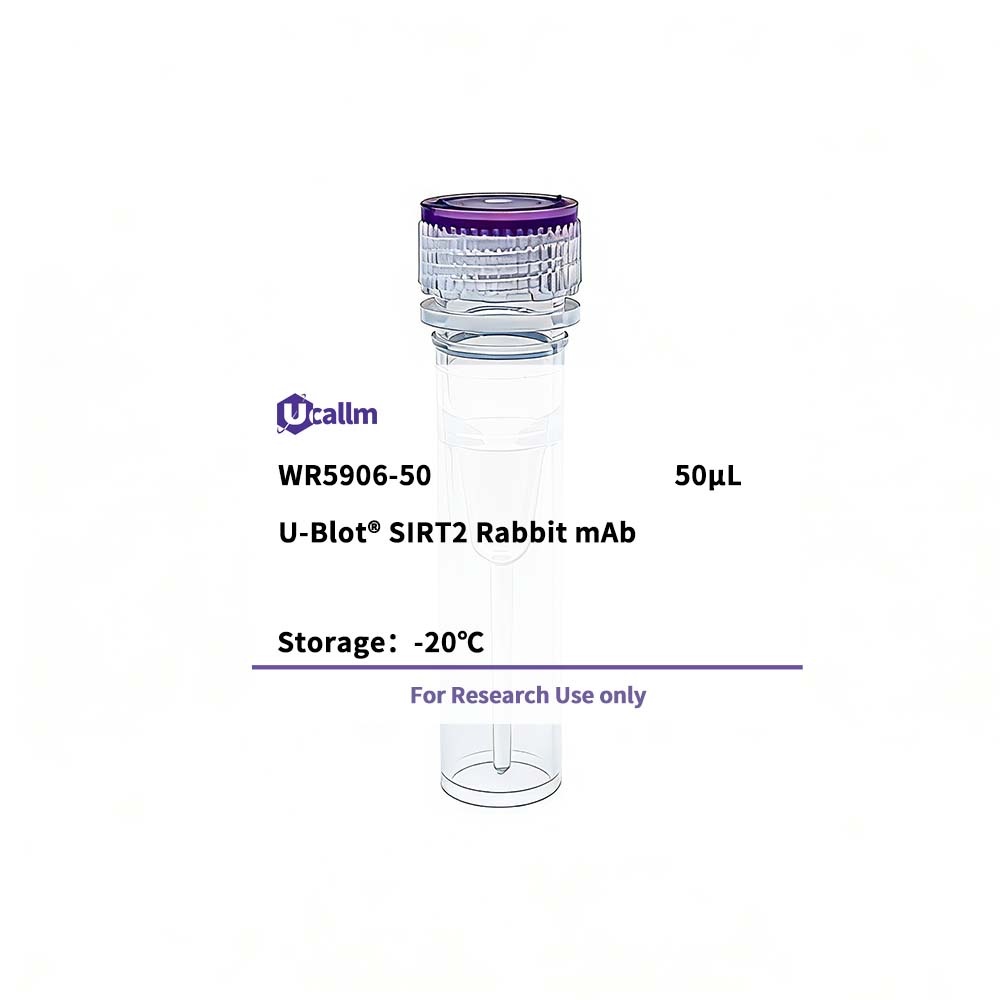
U-Blot® SIRT2 Rabbit mAb

Price range: $268.00 through $328.00

SKU: WR5906-50
Enter the quantity you would like, or drag the panel to find the quantity and price that best for you
Bulk QuoteAuthorize OEM & ODM

Product details

Background:
This gene encodes a member of the sirtuin family of proteins , homologs to the yeast Sir2 protein. Members of the sirtuin family are characterized by a sirtuin core domain and grouped into four classes. The functions of human sirtuins have not yet been determined; however , yeast sirtuin proteins are known to regulate epigenetic gene silencing and suppress recombination of rDNA. Studies suggest that the human sirtuins may function as intracellular regulatory proteins with mono-ADP-ribosyltransferase activity. The protein encoded by this gene is included in class I of the sirtuin family. Several transcript variants are resulted from alternative splicing of this gene. [provided by RefSeq , Jul 2010] ,

Specifications

Size50μL/100μL
TargetSIRT2
ReactivityHuman, Mouse, Rat
ApplicationsWB, IHC, IF, IP, ELISA
MW(Calculated)34kD
MW(Observed)39kD
Host SpeciesRabbit
IsotypeIgG,Kappa
Conjugate/ModificationUnmodified
Recommended Dilution RatioWB 1:2000-1:10000; IF 1:200-1:1000; ELISA 1:5000-1:20000; IP 1:50-1:200;
FormulationPBS, 50% glycerol, 0.05% Proclin 300, 0.05%BSA
PurificationRecombinant Antibody expressed in animal component-free (ACF) media, purified via Protein A affinity chromatography.
Storage-15°C to -25°C/1 year(Do not lower than -25°C)
Concentration
ClonalityMonoclonal
Clone NumberRM1904R
ImmunogenThe specific immunogen used to produce this antibody is proprietary information.
SpecificityEndogenous
Gene NameSIRT2
Protein NameNAD-dependent protein deacetylase sirtuin-2
Other NameFLJ35621; / FLJ37491; / NAD dependent deacetylase sirtuin 2; / NAD-dependent deacetylase sirtuin-2; / NAD-dependent protein deacetylase sirtuin-2; / Regulatory protein SIR2 homolog 2; / Silencing information regulator 2 like; / Silent information regulator 2; / Silent mating type information regulation 2; / Silent mating type information regulation 2 homolog; / SIR 2; / SIR2; / SIR2 like; / SIR2 like protein 2; / Sir2 related protein type 2; / SIR2, S. cerevisiae, homolog-loke 2; / SIR2-like protein 2; / SIR2L; / SIR2L2; / SIRT 2; / SIRT2; / SIRT2_HUMAN; / Sirtuin; / silent mating type information regulation 2 homolog; / 2; / S.cerevisiae; / Sirtuin 2; / Sirtuin type 2; / Sirtuin2.
SpeciesHuman
Gene ID22933
UniprotQ8IXJ6,
Species.1Mouse
Gene ID.164383
Uniprot.1Q8VDQ8,
Species.2Rat
Gene ID.2361532
Uniprot.2Q5RJQ4
Cellular LocalizationNucleus . Cytoplasm, perinuclear region . Cytoplasm . Cytoplasm, cytoskeleton . Cytoplasm, cytoskeleton, microtubule organizing center, centrosome . Cytoplasm, cytoskeleton, microtubule organizing center, centrosome, centriole . Cytoplasm, cytoskeleton, spindle . Midbody . Chromosome . Perikaryon . Cell projection . Cell projection, growth cone . Myelin membrane . Localizes in the cytoplasm during most of the cell cycle except in the G2/M transition and during mitosis, where it is localized in association with chromatin and induces deacetylation of histone at 'Lys-16' (H4K16ac) (PubMed:17726514, PubMed:23468428). Colocalizes with KMT5A at mitotic foci (PubMed:23468428). Colocalizes with CDK1 at centrosome during prophase and splindle fibers during metaphase (PubMed:17488717). Colocalizes with Aurora kinase AURKA at centrosome during early prophase and in the centrioles and growing mitotic spindle throughout metaphase (PubMed:17488717). Colocalizes with Aurora kinase AURKB during cytokinesis with the midbody (PubMed:17488717). Colocalizes with microtubules (PubMed:12620231). Detected in perinuclear foci that may be aggresomes containing misfolded, ubiquitinated proteins (By similarity). Shuttles between the cytoplasm and the nucleus through the CRM1 export pathway (PubMed:17726514). Colocalizes with EP300 in the nucleus (PubMed:24177535). Translocates to the nucleus and chromatin upon bacterium Listeria monocytogenes infection in interphase cells (PubMed:23908241). Deacetylates FOXO3 in the cytoplasm (By similarity). Colocalizes with PLP1 in internodal regions, at paranodal axoglial junction and Schmidt-Lanterman incisures of myelin sheat (By similarity). Colocalizes with CDK5R1 in the perikaryon, neurites and growth cone of hippocampal neurons (By similarity). Colocalizes with alpha-tubulin in neuronal growth cone (By similarity). Localizes in the cytoplasm and nucleus of germinal vesicle (GV) stage oocytes (By similarity). Colocalizes with alpha-tubulin on the meiotic spindle as the oocytes enter into metaphase, and also during meiotic anaphase and telophase, especially with the midbody (By similarity). Colocalizes with PARD3 in internodal region of axons (By similarity). Colocalizes with acetylated alpha-tubulin in cell projection processes during primary oligodendrocyte precursor (OLP) differentiation (By similarity). .; [Isoform 1]: Cytoplasm . Nucleus . Predominantly localized in the cytoplasmic. .; [Isoform 2]: Cytoplasm . Nucleus . Predominantly localized in the cytoplasmic. .; [Isoform 5]: Cytoplasm . Nucleus . Predominantly localized in the nucleus. .
Tissue ExpressionIsoform 1 is expressed in heart, liver and skeletal muscle, weakly expressed in the cortex. Isoform 2 is strongly expressed in the cortex, weakly expressed in heart and liver. Weakly expressed in several malignancies including breast, liver, brain, kidney and prostate cancers compared to normal tissues. Weakly expressed in glioma cell lines compared to normal brain tissues (at protein level). Widely expressed. Highly expressed in heart, brain and skeletal muscle, while it is weakly expressed in placenta and lung. Down-regulated in many gliomas suggesting that it may act as a tumor suppressor gene in human gliomas possibly through the regulation of microtubule network.
Signaling_pathway
Research Areas>>Nicotinate and nicotinamide metabolism; / >>Metabolic pathways
FunctionCatalytic activity:NAD(+) + an acetylprotein = nicotinamide + O-acetyl-ADP-ribose + a protein.,cofactor:Binds 1 zinc ion per subunit.,developmental stage:Peaks during mitosis. After mitosis, it is probably degraded by the 26S proteasome.,enzyme regulation:Inhibited by Sirtinol, A3 and M15 small molecules. Inhibited by nicotinamide.,Function:NAD-dependent deacetylase, which deacetylates the 'Lys-40' of alpha-tubulin. Involved in the control of mitotic exit in the cell cycle, probably via its role in the regulation of cytoskeleton. Despite some ability to deacetylate histones in vitro, it is unlikely in vivo.,PTM:Phosphorylated at the G2/M transition of the cell cycle.,similarity:Belongs to the sirtuin family.,similarity:Contains 1 deacetylase sirtuin-type domain.,subcellular location:Colocalizes with microtubules.,subunit:Interacts with HDAC6, suggesting that these proteins belong to a large complex that deacetylate the cytoskeleton.,tissue specificity:Widely expressed. Highly expressed in heart, brain and skeletal muscle, while it is weakly expressed in placenta and lung. Down-regulated in many gliomas suggesting that it may act as a tumor suppressor gene in human gliomas possibly through the regulation of microtubule network.,
Please login to post questions
Back to Top
Product has been added to your cart

