SKU: WR5984 Categories: ,

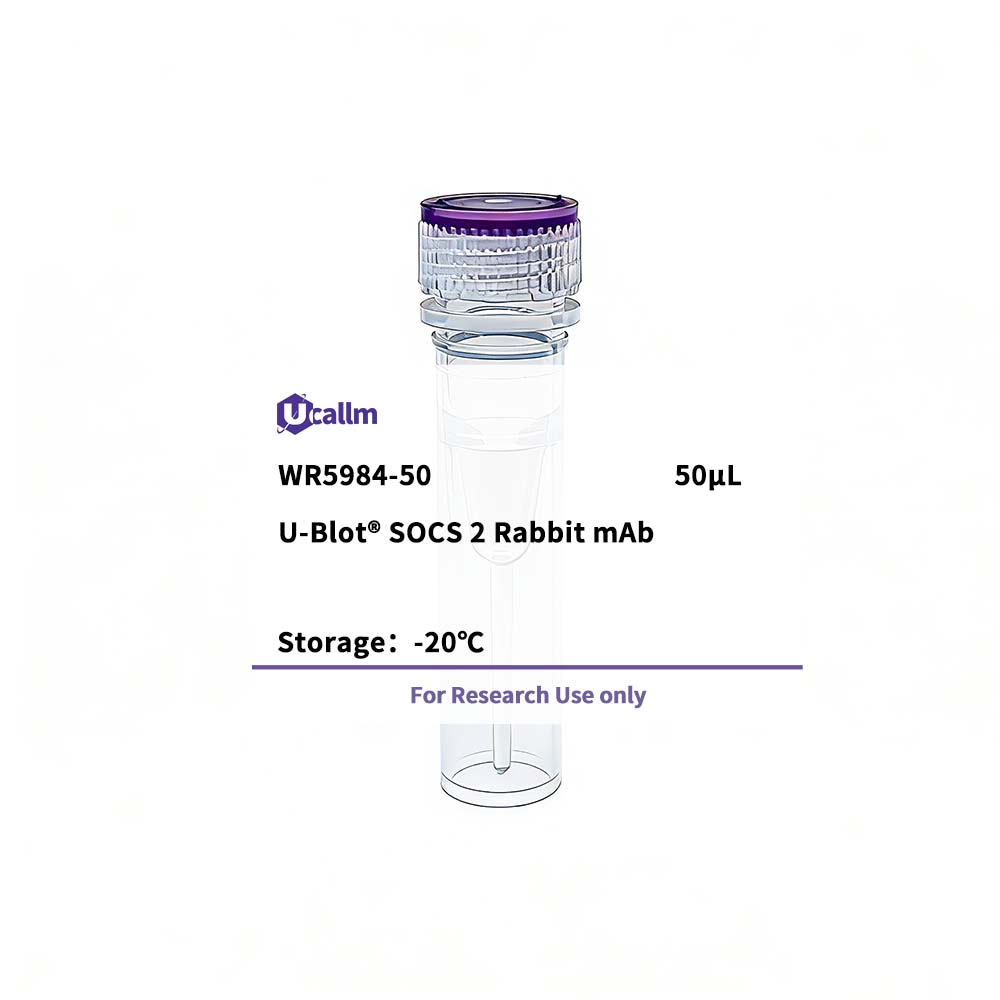
U-Blot® SOCS 2 Rabbit mAb

Price range: $268.00 through $328.00

SKU: WR5984-50
Enter the quantity you would like, or drag the panel to find the quantity and price that best for you
Bulk QuoteAuthorize OEM & ODM

Product details

Background:
This gene encodes a member of the suppressor of cytokine signaling (SOCS) family. SOCS family members are cytokine-inducible negative regulators of cytokine receptor signaling via the Janus kinase/signal transducer and activation of transcription pathway (the JAK/STAT pathway) . SOCS family proteins interact with major molecules of signaling complexes to block further signal transduction , in part , by proteasomal depletion of receptors or signal-transducing proteins via ubiquitination. The expression of this gene can be induced by a subset of cytokines , including erythropoietin , GM-CSF , IL10 , interferon (IFN) -gamma and by cytokine receptors such as growth horomone receptor. The protein encoded by this gene interacts with the cytoplasmic domain of insulin-like growth factor-1 receptor (IGF1R) and is thought to be involved in the regulation of IGF1R mediated cell signaling. This gene has


Specifications

Size50μL/100μL
TargetSOCS-2
ReactivityHuman, Mouse, Rat
ApplicationsWB, IHC, IF, IP, ELISA
MW(Calculated)22kD
MW(Observed)20kD
Host SpeciesRabbit
IsotypeIgG,Kappa
Conjugate/ModificationUnmodified
Recommended Dilution RatioIHC 1:200-1:1000; WB 1:2000-1:10000; IF 1:200-1:1000; ELISA 1:5000-1:20000; IP 1:50-1:200; / Note: For IHC, we suggest antigen retrieval with TE buffer pH 9.0 (Cat#WT1004)
FormulationPBS, 50% glycerol, 0.05% Proclin 300, 0.05%BSA
PurificationRecombinant Antibody expressed in animal component-free (ACF) media, purified via Protein A affinity chromatography.
Storage-15°C to -25°C/1 year(Do not lower than -25°C)
Concentration
ClonalityMonoclonal
Clone NumberRM1992R
ImmunogenThe specific immunogen used to produce this antibody is proprietary information.
SpecificityEndogenous
Gene NameSOCS2
Protein NameSuppressor of cytokine signaling 2
Other NameSOCS2; / CIS2; / SSI2; / STATI2; / Suppressor of cytokine signaling 2; / SOCS-2; / Cytokine-inducible SH2 protein 2; / CIS-2; / STAT-induced STAT inhibitor 2; / SSI-2
SpeciesHuman
Gene ID8835
UniprotO14508,
Species.1Mouse
Gene ID.1216233
Uniprot.1O35717,
Species.2Rat
Gene ID.284607
Uniprot.2O88582
Cellular Localizationcytoplasm,cytosol,
Tissue ExpressionHigh expression in heart, placenta, lung, kidney and prostate. Predominantly expressed in pulmonary epithelia cells, specifically type II pneumocytes.
Signaling_pathwayOrganismal Systems >> Endocrine system >> Insulin signaling pathway;Organismal Systems >> Endocrine system >> Prolactin signaling pathway;Organismal Systems >> Endocrine system >> Growth hormone synthesis, secretion and action;Environmental Information Processing >> Signal transduction >> JAK-STAT signaling pathway
Research Areas>>JAK-STAT signaling pathway; / >>Insulin signaling pathway; / >>Prolactin signaling pathway; / >>Type II diabetes mellitus; / >>Growth hormone synthesis, secretion and action
FunctionDomain:The SOCS box domain mediates the interaction with the Elongin BC complex, an adapter module in different E3 ubiquitin ligase complexes.,Function:SOCS family proteins form part of a classical negative feedback system that regulates cytokine signal transduction. SOCS2 appears to be a negative regulator in the growth hormone/IGF1 signaling pathway. Probable substrate recognition component of a SCF-like ECS (Elongin BC-CUL2/5-SOCS-box protein) E3 ubiquitin-protein ligase complex which mediates the ubiquitination and subsequent proteasomal degradation of target proteins.,induction:By a subset of cytokines, including erythropoietin and granulocyte-macrophage colony stimulating factor (GM-CSF).,pathway:Protein modification; protein ubiquitination.,similarity:Contains 1 SH2 domain.,similarity:Contains 1 SOCS box domain.,subunit:Interacts with IGF1 receptor, prolactin receptor and growth hormone (GH) receptor. Associates with the Elongin BC complex.,tissue specificity:High expression in heart, placenta, lung, kidney and prostate.,
Please login to post questions
Back to Top
Product has been added to your cart
