


U-Blot® TOMM70 Rabbit mAb
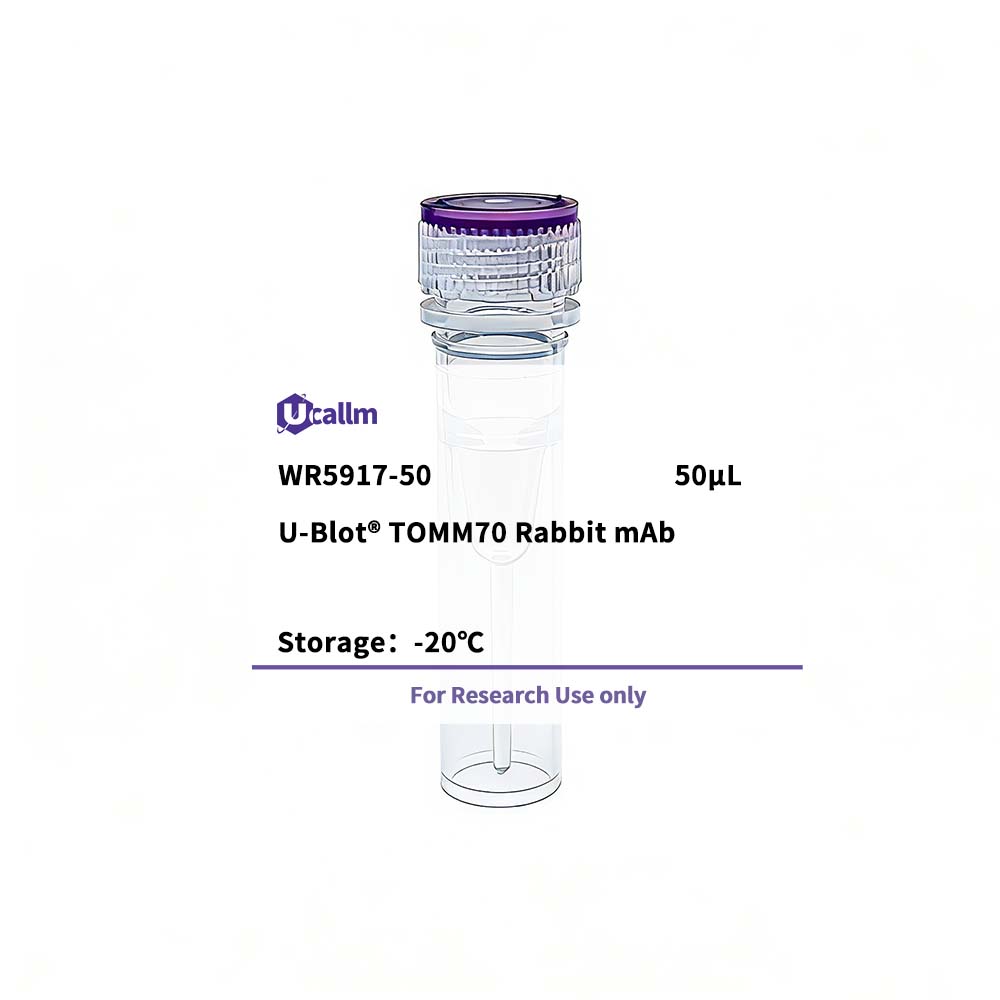
Ucallm_WR5917-50
Price range: $268.00 through $328.00
Product details
Background:
Specifications
| Size | 50μL/100μL |
| Target | TOMM70 |
| Reactivity | Human, Mouse, Rat |
| Applications | WB, IHC, IF, IP, ELISA |
| MW(Calculated) | 67kD |
| MW(Observed) | 72kD |
| Host Species | Rabbit |
| Isotype | IgG,Kappa |
| Conjugate/Modification | Unmodified |
| Recommended Dilution Ratio | WB 1:2000-1:10000; IF 1:200-1:1000; ELISA 1:5000-1:20000; IP 1:50-1:200; |
| Formulation | PBS, 50% glycerol, 0.05% Proclin 300, 0.05%BSA |
| Purification | Recombinant Antibody expressed in animal component-free (ACF) media, purified via Protein A affinity chromatography. |
| Storage | -15°C to -25°C/1 year(Do not lower than -25°C) |
| Concentration | |
| Clonality | Monoclonal |
| Clone Number | RM1881R |
| Immunogen | The specific immunogen used to produce this antibody is proprietary information. |
| Specificity | Endogenous |
| Gene Name | TOMM70A KIAA0719 TOMM70 |
| Protein Name | Mitochondrial import receptor subunit TOMM70 (Mitochondrial precursor proteins import receptor) (Translocase of outer membrane 70 kDa subunit) |
| Other Name | |
| Species | Human |
| Gene ID | 9868 |
| Uniprot | O94826, |
| Species.1 | Mouse |
| Gene ID.1 | 28185 |
| Uniprot.1 | Q9CZW5, |
| Species.2 | Rat |
| Gene ID.2 | 304017 |
| Uniprot.2 | Q75Q39 |
| Cellular Localization | Mitochondrion outer membrane; Single-pass membrane protein . |
| Tissue Expression | |
| Signaling_pathway | Cellular Processes >> Transport and catabolism >> Mitophagy - animal |
| Research Areas | |
| Function | Acts as receptor of the preprotein translocase complex of the outer mitochondrial membrane (TOM complex). Recognizes and mediates the translocation of mitochondrial preproteins from the cytosol into the mitochondria in a chaperone dependent manner . Mediates TBK1 and IRF3 activation induced by MAVS in response to Sendai virus infection and promotes host antiviral responses during virus infection . Upon Sendai virus infection, recruits HSP90AA1:IRF3:BAX in mitochondrion and the complex induces apoptosis . |
Please login to post questions
Related products


