

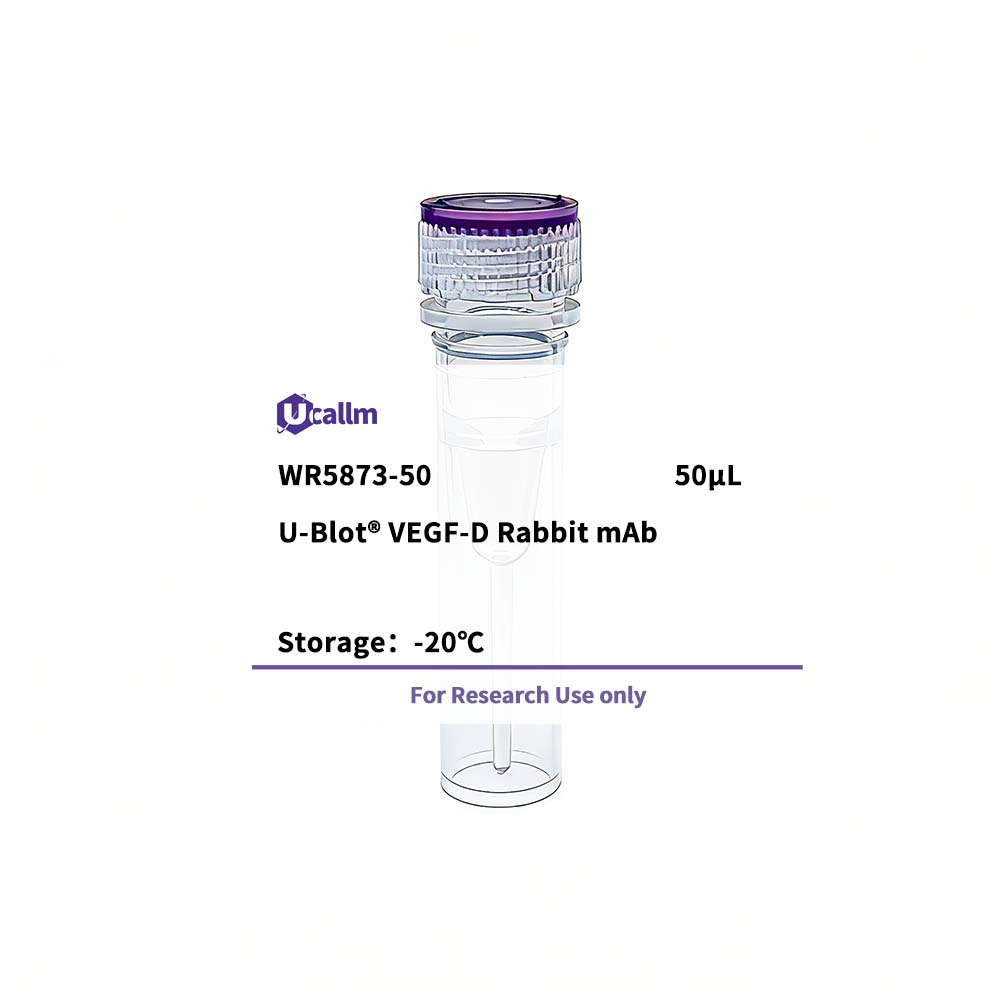
Specifications
| Size | 50μL/100μL |
| Target | VEGF-D |
| Reactivity | Human, Mouse, Rat |
| Applications | WB, IHC, IF, ELISA |
| MW(Calculated) | 40kD |
| MW(Observed) | 40kD |
| Host Species | Rabbit |
| Isotype | IgG,Kappa |
| Conjugate/Modification | Unmodified |
| Recommended Dilution Ratio | IHC 1:200-1:1000; WB 1:2000-1:10000; IF 1:200-1:1000; ELISA 1:5000-1:20000; / Note: For IHC, we suggest antigen retrieval with TE buffer pH 9.0 (Cat#WT1004) |
| Formulation | PBS, 50% glycerol, 0.05% Proclin 300, 0.05%BSA |
| Purification | Recombinant Antibody expressed in animal component-free (ACF) media, purified via Protein A affinity chromatography. |
| Storage | -15°C to -25°C/1 year(Do not lower than -25°C) |
| Concentration | |
| Clonality | Monoclonal |
| Clone Number | RM1847R |
| Immunogen | The specific immunogen used to produce this antibody is proprietary information. |
| Specificity | Endogenous |
| Gene Name | FIGF |
| Protein Name | Vascular endothelial growth factor D |
| Other Name | FIGF; / VEGFD; / Vascular endothelial growth factor D; / VEGF-D; / c-Fos-induced growth factor; / FIGF |
| Species | Human |
| Gene ID | 2277 |
| Uniprot | O43915, |
| Species.1 | Mouse |
| Gene ID.1 | 11909 |
| Uniprot.1 | P16951, |
| Species.2 | Rat |
| Gene ID.2 | 81647 |
| Uniprot.2 | Q00969 |
| Cellular Localization | Secreted. |
| Tissue Expression | Highly expressed in lung, heart, small intestine and fetal lung, and at lower levels in skeletal muscle, colon, and pancreas. |
| Signaling_pathway | Cellular Processes >> Cellular community - eukaryotes >> Focal adhesion;Organismal Systems >> Endocrine system >> Relaxin signaling pathway;Human Diseases >> Cancer: overview >> Pathways in cancer;Environmental Information Processing >> Signal transduction >> MAPK signaling pathway;Environmental Information Processing >> Signal transduction >> Ras signaling pathway;Environmental Information Processing >> Signal transduction >> Rap1 signaling pathway;Environmental Information Processing >> Signal transduction >> TNF signaling pathway;Environmental Information Processing >> Signal transduction >> Calcium signaling pathway;Environmental Information Processing >> Signal transduction >> PI3K-Akt signaling pathway |
| Research Areas | >>MAPK signaling pathway; / >>Ras signaling pathway; / >>Rap1 signaling pathway; / >>Calcium signaling pathway; / >>PI3K-Akt signaling pathway; / >>Focal adhesion; / >>TNF signaling pathway; / >>Relaxin signaling pathway; / >>AGE-RAGE signaling pathway in diabetic complications; / >>Pathways in cancer |
| Function | Function:Growth factor active in angiogenesis, lymphangiogenesis and endothelial cell growth, stimulating their proliferation and migration and also has effects on the permeability of blood vessels. May function in the formation of the venous and lymphatic vascular systems during embryogenesis, and also in the maintenance of differentiated lymphatic endothelium in adults. Binds and activates VEGFR-2 (Flk1) and VEGFR-3 (Flt4) receptors.,PTM:Undergoes a complex proteolytic maturation which generates a variety of processed secreted forms with increased activity toward VEGFR-3 and VEGFR-2. VEGF-D first form an antiparallel homodimer linked by disulfide bonds before secretion. The fully processed VEGF-D is composed mostly of two VEGF homology domains (VHDs) bound by non-covalent interactions.,similarity:Belongs to the PDGF/VEGF growth factor family.,subunit:Homodimer; non-covalent and antiparallel.,tissue specificity:Highly expressed in lung, heart, small intestine and fetal lung, and at lower levels in skeletal muscle, colon, and pancreas., |





