

USP16 Polyclonal Antibody
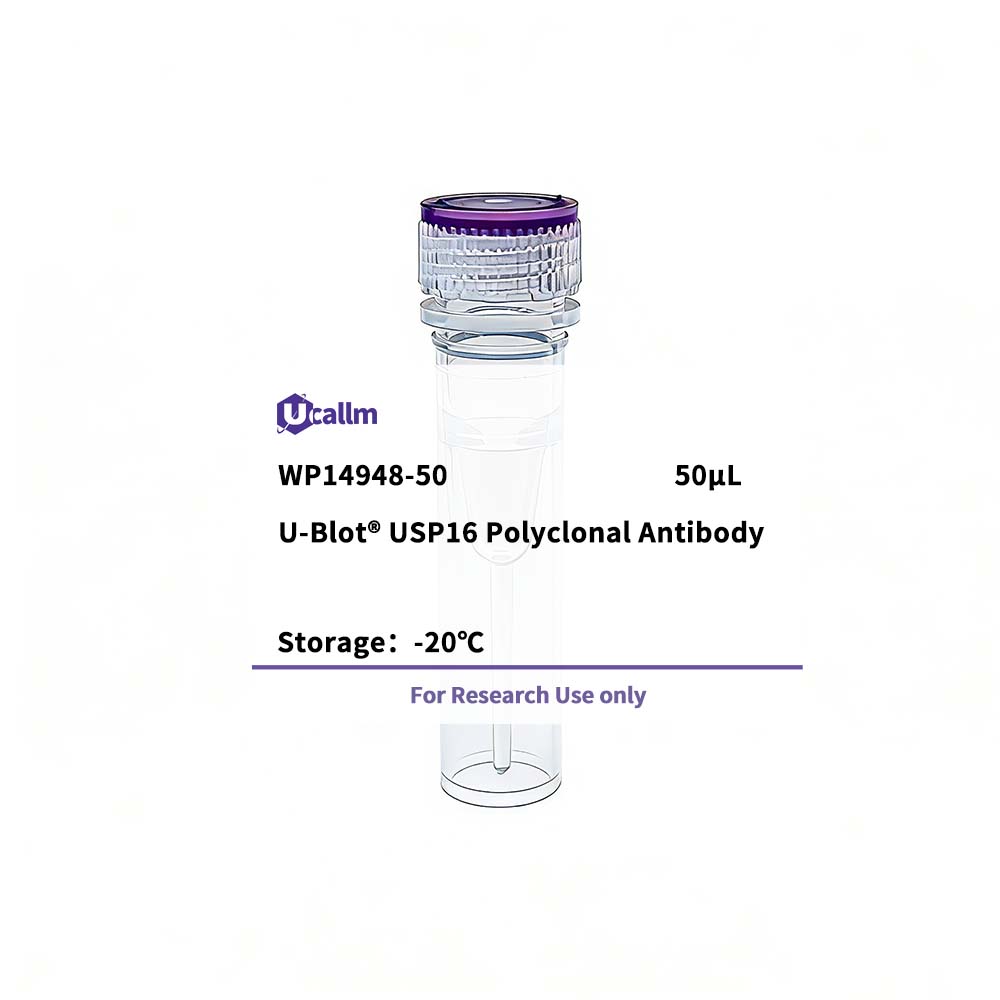
Ucallm_WP14948-50
Price range: $268.00 through $328.00
Product details
Background:
This gene encodes a deubiquitinating enzyme that is phosphorylated at the onset of mitosis and then dephosphorylated at the metaphase/anaphase transition. It can deubiquitinate H2A, one of two major ubiquitinated proteins of chromatin, in vitro and a mutant form of the protein was shown to block cell division. Alternate transcriptional splice variants, encoding different isoforms, have been characterized. [provided by RefSeq, Jul 2008],
Specifications
| Size | 50μL/100μL |
| Target | USP16 |
| Reactivity | Human, Mouse, Rat |
| Applications | WB, ELISA |
| MW(Calculated) | |
| MW(Observed) | 93kD |
| Host Species | Rabbit |
| Isotype | IgG |
| Conjugate/Modification | Unmodified |
| Recommended Dilution Ratio | WB 1:500-1:2000; ELISA 1:10000; Not yet tested in other applications. |
| Formulation | Liquid in PBS containing 50% glycerol, 0.5% BSA and 0.02% sodium azide. |
| Purification | The antibody was affinity-purified from rabbit antiserum by affinity-chromatography using epitope-specific immunogen. |
| Storage | -15°C to -25°C/1 year(Do not lower than -25°C) |
| Concentration | 1 mg/ml |
| Clonality | Polyclonal |
| Clone Number | |
| Immunogen | Synthesized peptide derived from the Internal region of human USP16. |
| Specificity | USP16 Polyclonal Antibody detects endogenous levels of USP16 protein. |
| Gene Name | USP16 |
| Protein Name | Ubiquitin carboxyl-terminal hydrolase 16 |
| Other Name | USP16; / MSTP039; / Ubiquitin carboxyl-terminal hydrolase 16; / Deubiquitinating enzyme 16; / Ubiquitin thioesterase 16; / Ubiquitin-processing protease UBP-M; / Ubiquitin-specific-processing protease 16 |
| Species | Human |
| Gene ID | 10600 |
| Uniprot | Q9Y5T5, |
| Species.1 | Mouse |
| Gene ID.1 | 74112 |
| Uniprot.1 | Q99LG0, |
| Species.2 | Rat |
| Gene ID.2 | 288306 |
| Uniprot.2 | Q2KJ09 |
| Cellular Localization | Nucleus . |
| Tissue Expression | Present in all the tissues examined including fetal brain, lung, liver, kidney, and adult heart, brain, placenta, lung, liver, skeletal muscle, kidney and pancreas. |
| Signaling_pathway | |
| Research Areas | |
| Function | Catalytic activity:Ubiquitin C-terminal thioester + H(2)O = ubiquitin + a thiol.,Disease:A chromosomal aberration involving USP16 is a cause of Chronic myelomonocytic leukemia. Inversion inv(21) (q21; q22) with RUNX1/AML1.,Domain:The UBP-type zinc finger binds 3 zinc ions that form a pair of cross-braced ring fingers encapsulated within a third zinc finger in the primary structure. It recognizes the C-terminal tail of free ubiquitin.,Function:Specifically deubiquitinates histone H2A, a specific tag for epigenetic transcriptional repression, thereby acting as a coactivator. Deubiquitination of histone H2A is a prerequisite for subsequent phosphorylation at 'Ser-10' of histone H3, and is required for chromosome segregation when cells enter into mitosis. Regulates Hox gene expression via histone H2A deubiquitination. Prefers nucleosomal substrates. Does not deubiquitinate histone H2B.,PTM:Phosphorylated at the onset of mitosis and dephosphorylated during the metaphase/anaphase transition. The phosphorylated form of the protein is also enzymatically active.,similarity:Belongs to the peptidase C19 family. USP16 subfamily.,similarity:Contains 1 UBP-type zinc finger.,subunit:Homotetramer.,tissue specificity:Present in all the tissues examined including fetal brain, lung, liver, kidney, and adult heart, brain, placenta, lung, liver, skeletal muscle, kidney and pancreas., |
Please login to post questions
Related products





