


VATC1 Polyclonal Antibody
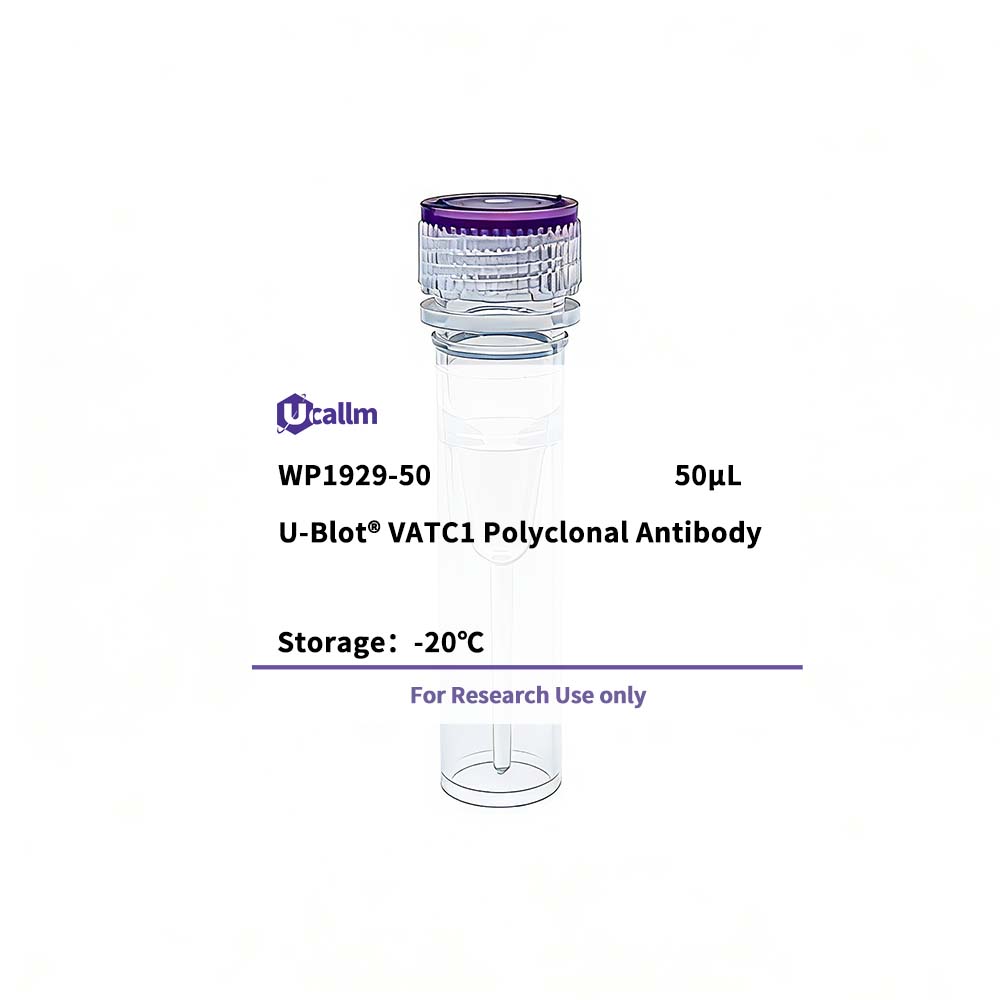
Ucallm_WP1929-50
Price range: $268.00 through $328.00
Product details
Background:
This gene encodes a component of vacuolar ATPase (V-ATPase), a multisubunit enzyme that mediates acidification of intracellular compartments of eukaryotic cells. V-ATPase dependent acidification is necessary for such intracellular processes as protein sorting, zymogen activation, receptor-mediated endocytosis, and synaptic vesicle proton gradient generation. V-ATPase is composed of a cytosolic V1 domain and a transmembrane V0 domain. The V1 domain consists of three A and three B subunits, two G subunits plus the C, D, E, F, and H subunits. The V1 domain contains the ATP catalytic site. The V0 domain consists of five different subunits: a, c, c', c'', and d. Additional isoforms of many of the V1 and V0 subunit proteins are encoded by multiple genes or alternatively spliced transcript variants. This gene is one of two genes that encode the V1 domain C subunit proteins an
Specifications
| Size | 50μL/100μL |
| Target | VATC1 |
| Reactivity | Human, Mouse, Rat |
| Applications | WB, ELISA |
| MW(Calculated) | |
| MW(Observed) | 42kD |
| Host Species | Rabbit |
| Isotype | IgG |
| Conjugate/Modification | Unmodified |
| Recommended Dilution Ratio | WB 1:500-2000; ELISA 1:5000-20000 |
| Formulation | Liquid in PBS containing 50% glycerol,0.5% BSA and 0.02% sodium azide. |
| Purification | The antibody was affinity-purified from rabbit antiserum by affinity-chromatography using epitope-specific immunogen. |
| Storage | -15°C to -25°C/1 year(Do not lower than -25°C) |
| Concentration | 1 mg/ml |
| Clonality | Polyclonal |
| Clone Number | |
| Immunogen | Synthesized peptide derived from part region of human protein |
| Specificity | VATC1 Polyclonal Antibody detects endogenous levels of protein. |
| Gene Name | ATP6V1C1 ATP6C ATP6D VATC |
| Protein Name | V-type proton ATPase subunit C 1 (V-ATPase subunit C 1) (Vacuolar proton pump subunit C 1) |
| Other Name | |
| Species | Human |
| Gene ID | 528 |
| Uniprot | P21283, |
| Species.1 | Mouse |
| Gene ID.1 | |
| Uniprot.1 | Q9Z1G3, |
| Species.2 | Rat |
| Gene ID.2 | |
| Uniprot.2 | Q5FVI6 |
| Cellular Localization | Cytoplasmic vesicle, secretory vesicle, synaptic vesicle membrane; Peripheral membrane protein . Cytoplasmic vesicle, clathrin-coated vesicle membrane; Peripheral membrane protein . |
| Tissue Expression | Ubiquitous. |
| Signaling_pathway | Cellular Processes >> Transport and catabolism >> Phagosome;Organismal Systems >> Nervous system >> Synaptic vesicle cycle;Human Diseases >> Immune disease >> Rheumatoid arthritis;Environmental Information Processing >> Signal transduction >> mTOR signaling pathway |
| Research Areas | >>Oxidative phosphorylation; / >>Metabolic pathways; / >>Phagosome; / >>mTOR signaling pathway; / >>Synaptic vesicle cycle; / >>Collecting duct acid secretion; / >>Vibrio cholerae infection; / >>Epithelial cell signaling in Helicobacter pylori infection; / >>Human papillomavirus infection; / >>Rheumatoid arthritis |
| Function | Function:Subunit of the peripheral V1 complex of vacuolar ATPase. Subunit C is necessary for the assembly of the catalytic sector of the enzyme and is likely to have a specific function in its catalytic activity. V-ATPase is responsible for acidifying a variety of intracellular compartments in eukaryotic cells.,similarity:Belongs to the V-ATPase C subunit family.,subunit:V-ATPase is an heteromultimeric enzyme composed of a peripheral catalytic V1 complex (components A to H) attached to an integral membrane V0 proton pore complex (components: a, c, c', c'' and d).,tissue specificity:Ubiquitous., |
Please login to post questions
Related products





