


VCAM1 rabbit pAb
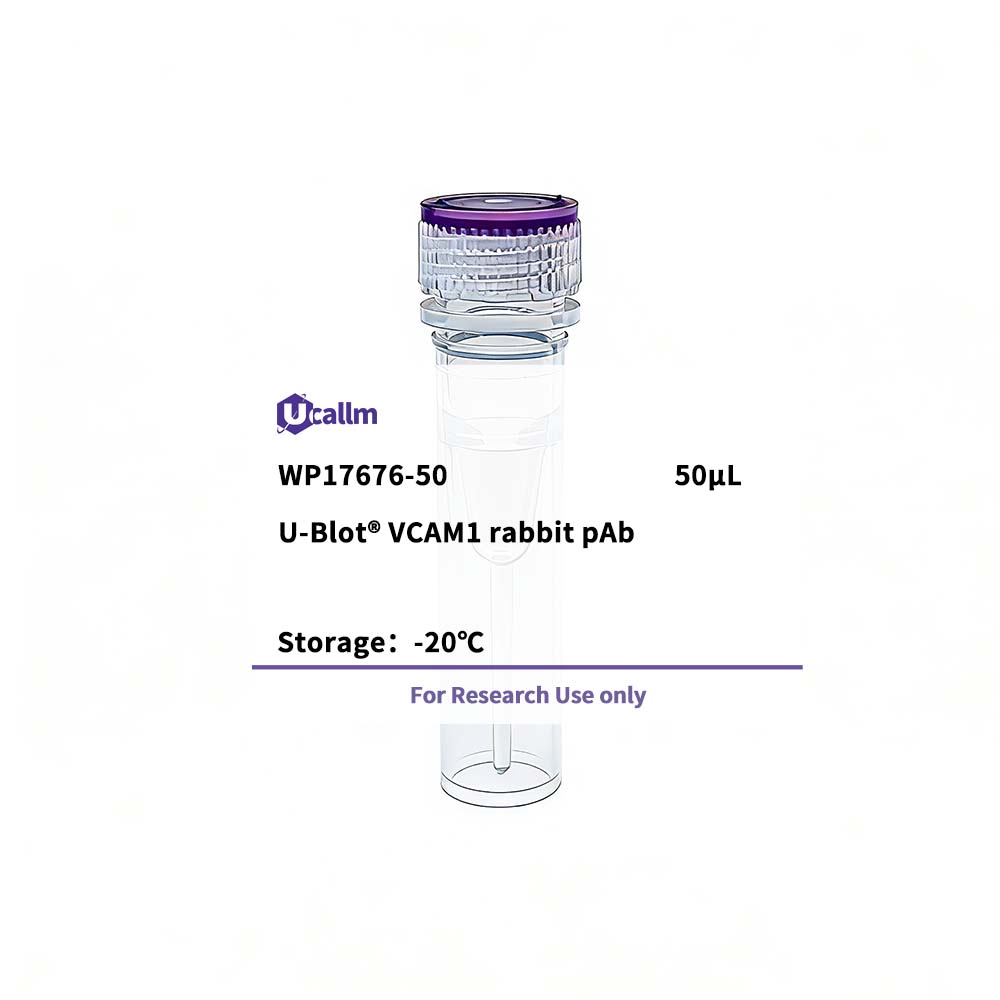
Ucallm_WP17676-50
Price range: $268.00 through $328.00
Product details
Background:
This gene is a member of the Ig superfamily and encodes a cell surface sialoglycoprotein expressed by cytokine-activated endothelium. This type I membrane protein mediates leukocyte-endothelial cell adhesion and signal transduction, and may play a role in the development of artherosclerosis and rheumatoid arthritis. Three alternatively spliced transcripts encoding different isoforms have been described for this gene. [provided by RefSeq, Dec 2010],
Specifications
| Size | 50μL/100μL |
| Target | VCAM-1 |
| Reactivity | Human, Mouse, Rat |
| Applications | WB, ELISA |
| MW(Calculated) | 81kD |
| MW(Observed) | |
| Host Species | Rabbit |
| Isotype | IgG |
| Conjugate/Modification | Unmodified |
| Recommended Dilution Ratio | WB 1:1000-2000; ELISA 1:5000-20000 |
| Formulation | Liquid in PBS containing 50% glycerol, 0.5% BSA and 0.02% sodium azide. |
| Purification | The antibody was affinity-purified from rabbit antiserum by affinity-chromatography using epitope-specific immunogen. |
| Storage | -15°C to -25°C/1 year(Do not lower than -25°C) |
| Concentration | 1 mg/ml |
| Clonality | Polyclonal |
| Clone Number | |
| Immunogen | Synthesized peptide derived from human VCAM1 |
| Specificity | This antibody detects endogenous levels of Human VCAM1 |
| Gene Name | VCAM1 L1CAM |
| Protein Name | VCAM1 |
| Other Name | Vascular cell adhesion protein 1; / V-CAM 1; / VCAM-1; / INCAM-100; / CD antigen CD106 |
| Species | Human |
| Gene ID | 7412 |
| Uniprot | P19320, |
| Species.1 | Mouse |
| Gene ID.1 | 22329 |
| Uniprot.1 | P29533, |
| Species.2 | Rat |
| Gene ID.2 | 25361 |
| Uniprot.2 | P29534 |
| Cellular Localization | Membrane; Single-pass type I membrane protein. |
| Tissue Expression | Expressed on inflamed vascular endothelium, as well as on macrophage-like and dendritic cell types in both normal and inflamed tissue. |
| Signaling_pathway | Organismal Systems >> Immune system >> Leukocyte transendothelial migration;Environmental Information Processing >> Signal transduction >> NF-kappa B signaling pathway;Environmental Information Processing >> Signal transduction >> TNF signaling pathway;Environmental Information Processing >> Signaling molecules and interaction >> Cell adhesion molecules |
| Research Areas | >>NF-kappa B signaling pathway; / >>Cell adhesion molecules; / >>TNF signaling pathway; / >>Leukocyte transendothelial migration; / >>AGE-RAGE signaling pathway in diabetic complications; / >>African trypanosomiasis; / >>Malaria; / >>Lipid and atherosclerosis; / >>Fluid shear stress and atherosclerosis |
| Function | Alternative products:Additional isoforms seem to exist,Disease:May play an important role in the genesis of atherosclerosis and rheumatoid arthritis.,Domain:Either the first or the fourth Ig-like C2-type domain is required for VLA4-dependent cell adhesion.,Function:Important in cell-cell recognition. Appears to function in leukocyte-endothelial cell adhesion. Interacts with the beta-1 integrin VLA4 on leukocytes, and mediates both adhesion and signal transduction. The VCAM1/VLA4 interaction may play a pathophysiologic role both in immune responses and in leukocyte emigration to sites of inflammation.,induction:By cytokines (e.g. IL-1, TNF-alpha).,online information:VCAM-1,online information:VCAM1 entry,PTM:Sialoglycoprotein.,similarity:Contains 7 Ig-like C2-type (immunoglobulin-like) domains.,subunit:Binds to ECMV-D capsid proteins and acts as a receptor for this virus.,tissue specificity:Expressed on inflamed vascular endothelium, as well as on macrophage-like and dendritic cell types in both normal and inflamed tissue., |
Please login to post questions
Related products





