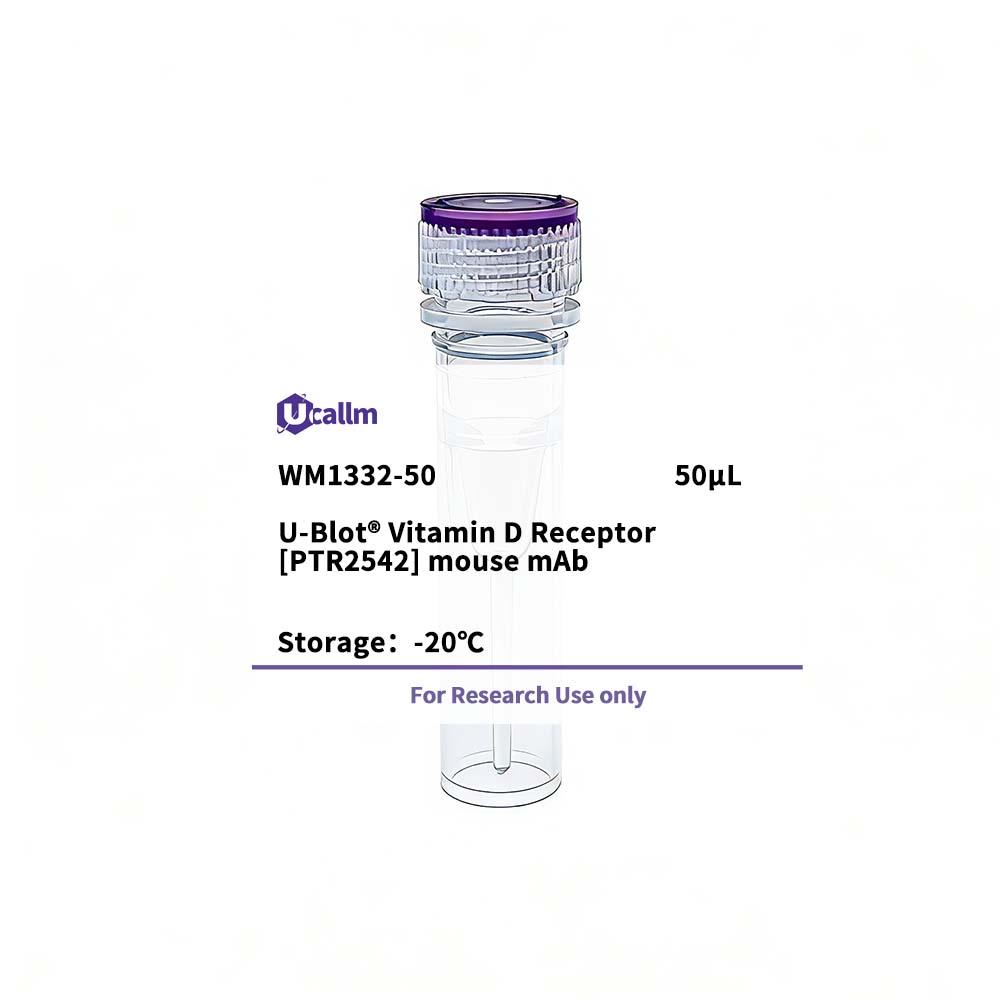
SKU: WM1332 Categories: ,

Vitamin D Receptor [PTR2542] mouse mAb

Price range: $268.00 through $328.00

SKU: WM1332-50
Enter the quantity you would like, or drag the panel to find the quantity and price that best for you
Bulk QuoteAuthorize OEM & ODM

Product details

Background:
vitamin D (1, 25- dihydroxyvitamin D3) receptor(VDR) Homo sapiens This gene encodes the nuclear hormone receptor for vitamin D3. This receptor also functions as a receptor for the secondary bile acid lithocholic acid. The receptor belongs to the family of trans-acting transcriptional regulatory factors and shows sequence similarity to the steroid and thyroid hormone receptors. Downstream targets of this nuclear hormone receptor are principally involved in mineral metabolism though the receptor regulates a variety of other metabolic pathways, such as those involved in the immune response and cancer. Mutations in this gene are associated with type II vitamin D-resistant rickets. A single nucleotide polymorphism in the initiation codon results in an alternate translation start site three codons downstream. Alternative splicing results in multiple transcript variants encoding different proteins. [provided by RefSeq, Feb 2011],


Specifications

Size50μL/100μL
TargetVitamin D Receptor
ReactivityHuman
ApplicationsWB, IF, ELISA
MW(Calculated)48kD
MW(Observed)37kD
Host SpeciesMouse
IsotypeIgG1,Kappa
Conjugate/ModificationUnmodified
Recommended Dilution RatioWB 1:500-2000; IF 1:100-500; ELISA 1:1000-5000
FormulationPBS, 50% glycerol, 0.05% Proclin 300, 0.05%BSA
PurificationRecombinant Antibody expressed in animal component-free (ACF) media, purified via Protein G affinity chromatography.
Storage-15°C to -25°C/1 year(Do not lower than -25°C)
Concentration
ClonalityMonoclonal
Clone NumberRMMR2542
ImmunogenSynthesized peptide derived from human Vitamin D Receptor AA range: 150-250
SpecificityThis antibody detects endogenous levels of Vitamin D Receptor protein.
Gene NameVDR NR1I1
Protein NameVitamin D3 receptor (VDR) (1,25-dihydroxyvitamin D3 receptor) (Nuclear receptor subfamily 1 group I member 1)
Other NameVitamin D3 receptor; / VDR; / 1,25-dihydroxyvitamin D3 receptor; / Nuclear receptor subfamily 1 group I member 1
SpeciesHuman
Gene ID7421
UniprotP11473,
Species.1Mouse
Gene ID.122337
Uniprot.1P48281,
Species.2Rat
Gene ID.224873
Uniprot.2P13053
Cellular LocalizationNucleus . Cytoplasm . Localizes mainly to the nucleus (PubMed:28698609, PubMed:12145331). Localization to the nucleus is enhanced by vitamin D3. .
Tissue Expression
Signaling_pathway
Research Areas>>Parathyroid hormone synthesis, secretion and action; / >>Endocrine and other factor-regulated calcium reabsorption; / >>Mineral absorption; / >>Tuberculosis; / >>Chemical carcinogenesis - receptor activation
FunctionCaution:It is uncertain whether Met-1 or Met-4 is the initiator.,Disease:Defects in VDR are the cause of type IIA rickets [MIM:277440]; also known as hypocalcemic vitamin D-resistant rickets (HVDRR). HVDRR is most frequently an autosomal recessive disorder characterized by severe rickets, hypocalcemia and secondary hyperparathyroidism.,Domain:Composed of three domains: a modulating N-terminal domain, a DNA-binding domain and a C-terminal steroid-binding domain.,Function:Nuclear hormone receptor. Transcription factor that mediates the action of vitamin D3 by controlling the expression of hormone sensitive genes. Regulates transcription of hormone sensitive genes via its association with the WINAC complex, a chromatin-remodeling complex. Recruited to promoters via its interaction with the WINAC complex subunit BAZ1B/WSTF, which mediates the interaction with acetylated histones, an essential step for VDR-promoter association. Plays a central role in calcium homeostasis.,online information:The Singapore human mutation and polymorphism database,polymorphism:Genetic variations in VDR may determine Mycobacterium tuberculosis susceptibility [MIM:607948].,similarity:Belongs to the nuclear hormone receptor family. NR1 subfamily.,similarity:Contains 1 nuclear receptor DNA-binding domain.,subunit:Homodimer in the absence of bound vitamin D3. Heterodimer with RXRA after vitamin D3 binding. Interacts with SMAD3. Interacts with MED1, NCOA1, NCOA2, NCOA3 and NCOA6 coactivators, leading to a strong increase of transcription of target genes. Interacts (in a ligand-dependent manner) with BAZ1B/WSTF.,
Please login to post questions
Back to Top
Product has been added to your cart