SKU: WP1692 Categories: ,

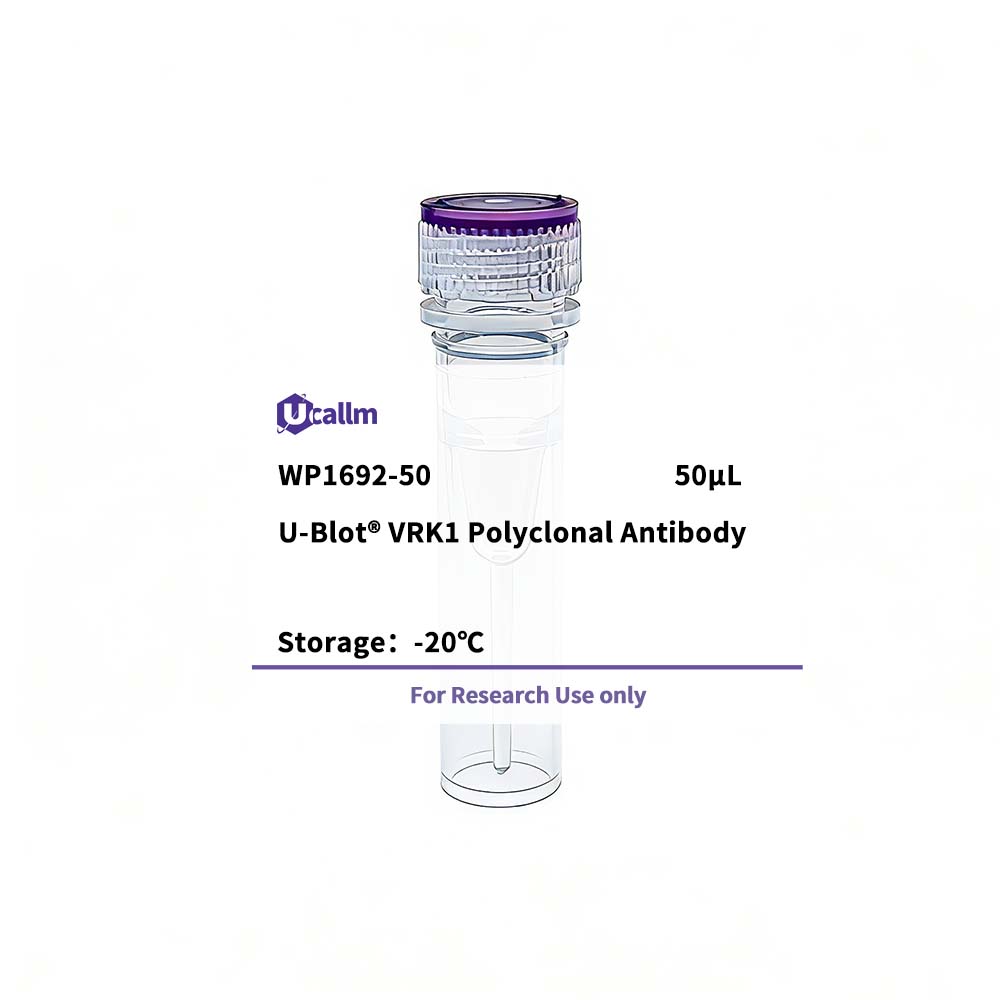
VRK1 Polyclonal Antibody

Price range: $268.00 through $328.00

SKU: WP1692-100
Enter the quantity you would like, or drag the panel to find the quantity and price that best for you
Bulk QuoteAuthorize OEM & ODM

Product details

Background:

vaccinia related kinase 1(VRK1) Homo sapiens This gene encodes a member of the vaccinia-related kinase (VRK) family of serine/threonine protein kinases. This gene is widely expressed in human tissues and has increased expression in actively dividing cells, such as those in testis, thymus, fetal liver, and carcinomas. Its protein localizes to the nucleus and has been shown to promote the stability and nuclear accumulation of a transcriptionally active p53 molecule and, in vitro, to phosphorylate Thr18 of p53 and reduce p53 ubiquitination. This gene, therefore, may regulate cell proliferation. This protein also phosphorylates histone, casein, and the transcription factors ATF2 (activating transcription factor 2) and c-JUN. [provided by RefSeq, Jul 2008],

Specifications

Size50μL/100μL
TargetVRK1
ReactivityHuman, Mouse
ApplicationsWB, ELISA
MW(Calculated)
MW(Observed)43kD
Host SpeciesRabbit
IsotypeIgG
Conjugate/ModificationUnmodified
Recommended Dilution RatioWB 1:500-2000; ELISA 1:5000-20000
FormulationLiquid in PBS containing 50% glycerol,0.5% BSA and 0.02% sodium azide.
PurificationThe antibody was affinity-purified from rabbit antiserum by affinity-chromatography using epitope-specific immunogen.
Storage-15°C to -25°C/1 year(Do not lower than -25°C)
Concentration1 mg/ml
ClonalityPolyclonal
Clone Number
ImmunogenSynthesized peptide derived from part region of human protein
SpecificityVRK1 Polyclonal Antibody detects endogenous levels of protein.
Gene NameVRK1
Protein NameSerine/threonine-protein kinase VRK1 (Vaccinia-related kinase 1)
Other Name
SpeciesHuman
Gene ID7443
UniprotQ99986,
Species.1Mouse
Gene ID.1
Uniprot.1Q80X41
Species.2
Gene ID.2
Uniprot.2
Cellular LocalizationNucleus . Cytoplasm . Dispersed throughout the cell but not located on mitotic spindle or chromatids during mitosis.
Tissue ExpressionWidely expressed. Highly expressed in fetal liver, testis and thymus.
Signaling_pathway
Research Areas
FunctionCatalytic activity:ATP + a protein = ADP + a phosphoprotein.,enzyme regulation:Active in presence of Mn(2+), Mg(2+) and Zn(2+), but is not functional with Ca(2+) or Cu(2+). Has a higher affinity for Mn(2+) than for Mg(2+).,Function:Serine/threonine kinase that phosphorylates 'Thr-18' of p53/TP53 and may thereby prevent the interaction between p53/TP53 and MDM2.,PTM:Autophosphorylated at various serine and threonine residues. Autophosphorylation does not impair its ability to phosphorylate p53/TP53.,similarity:Belongs to the protein kinase superfamily. CK1 Ser/Thr protein kinase family. VRK subfamily.,similarity:Contains 1 protein kinase domain.,subcellular location:Dispersed throughout the cell but not located on mitotic spindle or chromatids during mitosis.,tissue specificity:Widely expressed. Highly expressed in fetal liver, testis and thymus.,
Please login to post questions
Back to Top
Product has been added to your cart

