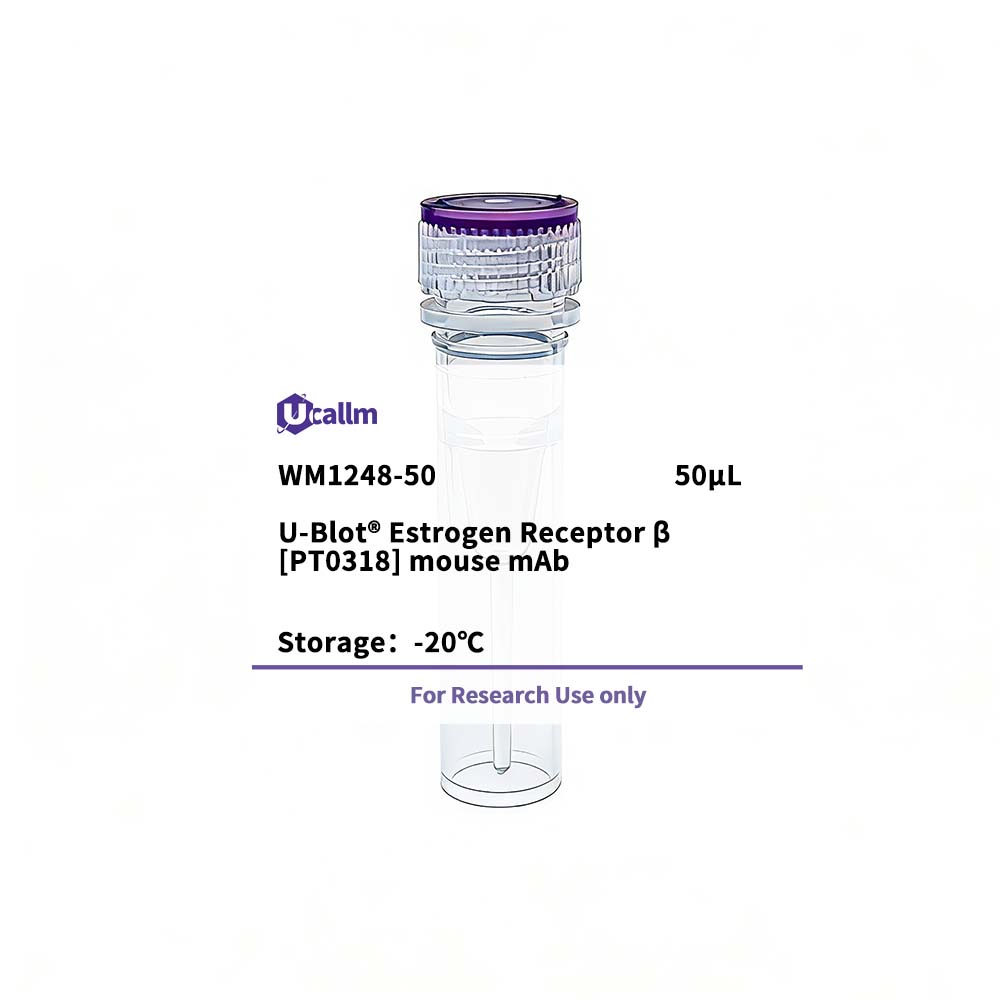
SKU: WM1248 Categories: ,

Estrogen Receptor β [PT0318] mouse mAb

Price range: $268.00 through $328.00

SKU: WM1248-50
Enter the quantity you would like, or drag the panel to find the quantity and price that best for you
Bulk QuoteAuthorize OEM & ODM

Product details

Background:
This gene encodes a member of the family of estrogen receptors and superfamily of nuclear receptor transcription factors. The gene product contains an N-terminal DNA binding domain and C-terminal ligand binding domain and is localized to the nucleus, cytoplasm, and mitochondria. Upon binding to 17beta-estradiol or related ligands, the encoded protein forms homo- or hetero-dimers that interact with specific DNA sequences to activate transcription. Some isoforms dominantly inhibit the activity of other estrogen receptor family members. Several alternatively spliced transcript variants of this gene have been described, but the full-length nature of some of these variants has not been fully characterized. [provided by RefSeq, Jul 2008],

Specifications

Size50μL/100μL
TargetEstrogen Receptor-β
ReactivityHuman
ApplicationsWB, IF, ELISA
MW(Calculated)59kD
MW(Observed)59kD
Host SpeciesMouse
IsotypeIgG2b,Kappa
Conjugate/ModificationUnmodified
Recommended Dilution RatioWB 1:500-2000; IF 1:100-500; ELISA 1:1000-5000
FormulationPBS, 50% glycerol, 0.05% Proclin 300, 0.05%BSA
PurificationRecombinant Antibody expressed in animal component-free (ACF) media, purified via Protein G affinity chromatography.
Storage-15°C to -25°C/1 year(Do not lower than -25°C)
Concentration
ClonalityMonoclonal
Clone NumberRMM0318
ImmunogenSynthesized peptide derived from human Estrogen Receptor β AA range: 400-530
SpecificityThis antibody detects endogenous levels of Estrogen Receptor β protein.
Gene NameESR2 ESTRB NR3A2
Protein NameEstrogen receptor beta
Other NameESR2; / ESTRB; / NR3A2; / Estrogen receptor beta; / ER-beta; / Nuclear receptor subfamily 3 group A member 2
SpeciesHuman
Gene ID2100
UniprotQ92731
Species.1
Gene ID.1
Uniprot.1
Species.2
Gene ID.2
Uniprot.2
Cellular LocalizationNuclear
Tissue Expression[Isoform 1]: Expressed in testis and ovary, and at a lower level in heart, brain, placenta, liver, skeletal muscle, spleen, thymus, prostate, colon, bone marrow, mammary gland and uterus. Also found in uterine bone, breast, and ovarian tumor cell lines, but not in colon and liver tumors.; [Isoform 2]: Expressed in spleen, thymus, testis and ovary and at a lower level in skeletal muscle, prostate, colon, small intestine, leukocytes, bone marrow, mammary gland and uterus.; [Isoform 4]: Expressed in the testis.; [Isoform 5]: Expressed in testis, and at a lower level in spleen, thymus, ovary, mammary gland and uterus.; [Isoform 6]: Expressed in testis, placenta, skeletal muscle, spleen and leukocytes, and at a lower level in heart, lung, liver, kidney, pancreas, thymus, prostate, colon, small intestine, bone marrow, mammary gland and uterus. Not expressed in brain.
Signaling_pathwayOrganismal Systems >> Endocrine system >> Estrogen signaling pathway;Organismal Systems >> Endocrine system >> Prolactin signaling pathway;Human Diseases >> Cancer: overview >> Pathways in cancer;Human Diseases >> Cancer: specific types >> Breast cancer
Research Areas>>Endocrine resistance; / >>Estrogen signaling pathway; / >>Prolactin signaling pathway; / >>GnRH secretion; / >>Pathways in cancer; / >>Chemical carcinogenesis - receptor activation; / >>Breast cancer
FunctionDomain:Composed of three domains: a modulating N-terminal domain, a DNA-binding domain and a C-terminal steroid-binding domain.,Function:Nuclear hormone receptor. Binds estrogens with an affinity similar to that of ESR1, and activates expression of reporter genes containing estrogen response elements (ERE) in an estrogen-dependent manner. Isoform beta-cx lacks ligand binding ability and has no or only very low ere binding activity resulting in the loss of ligand-dependent transactivation ability. DNA-binding by ESR1 and ESR2 is rapidly lost at 37 degrees Celsius in the absence of ligand while in the presence of 17 beta-estradiol and 4-hydroxy-tamoxifen loss in DNA-binding at elevated temperature is more gradual.,online information:Estrogen receptor entry,similarity:Belongs to the nuclear hormone receptor family.,similarity:Belongs to the nuclear hormone receptor family. NR3 subfamily.,similarity:Contains 1 nuclear receptor DNA-binding domain.,subunit:Binds DNA as a homodimer. Can form a heterodimer with ESR1. Interacts with NCOA3, NCOA5 and NCOA6 coactivators, leading to a strong increase of transcription of target genes. Interacts with PELP1 and UBE1C. Isoform beta-2/cx preferentially forms a hetereodimer with ESR1 rather than ESR2 and inhibits DNA-binding by ESR1. Interacts with AKAP13. Interacts with DNTTIP2. Interacts with isoform 4 of TXNRD1.,tissue specificity:Isoform beta-1 is expressed in testis and ovary, and at a lower level in heart, brain, placenta, liver, skeletal muscle, spleen, thymus, prostate, colon, bone marrow, mammary gland and uterus. Also found in uterine bone, breast, and ovarian tumor cell lines, but not in colon and liver tumors. Isoform beta-2 is expressed in spleen, thymus, testis and ovary and at a lower level in skeletal muscle, prostate, colon, small intestine, leukocytes, bone marrow, mammary gland and uterus. Isoform beta-3 is found in testis. Isoform beta-4 is expressed in testis, and at a lower level in spleen, thymus, ovary, mammary gland and uterus. Isoform beta-5 is expressed in testis, placenta, skeletal muscle, spleen and leukocytes, and at a lower level in heart, lung, liver, kidney, pancreas, thymus, prostate, colon, small intestine, bone marrow, mammary gland and uterus. Not expressed in brain.,
Please login to post questions
Back to Top
Product has been added to your cart
