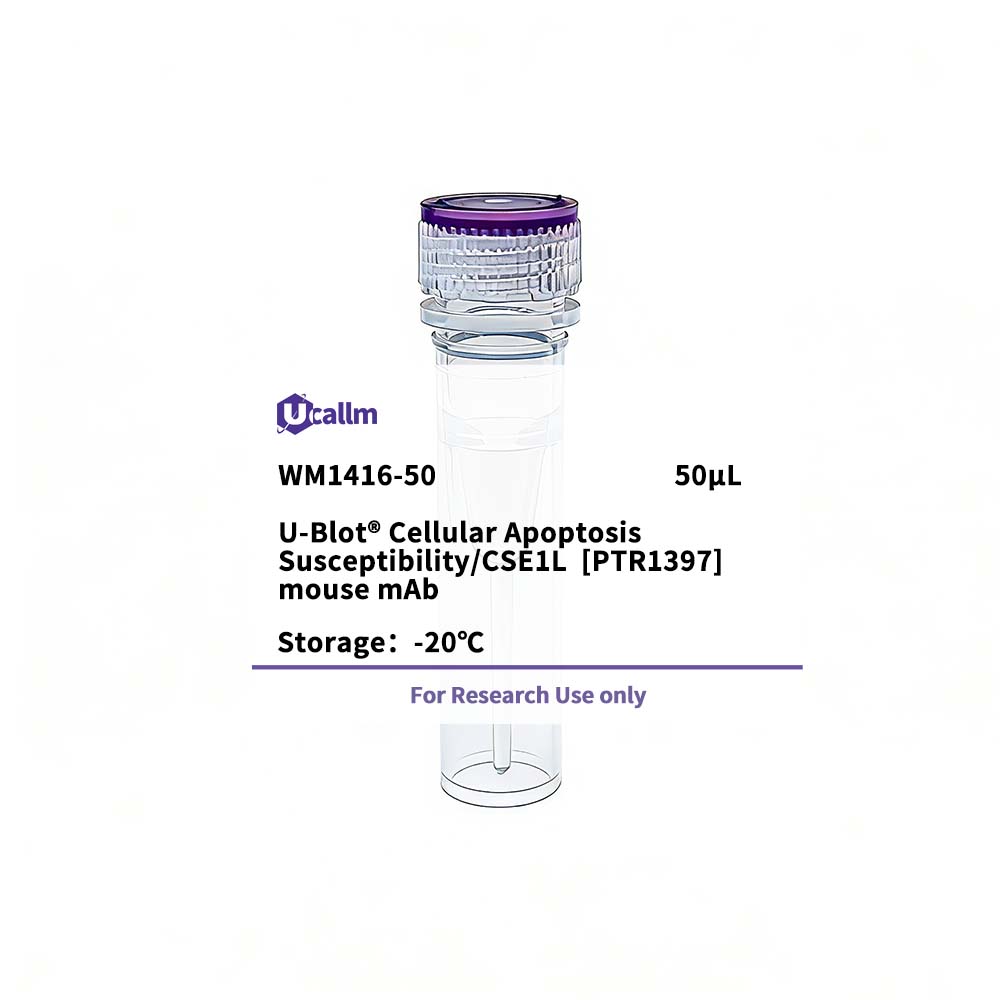
SKU: WM1416 Categories: ,

Cellular Apoptosis Susceptibility/CSE1L [PTR1397] mouse mAb

Price range: $268.00 through $328.00

SKU: WM1416-50
Enter the quantity you would like, or drag the panel to find the quantity and price that best for you
Bulk QuoteAuthorize OEM & ODM

Product details

Background:
Proteins that carry a nuclear localization signal (NLS) are transported into the nucleus by the importin-alpha/beta heterodimer. Importin-alpha binds the NLS, while importin-beta mediates translocation through the nuclear pore complex. After translocation, RanGTP binds importin-beta and displaces importin-alpha. Importin-alpha must then be returned to the cytoplasm, leaving the NLS protein behind. The protein encoded by this gene binds strongly to NLS-free importin-alpha, and this binding is released in the cytoplasm by the combined action of RANBP1 and RANGAP1. In addition, the encoded protein may play a role both in apoptosis and in cell proliferation. Alternatively spliced transcript variants have been found for this gene. [provided by RefSeq, Jan 2012],

Specifications

Size50μL/100μL
TargetCAS
ReactivityHuman, Mouse, Rat
ApplicationsWB, IF, ELISA
MW(Calculated)110kD
MW(Observed)110kD
Host SpeciesMouse
IsotypeIgG3,Kappa
Conjugate/ModificationUnmodified
Recommended Dilution RatioWB 1:500-2000; IF 1:100-500; ELISA 1:1000-5000
FormulationPBS, 50% glycerol, 0.05% Proclin 300, 0.05%BSA
PurificationRecombinant Antibody expressed in animal component-free (ACF) media, purified via Protein G affinity chromatography.
Storage-15°C to -25°C/1 year(Do not lower than -25°C)
Concentration
ClonalityMonoclonal
Clone NumberRMMR1397
ImmunogenSynthesized peptide derived from human protein.AA range:1-100
SpecificityThis antibody detects endogenous levels of CSE1L.
Gene NameCSE1L
Protein NameExportin-2
Other NameCSE1L; / CAS; / XPO2; / Exportin-2; / Exp2; / Cellular apoptosis susceptibility protein; / Chromosome segregation 1-like protein; / Importin-alpha re-exporter
SpeciesHuman
Gene ID1434
UniprotP55060,
Species.1Mouse
Gene ID.1
Uniprot.1Q9ERK4
Species.2
Gene ID.2
Uniprot.2
Cellular Localization
Tissue ExpressionDetected in brain, placenta, ovary, testis and trachea (at protein level) (PubMed:10331944). Widely expressed (PubMed:10331944). Highly expressed in testis and in proliferating cells (PubMed:7479798,PubMed:10331944).
Signaling_pathwayGenetic Information Processing >> Translation >> Nucleocytoplasmic transport
Research Areas>>Nucleocytoplasmic transport; / >>Salmonella infection
FunctionFunction:Export receptor for importin-alpha. Mediates importin-alpha re-export from the nucleus to the cytoplasm after import substrates (cargos) have been released into the nucleoplasm. In the nucleus binds cooperatively to importin-alpha and to the GTPase Ran in its active GTP-bound form. Docking of this trimeric complex to the nuclear pore complex (NPC) is mediated through binding to nucleoporins. Upon transit of a nuclear export complex into the cytoplasm, disassembling of the complex and hydrolysis of Ran-GTP to Ran-GDP (induced by RANBP1 and RANGAP1, respectively) cause release of the importin-alpha from the export receptor. CSE1L/XPO2 then return to the nuclear compartment and mediate another round of transport. The directionality of nuclear export is thought to be conferred by an asymmetric distribution of the GTP- and GDP-bound forms of Ran between the cytoplasm and nucleus.,similarity:Belongs to the XPO2/CSE1 family.,similarity:Contains 1 importin N-terminal domain.,subcellular location:Shuttles between the nucleus and the cytoplasm.,subunit:Found in a complex with CSE1L/XPO2, Ran and KPNA2. Binds with high affinity to importin-alpha only in the presence of RanGTP. The complex is dissociated by the combined action of RanBP1 and RanGAP1.,tissue specificity:Highly expressed in proliferating cells.,
Please login to post questions
Back to Top
Product has been added to your cart

