

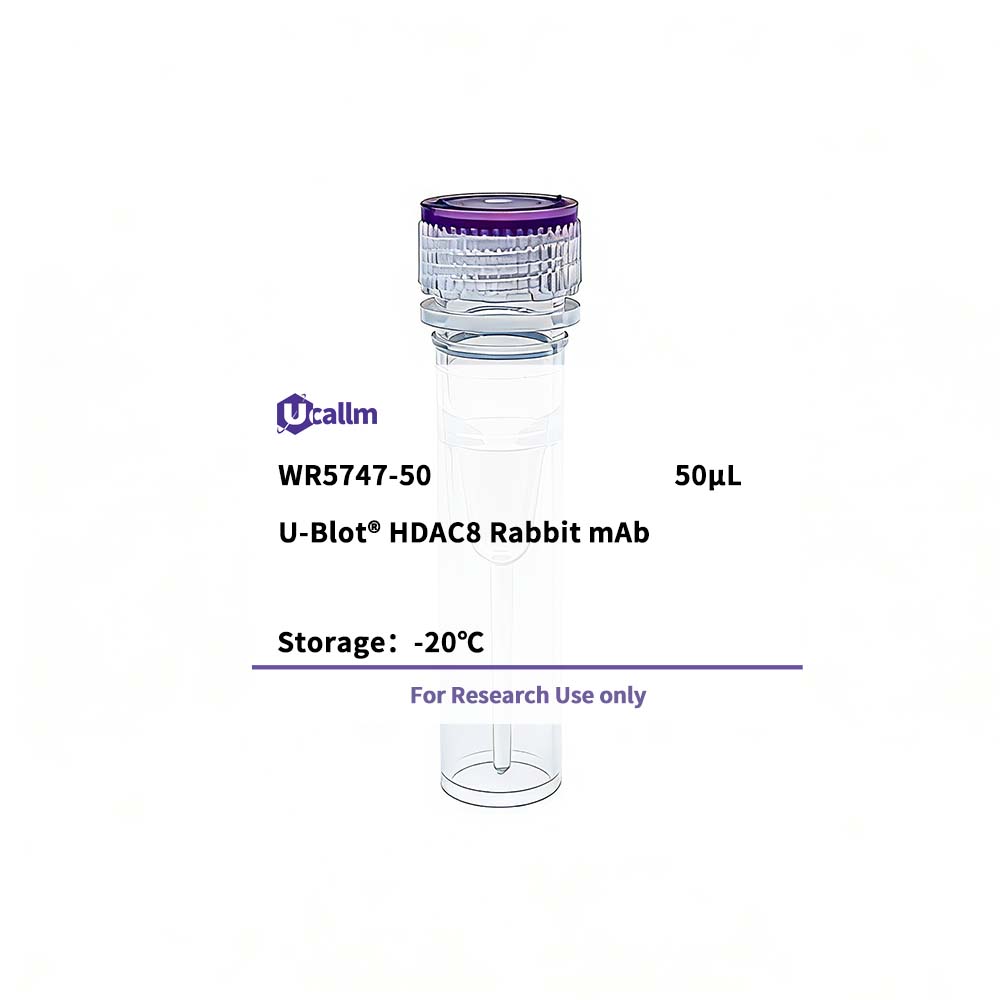
Specifications
| Size | 50μL/100μL |
| Target | HDAC8 |
| Reactivity | Human, Mouse, Rat |
| Applications | WB, IHC, IF, IP, ELISA |
| MW(Calculated) | 42kD |
| MW(Observed) | 44kD |
| Host Species | Rabbit |
| Isotype | IgG,Kappa |
| Conjugate/Modification | Unmodified |
| Recommended Dilution Ratio | IHC 1:200-1:500; WB 1:2000-1:10000; IF 1:200-1:1000; ELISA 1:5000-1:20000; IP 1:50-1:200; / Note: For IHC, we suggest antigen retrieval with TE buffer pH 9.0 (Cat#WT1004) |
| Formulation | PBS, 50% glycerol, 0.05% Proclin 300, 0.05%BSA |
| Purification | Recombinant Antibody expressed in animal component-free (ACF) media, purified via Protein A affinity chromatography. |
| Storage | -15°C to -25°C/1 year(Do not lower than -25°C) |
| Concentration | |
| Clonality | Monoclonal |
| Clone Number | RM1709R |
| Immunogen | The specific immunogen used to produce this antibody is proprietary information. |
| Specificity | Endogenous |
| Gene Name | HDAC8 |
| Protein Name | Histone deacetylase 8 |
| Other Name | HDAC8; / HDACL1; / CDA07; / Histone deacetylase 8; / HD8 |
| Species | Human |
| Gene ID | 55869 |
| Uniprot | Q9BY41, |
| Species.1 | Mouse |
| Gene ID.1 | 70315 |
| Uniprot.1 | Q8VH37, |
| Species.2 | Rat |
| Gene ID.2 | 363481 |
| Uniprot.2 | B1WC68 |
| Cellular Localization | Nucleus . Chromosome . Cytoplasm . Excluded from the nucleoli (PubMed:10748112). Found in the cytoplasm of cells showing smooth muscle differentiation (PubMed:15772115, PubMed:16538051). . |
| Tissue Expression | Weakly expressed in most tissues. Expressed at higher level in heart, brain, kidney and pancreas and also in liver, lung, placenta, prostate and kidney. |
| Signaling_pathway | Cellular Processes >> Cell growth and death >> Cell cycle;Organismal Systems >> Immune system >> Neutrophil extracellular trap formation |
| Research Areas | >>Neutrophil extracellular trap formation; / >>Alcoholism; / >>Viral carcinogenesis |
| Function | Catalytic activity:Hydrolysis of an N(6)-acetyl-lysine residue of a histone to yield a deacetylated histone.,Caution:The sequence shown here is derived from an Ensembl automatic analysis pipeline and should be considered as preliminary data.,Function:Responsible for the deacetylation of lysine residues on the N-terminal part of the core histones (H2A, H2B, H3 and H4). Histone deacetylation gives a tag for epigenetic repression and plays an important role in transcriptional regulation, cell cycle progression and developmental events. Histone deacetylases act via the formation of large multiprotein complexes.,miscellaneous:Its activity is inhibited by trichostatin A (TSA) and butyrate, two well known histone deacetylase inhibitors.,similarity:Belongs to the histone deacetylase family. Type 1 subfamily.,subcellular location:Excluded from the nucleoli.,subunit:Interacts with PEPB2-MYH11, a fusion protein consisting of the 165 N-terminal residues of CBF-beta (PEPB2) with the tail region of MYH11 produced by the inversion Inv(16)(p13q22), a translocation associated with acute myeloid leukemia of M4EO subtype. The PEPB2-MYH1 fusion protein also interacts with RUNX1, a well known transcriptional regulator, suggesting that the interaction with HDAC8 may participate in the conversion of RUNX1 into a constitutive transcriptional repressor. Interacts with CBFA2T3.,tissue specificity:Weakly expressed in most tissues. Expressed at higher level in heart, brain, kidney and pancreas., |



