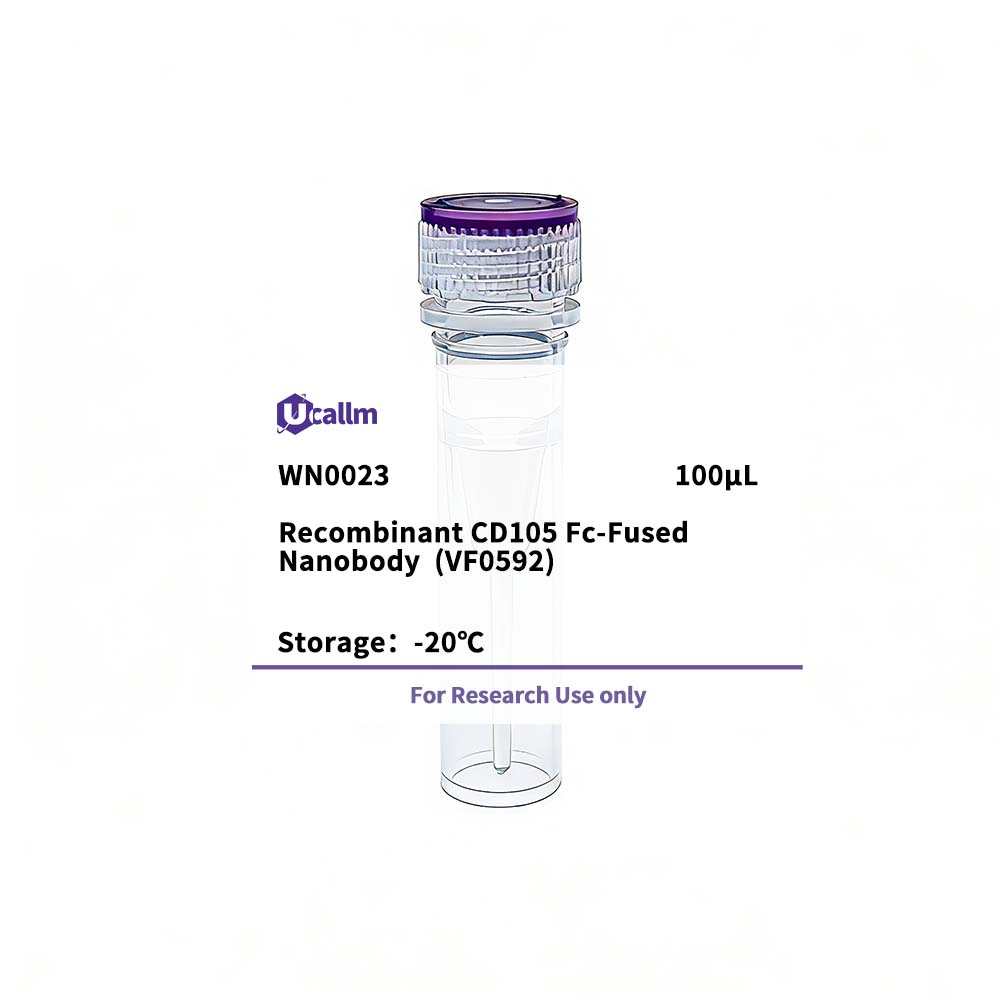
SKU: WN0023 Categories: ,

Recombinant CD105 Fc-Fused Nanobody (VF0592)

$365.00

SKU: WN0023
Enter the quantity you would like, or drag the panel to find the quantity and price that best for you
Bulk QuoteAuthorize OEM & ODM

Product details

Background:This gene encodes a homodimeric transmembrane protein which is a major glycoprotein of the vascular endothelium.This protein is a component of the transforming growth factor beta receptor complex and it binds to the beta1 and beta3 peptides with high affinity. Mutations inThis gene cause hereditary hemorrhagic telangiectasia, also known as Osler-Rendu-Weber syndrome 1, an autosomal dominant multisystemic vascular dysplasia.This gene may also be involved in preeclampsia and several types of cancer. Alternatively spliced transcript variants encoding different isoforms have been found forThis gene. [provided by RefSeq, May 2013]

Specifications

Size100μL
TargetCD105
ReactivityHuman
ApplicationsELISA
MW(Calculated)
MW(Observed)
Host Species
IsotypeIgG2a,Kappa
Conjugate/ModificationUnmodified
Recommended Dilution RatioELISA 1:5000-100000
FormulationPhosphate-buffered solution
PurificationRecombinant Expression and Affinity purified
Storage-15°C to -25°C/1 year(Avoid freeze / thaw cycles)
ConcentrationPlease check the information on the tube
Clonality
Clone NumberVF0121
ImmunogenPurified recombinant Human CD105
SpecificityThis recombinant monoclonal antibody can detects endogenous levels of CD105 protein.
Gene NameENG END
Protein NameEndoglin (CD antigen CD105)
Other NameEndoglin; / CD antigen CD105
SpeciesHuman
Gene ID2022
UniprotP17813
Species.1
Gene ID.1
Uniprot.1
Species.2
Gene ID.2
Uniprot.2
Cellular LocalizationCell membrane; Single-pass type I membrane protein .
Tissue ExpressionDetected in normal myeloid cells and in acute myeloid leukemia cells. Detected in neutrophils, eosinophils, monocytes and dendritic cells. Detected in spleen macrophage-rich red pulp and in lymph node (at protein level). Detected in peripheral blood leukocytes, dendritic cells, bone marrow, monocytes, mononuclear leukocytes and macrophages.
Signaling_pathway
Research Areas
FunctionDisease:Defects in ENG are the cause of hereditary hemorrhagic telangiectasia type 1 (HHT1) [MIM:187300, 108010]; also known as Osler-Rendu-Weber syndrome 1 (ORW1). HHT1 is an autosomal dominant multisystemic vascular dysplasia, characterized by recurrent epistaxis, muco-cutaneous telangiectases, gastro-intestinal hemorrhage, and pulmonary (PAVM), cerebral (CAVM) and hepatic arteriovenous malformations; all secondary manifestations of the underlying vascular dysplasia. Although the first symptom of HHT1 in children is generally nose bleed, there is an important clinical heterogeneity.,Major glycoprotein of vascular endothelium. May play a critical role in the binding of endothelial cells to integrins and/or other RGD receptors.,subunit:Homodimer that forms an heteromeric complex with the signaling receptors for transforming growth factor-beta: TGF-beta receptors I and/or II. It is able to bind TGF-beta 1, and 3 efficiently and TGF-beta 2 less efficiently. Interacts with TCTEX1D4.,tissue specificity:Endoglin is restricted to endothelial cells in all tissues except bone marrow.,
Please login to post questions
Back to Top
Product has been added to your cart
