Product details
Background:
Price range: $268.00 through $328.00
Background:
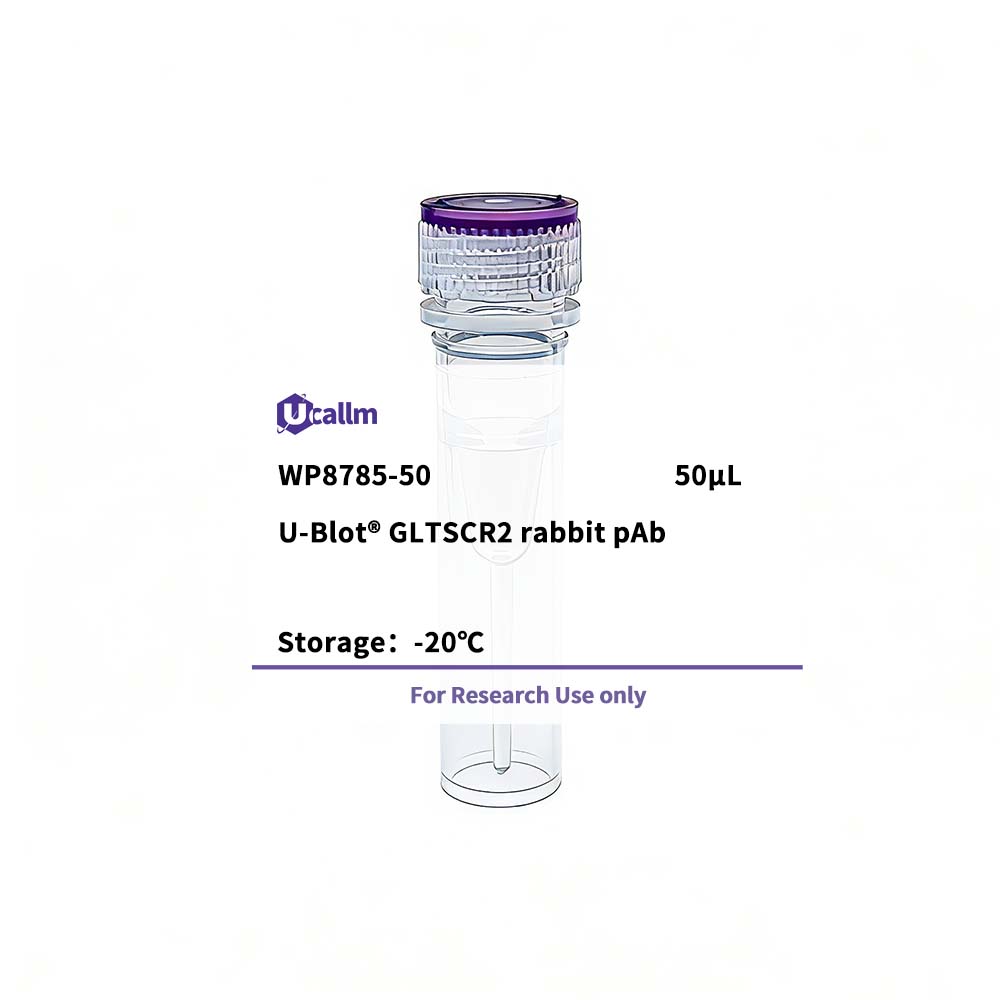
| Target | NOP53 |
| Reactivity | Human |
| Applications | WB |
| MW(Calculated) | 53kD |
| MW(Observed) | |
| Host Species | Rabbit |
| Isotype | IgG |
| Conjugate/Modification | Unmodified |
| Modification | |
| Recommended Dilution Ratio | WB 1:500-2000 |
| Formulation | Liquid in PBS containing 50% glycerol, 0.5% BSA and 0.02% sodium azide. |
| Source | |
| Purification | The antibody was affinity-purified from rabbit antiserum by affinity-chromatography using epitope-specific immunogen. |
| Purity | |
| Storage | -15°C to -25°C/1 year(Do not lower than -25°C) |
| Concentration | 1 mg/ml |
| Clonality | Polyclonal |
| Clone Number | |
| Immunogen | Synthesized peptide derived from human GLTSCR2 |
| Sequence | |
| Specificity | This antibody detects endogenous levels of GLTSCR2 at Human |
| Gene Name | GLTSCR2 |
| Protein Name | Glioma tumor suppressor candidate region gene 2 protein (p60) |
| Other Name | |
| Species | Human |
| Gene ID-1 | 29997 |
| Uniprot | Q9NZM5 |
| Species.1 | |
| Gene ID-2 | |
| Uniprot.1 | |
| Species.2 | |
| Gene ID-3 | |
| Uniprot.2 | |
| Organism-4 | |
| Gene ID-4 | |
| SwissProt-4 | |
| Background | |
| Cellular Localization | Nucleus, nucleolus . Nucleus, nucleoplasm . In the nucleolus may be more specifically localized to the fibrillar center (PubMed:27729611). Mainly nucleolar it relocalizes to the nucleoplasm under specific conditions including ribosomal stress enabling it to interact and regulate nucleoplasmic proteins like p53/TP53 (PubMed:22522597, PubMed:24923447, PubMed:27323397, PubMed:26903295). Also detected in the cytosol (PubMed:24923447, PubMed:27824081). . |
| Tissue Expression | Expressed at high levels in heart and pancreas, moderate levels in placenta, liver, skeletal muscle, and kidney, and low levels in brain and lung. |
| Signaling_pathway | |
| Research Areas | |
| Function | Nucleolar protein which is involved in the integration of the 5S RNP into the ribosomal large subunit during ribosome biogenesis . In ribosome biogenesis, may also play a role in rRNA transcription . Also functions as a nucleolar sensor that regulates the activation of p53/TP53 in response to ribosome biogenesis perturbation, DNA damage and other stress conditions . DNA damage or perturbation of ribosome biogenesis disrupt the interaction between NOP53 and RPL11 allowing RPL11 transport to the nucleoplasm where it can inhibit MDM2 and allow p53/TP53 activation . It may also positively regulate the function of p53/TP53 in cell cycle arrest and apoptosis through direct interaction, preventing its MDM2-dependent ubiquitin-mediated proteasomal degradation . Originally identified as a tumor suppressor, it may also play a role in cell proliferation and apoptosis by positively regulating the stability of PTEN, thereby antagonizing the PI3K-AKT/PKB signaling pathway . May also inhibit cell proliferation and increase apoptosis through its interaction with NF2 . May negatively regulate NPM1 by regulating its nucleoplasmic localization, oligomerization and ubiquitin-mediated proteasomal degradation . Thereby, may prevent NPM1 interaction with MYC and negatively regulate transcription mediated by the MYC-NPM1 complex . May also regulate cellular aerobic respiration . In the cellular response to viral infection, may play a role in the attenuation of interferon-beta through the inhibition of DDX58/RIG-1 . |
| RRID |