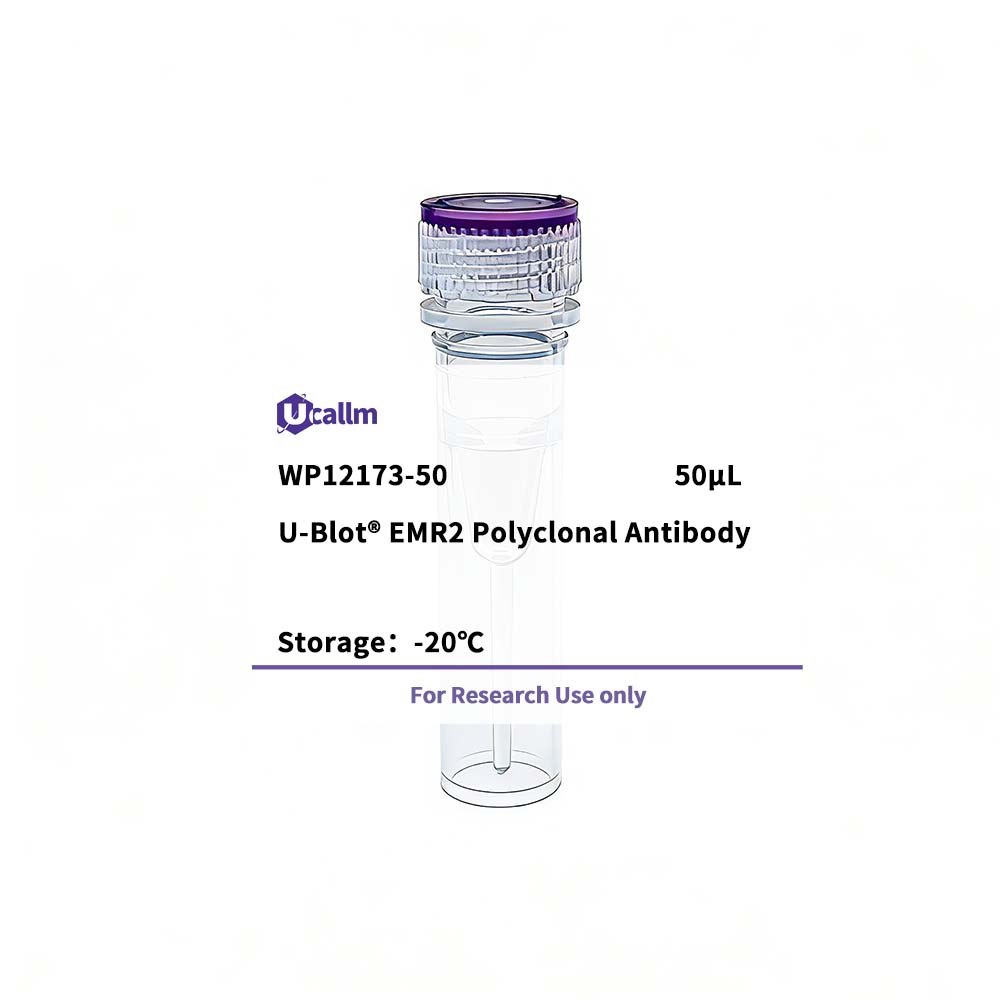
SKU: WP12173 Categories: ,

EMR2 Polyclonal Antibody

Price range: $268.00 through $328.00

SKU: WP12173-100
Enter the quantity you would like, or drag the panel to find the quantity and price that best for you
Bulk QuoteAuthorize OEM & ODM

Product details

Background:

This gene encodes a member of the class B seven-span transmembrane (TM7) subfamily of G-protein coupled receptors. These proteins are characterized by an extended extracellular region with a variable number of N-terminal epidermal growth factor-like domains coupled to a TM7 domain via a mucin-like spacer domain. The encoded protein is expressed mainly in myeloid cells where it promotes cell-cell adhesion through interaction with chondroitin sulfate chains. This gene is situated in a cluster of related genes on chromosome 19. Alternatively spliced transcript variants encoding multiple isoforms have been observed for this gene. [provided by RefSeq, Aug 2012],

Specifications

Size50μL/100μL
TargetEMR2
ReactivityHuman
ApplicationsWB, IF, ELISA
MW(Calculated)
MW(Observed)85kD
Host SpeciesRabbit
IsotypeIgG
Conjugate/ModificationUnmodified
Recommended Dilution RatioWB 1:500-1:2000; IF 1:200-1:1000; ELISA 1:20000; Not yet tested in other applications.
FormulationLiquid in PBS containing 50% glycerol, 0.5% BSA and 0.02% sodium azide.
PurificationThe antibody was affinity-purified from rabbit antiserum by affinity-chromatography using epitope-specific immunogen.
Storage-15°C to -25°C/1 year(Do not lower than -25°C)
Concentration1 mg/ml
ClonalityPolyclonal
Clone Number
ImmunogenThe antiserum was produced against synthesized peptide derived from human EMR2. AA range:765-814
SpecificityEMR2 Polyclonal Antibody detects endogenous levels of EMR2 protein.
Gene NameEMR2
Protein NameEGF-like module-containing mucin-like hormone receptor-like 2
Other NameEMR2; / EGF-like module-containing mucin-like hormone receptor-like 2; / EGF-like module receptor 2; / CD antigen CD312
SpeciesHuman
Gene ID30817
UniprotQ9UHX3
Species.1
Gene ID.1
Uniprot.1
Species.2
Gene ID.2
Uniprot.2
Cellular LocalizationCell membrane; Multi-pass membrane protein. Cell projection, ruffle membrane; Multi-pass membrane protein. Localized at the leading edge of migrating cells. .
Tissue ExpressionExpression is restricted to myeloid cells. Highest expression was found in peripheral blood leukocytes, followed by spleen and lymph nodes, with intermediate to low levels in thymus, bone marrow, fetal liver, placenta, and lung, and no expression in heart, brain, skeletal muscle, kidney, or pancreas. Expression is also detected in monocyte/macrophage and Jurkat cell lines but not in other cell lines tested. High expression in mast cells (PubMed:26841242).
Signaling_pathway
Research Areas
FunctionAlternative products:A number of isoforms are produced. A number of isoforms consisting of various number of EGF-like domains seems to exist. A soluble form due to a frameshift which introduced a stop codon immediately before the first TM domain is also detected,Domain:Binding to chondroitin sulfate is mediated by the fourth EGF domain.,Domain:The GPS domain is necessary, but not sufficient for receptor cleavage, which require the entire extracellular stalk.,Function:Receptor probably involved in cell attachment.,PTM:Proteolytically cleaved into 2 subunits, an extracellular alpha subunit and a seven-transmembrane subunit.,similarity:Belongs to the G-protein coupled receptor 2 family. LN-TM7 subfamily.,similarity:Contains 1 GPS domain.,similarity:Contains 5 EGF-like domains.,subunit:Forms a heterodimer, consisting of a large extracellular region non-covalently linked to a seven-transmembrane moiety. Interacts with chondroitin sulfate.,tissue specificity:Expression is restricted to myeloid cells. Highest expression was found in peripheral blood leukocytes, followed by spleen and lymph nodes, with intermediate to low levels in thymus, bone marrow, fetal liver, placenta, and lung, and no expression in heart, brain, skeletal muscle, kidney, or pancreas. Expression is also detected in monocyte/macrophage and Jurkat cell lines but not in other cell lines tested.,
Please login to post questions
Back to Top
Product has been added to your cart

