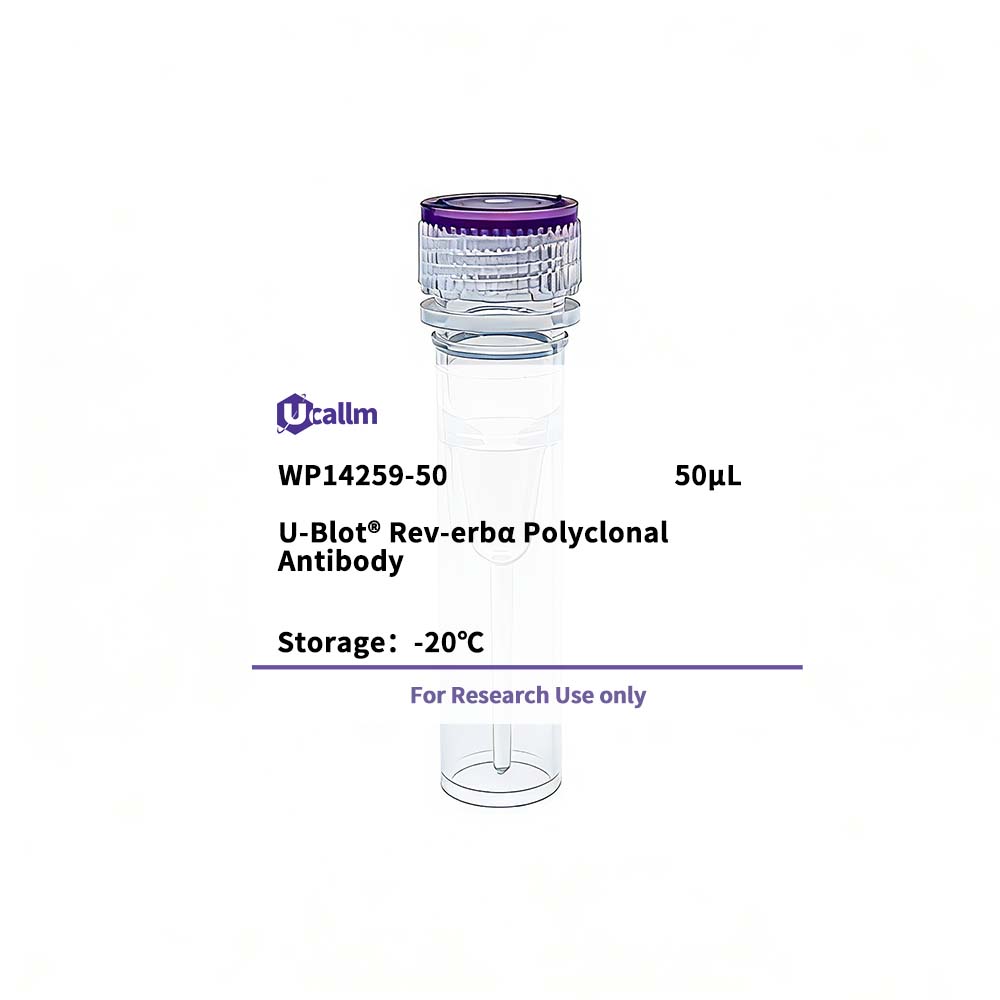
SKU: WP14259 Categories: ,

Rev-erbα Polyclonal Antibody

Price range: $268.00 through $328.00

SKU: WP14259-100
Enter the quantity you would like, or drag the panel to find the quantity and price that best for you
Bulk QuoteAuthorize OEM & ODM

Product details

Background:

This gene encodes a transcription factor that is a member of the nuclear receptor subfamily 1. The encoded protein is a ligand-sensitive transcription factor that negatively regulates the expression of core clock proteins. In particular this protein represses the circadian clock transcription factor aryl hydrocarbon receptor nuclear translocator-like protein 1 (ARNTL). This protein may also be involved in regulating genes that function in metabolic, inflammatory and cardiovascular processes. [provided by RefSeq, Jan 2013],


Specifications

Size50μL/100μL
TargetNR1D1
ReactivityHuman, Mouse, Rat
ApplicationsWB, IHC
MW(Calculated)
MW(Observed)67kD
Host SpeciesRabbit
IsotypeIgG
Conjugate/ModificationUnmodified
Recommended Dilution RatioWB 1:500-2000; IHC 1:50-300 / Note: For IHC, we suggest antigen retrieval with TE buffer pH 9.0 (Cat#WT1004)
FormulationLiquid in PBS containing 50% glycerol, 0.5% BSA and 0.02% sodium azide.
PurificationThe antibody was affinity-purified from rabbit antiserum by affinity-chromatography using epitope-specific immunogen.
Storage-15°C to -25°C/1 year(Do not lower than -25°C)
Concentration1 mg/ml
ClonalityPolyclonal
Clone Number
ImmunogenSynthesized peptide derived from Rev-erbα . at AA range: 350-430
SpecificityRev-erbα Polyclonal Antibody detects endogenous levels of Rev-erbα protein.
Gene NameNR1D1
Protein NameNuclear receptor subfamily 1 group D member 1
Other NameNR1D1; / EAR1; / HREV; / THRAL; / Nuclear receptor subfamily 1 group D member 1; / Rev-erbA-alpha; / V-erbA-related protein 1; / EAR-1
SpeciesHuman
Gene ID9572
UniprotP20393,
Species.1Mouse
Gene ID.1217166
Uniprot.1Q3UV55,
Species.2Rat
Gene ID.2252917
Uniprot.2Q63503
Cellular LocalizationNucleus . Cytoplasm . Cell projection, dendrite . Cell projection, dendritic spine . Localizes to the cytoplasm, dendrites and dendritic spine in the presence of OPHN1. Localizes predominantly to the nucleus at ZT8 whereas it is cytoplasmic at ZT20. Phosphorylation by CSNK1E enhances its cytoplasmic localization. .
Tissue ExpressionWidely expressed. Expressed at high levels in the liver, adipose tissue, skeletal muscle and brain. Also expressed in endothelial cells (ECs), vascular smooth muscle cells (VSMCs) and macrophages. Expression oscillates diurnally in the suprachiasmatic nucleus (SCN) of the hypothalamus as well as in peripheral tissues. Expression increases during the differentiation of pre-adipocytes into mature adipocytes. Expressed at high levels in some squamous carcinoma cell lines.
Signaling_pathwayOrganismal Systems >> Environmental adaptation >> Circadian rhythm
Research Areas>>Circadian rhythm
FunctionDomain:Composed of three domains: a modulating N-terminal domain, a DNA-binding domain and a C-terminal steroid-binding domain.,Function:Functions as a constitutive transcriptional repressor. Possible receptor for triiodothyronine.,similarity:Belongs to the nuclear hormone receptor family. NR1 subfamily.,similarity:Contains 1 nuclear receptor DNA-binding domain.,subunit:Interacts with C1D.,tissue specificity:Expressed in all tissues and cell lines examined. Expressed at high levels in some squamous carcinoma cell lines.,
Please login to post questions
Back to Top
Product has been added to your cart
