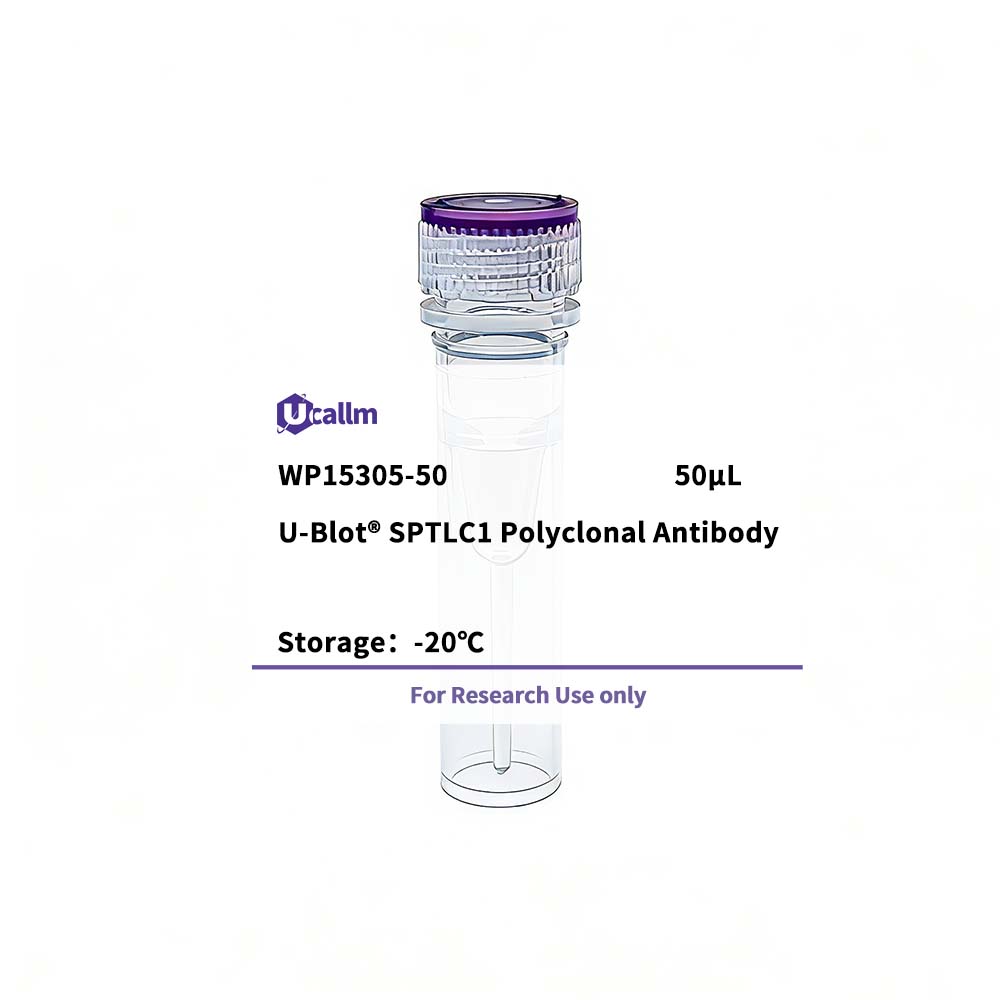
SKU: WP15305 Categories: ,

SPTLC1 Polyclonal Antibody

Price range: $268.00 through $328.00

SKU: WP15305-100
Enter the quantity you would like, or drag the panel to find the quantity and price that best for you
Bulk QuoteAuthorize OEM & ODM

Product details

Background:

This gene encodes a member of the class-II pyridoxal-phosphate-dependent aminotransferase family. The encoded protein is the long chain base subunit 1 of serine palmitoyltransferase. Serine palmitoyltransferase converts L-serine and palmitoyl-CoA to 3-oxosphinganine with pyridoxal 5'-phosphate and is the key enzyme in sphingolipid biosynthesis. Mutations in this gene were identified in patients with hereditary sensory neuropathy type 1. Alternatively spliced variants encoding different isoforms have been identified. Pseudogenes of this gene have been defined on chromosomes 1, 6, 10, and 13. [provided by RefSeq, Jul 2013],

Specifications

Size50μL/100μL
TargetSPTLC1
ReactivityHuman, Mouse, Rat
ApplicationsWB, IHC, IF, ELISA
MW(Calculated)
MW(Observed)52kD
Host SpeciesRabbit
IsotypeIgG
Conjugate/ModificationUnmodified
Recommended Dilution RatioWB 1:500-1:2000; IHC: 1:100-300; ELISA 1:20000; IF 1:50-200 / Note: For IHC, we suggest antigen retrieval with TE buffer pH 9.0 (Cat#WT1004)
FormulationLiquid in PBS containing 50% glycerol, 0.5% BSA and 0.02% sodium azide.
PurificationThe antibody was affinity-purified from rabbit antiserum by affinity-chromatography using epitope-specific immunogen.
Storage-15°C to -25°C/1 year(Do not lower than -25°C)
Concentration1 mg/ml
ClonalityPolyclonal
Clone Number
ImmunogenSynthesized peptide derived from SPTLC1 . at AA range: 411-460
SpecificitySPTLC1 Polyclonal Antibody detects endogenous levels of SPTLC1 protein.
Gene NameSPTLC1
Protein NameSerine palmitoyltransferase 1
Other NameSPTLC1; / LCB1; / Serine palmitoyltransferase 1; / Long chain base biosynthesis protein 1; / LCB 1; / Serine-palmitoyl-CoA transferase 1; / SPT 1; / SPT1
SpeciesHuman
Gene ID10558
UniprotO15269,
Species.1Mouse
Gene ID.1268656
Uniprot.1O35704
Species.2
Gene ID.2
Uniprot.2
Cellular LocalizationEndoplasmic reticulum membrane; Single-pass membrane protein .
Tissue ExpressionWidely expressed. Not detected in small intestine.
Signaling_pathwayEnvironmental Information Processing >> Signal transduction >> Sphingolipid signaling pathway
Research Areas>>Sphingolipid metabolism; / >>Metabolic pathways; / >>Sphingolipid signaling pathway
FunctionCatalytic activity:Palmitoyl-CoA + L-serine = CoA + 3-dehydro-D-sphinganine + CO(2).,cofactor:Pyridoxal phosphate.,Disease:Defects in SPTLC1 are the cause of hereditary sensory and autonomic neuropathy type 1 (HSAN1) [MIM:162400]. The hereditary sensory and autonomic neuropathies are a genetically and clinically heterogeneous group of disorders characterized by degeneration of dorsal root and autonomic ganglion cells, and by sensory and/or autonomic abnormalities. HSAN1 is an autosomal dominant axonal neuropathy with onset in the second or third decades. Initial symptoms are loss of pain, touch, heat, and cold sensation over the feet, followed by distal muscle wasting and weakness. Loss of pain sensation leads to chronic skin ulcers and distal amputations.,pathway:Lipid metabolism; sphingolipid metabolism.,similarity:Belongs to the class-II pyridoxal-phosphate-dependent aminotransferase family.,subunit:SPTLC1, SPTLC2 and SPTLC3 may encode subunits of the enzyme.,tissue specificity:Widely expressed. Not detected in small intestine.,
Please login to post questions
Back to Top
Product has been added to your cart
