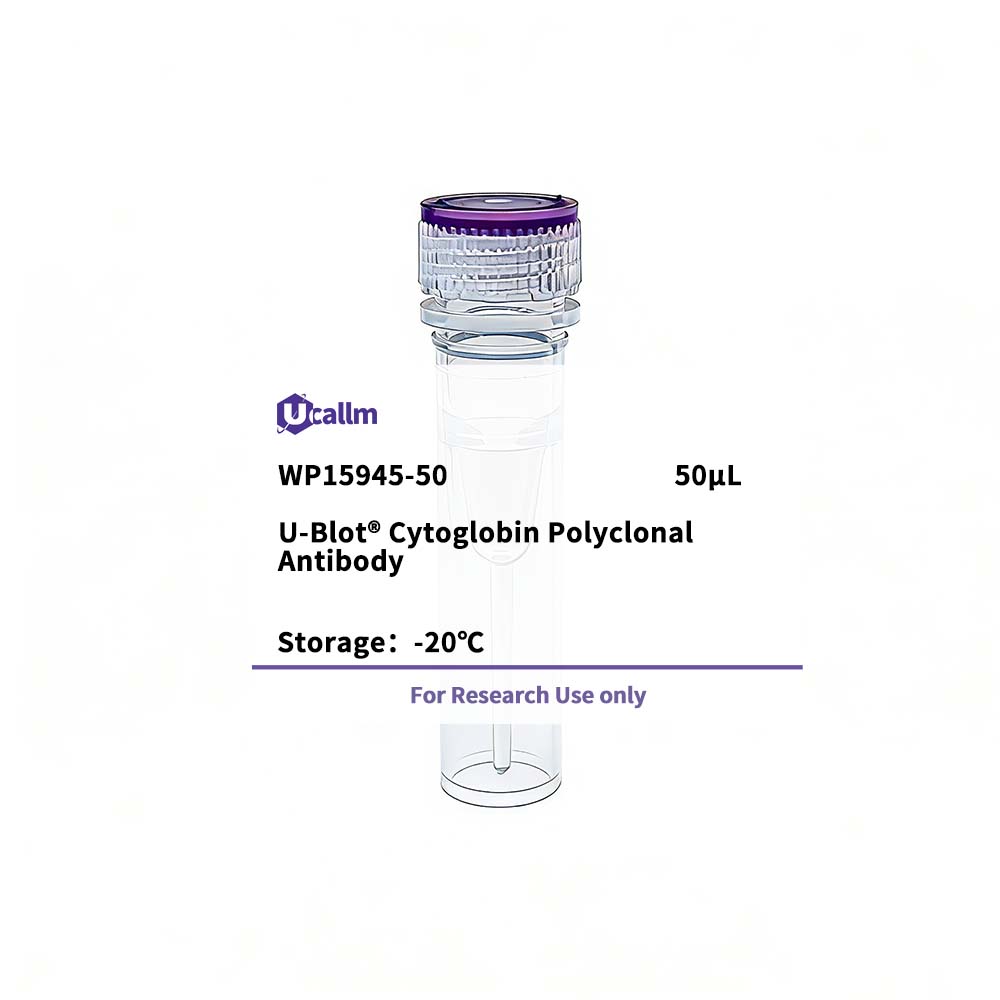
SKU: WP15945 Categories: ,

Cytoglobin Polyclonal Antibody

Price range: $268.00 through $328.00

SKU: WP15945-100
Enter the quantity you would like, or drag the panel to find the quantity and price that best for you
Bulk QuoteAuthorize OEM & ODM

Product details

Background:

This gene encodes a globin protein found in vertebrate cells. The encoded protein is described as a hexacoordinate hemoglobin which binds ligand differently from the pentacoordinate hemoglobins involved in oxygen transport, and may be involved in protection during oxidative stress. This gene is located on chromosome 17 in the same region as a retinal gene which is mutated in progressive rod-cone degeneration, but in the opposite orientation. [provided by RefSeq, Jan 2012],

Specifications

Size50μL/100μL
TargetCytoglobin
ReactivityHuman, Mouse, Rat
ApplicationsIHC, IF, ELISA
MW(Calculated)
MW(Observed)
Host SpeciesRabbit
IsotypeIgG
Conjugate/ModificationUnmodified
Recommended Dilution RatioIHC 1:50-200; ELISA 1:10000-20000; IF 1:50-200 / Note: For IHC, we suggest antigen retrieval with TE buffer pH 9.0 (Cat#WT1004)
FormulationLiquid in PBS containing 50% glycerol, 0.5% BSA and 0.02% sodium azide.
PurificationThe antibody was affinity-purified from rabbit antiserum by affinity-chromatography using epitope-specific immunogen.
Storage-15°C to -25°C/1 year(Do not lower than -25°C)
Concentration1 mg/ml
ClonalityPolyclonal
Clone Number
ImmunogenSynthetic peptide from human protein at AA range: 1-60
SpecificityThe antibody detects endogenous Cytoglobin
Gene NameCYGB STAP
Protein NameCytoglobin (Histoglobin) (HGb) (Stellate cell activation-associated protein)
Other NameCytoglobin; / Histoglobin; / HGb; / Stellate cell activation-associated protein
SpeciesHuman
Gene ID114757
UniprotQ8WWM9,
Species.1Mouse
Gene ID.1114886
Uniprot.1Q9CX80
Species.2
Gene ID.2
Uniprot.2
Cellular LocalizationCytoplasm .
Tissue ExpressionUbiquitously expressed. Highest expression in heart, stomach, bladder and small intestine.
Signaling_pathway
Research Areas
FunctionFunction:May have a protective function during conditions of oxidative stress. May be involved in intracellular oxygen storage or transfer.,similarity:Belongs to the globin family.,subunit:Homodimer; disulfide-linked.,tissue specificity:Ubiquitously expressed. Highest expression in heart, stomach, bladder and small intestine.,
Please login to post questions
Back to Top
Product has been added to your cart

