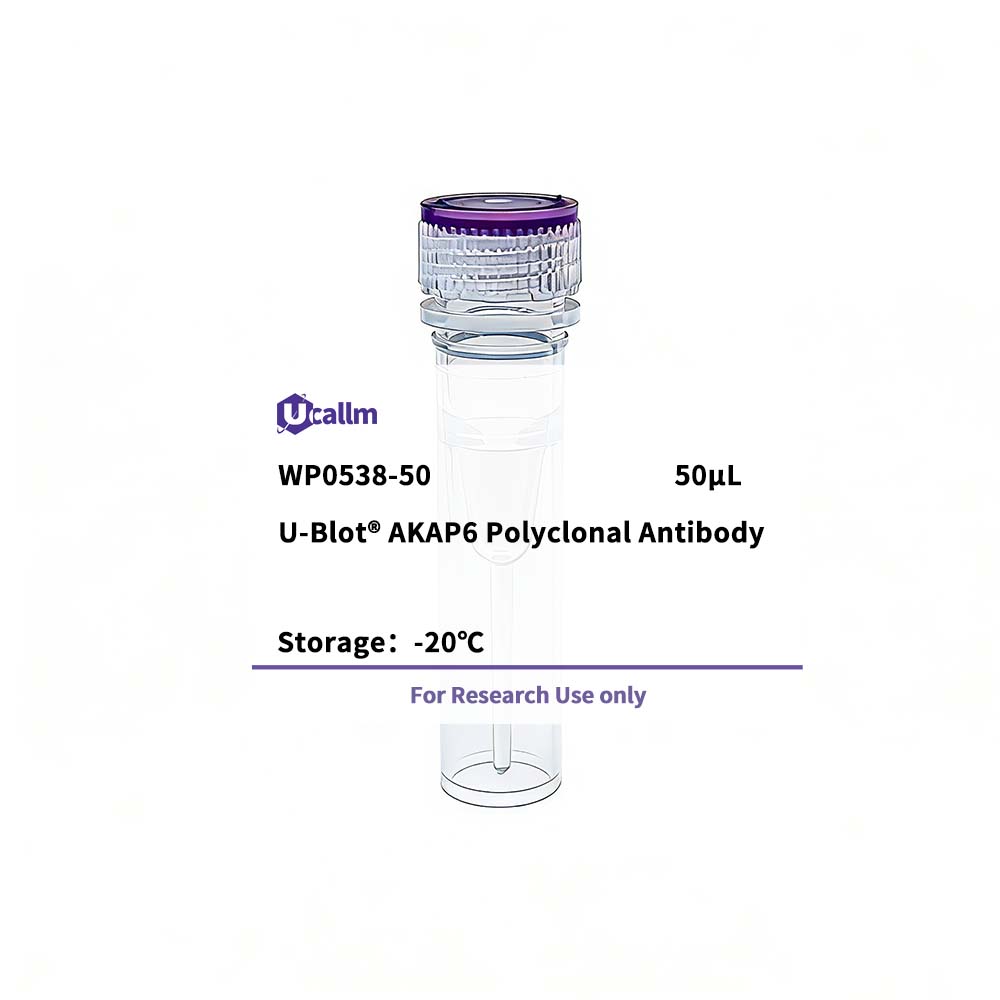
SKU: WP0538 Categories: ,

AKAP6 Polyclonal Antibody

Price range: $268.00 through $328.00

SKU: WP0538-100
Enter the quantity you would like, or drag the panel to find the quantity and price that best for you
Bulk QuoteAuthorize OEM & ODM

Product details

Background:

The A-kinase anchor proteins (AKAPs) are a group of structurally diverse proteins, which have the common function of binding to the regulatory subunit of protein kinase A (PKA) and confining the holoenzyme to discrete locations within the cell. This gene encodes a member of the AKAP family. The encoded protein is highly expressed in various brain regions and cardiac and skeletal muscle. It is specifically localized to the sarcoplasmic reticulum and nuclear membrane, and is involved in anchoring PKA to the nuclear membrane or sarcoplasmic reticulum. [provided by RefSeq, Jul 2008],


Specifications

Size50μL/100μL
TargetAKAP6
ReactivityHuman, Rat
ApplicationsIHC, IF
MW(Calculated)
MW(Observed)255kD
Host SpeciesRabbit
IsotypeIgG
Conjugate/ModificationUnmodified
Recommended Dilution RatioIHC 1:50-300; IF 1:50-200 / Note: For IHC, we suggest antigen retrieval with TE buffer pH 9.0 (Cat#WT1004)
FormulationLiquid in PBS containing 50% glycerol,0.5% BSA and 0.02% sodium azide.
PurificationThe antibody was affinity-purified from rabbit antiserum by affinity-chromatography using epitope-specific immunogen.
Storage-15°C to -25°C/1 year(Do not lower than -25°C)
Concentration1 mg/ml
ClonalityPolyclonal
Clone Number
ImmunogenSynthesized peptide derived from human protein . at AA range: 30-110
SpecificityAKAP6 Polyclonal Antibody detects endogenous levels of protein.
Gene NameAKAP6 AKAP100 KIAA0311
Protein NameA-kinase anchor protein 6 (AKAP-6) (A-kinase anchor protein 100 kDa) (AKAP 100) (Protein kinase A-anchoring protein 6) (PRKA6) (mAKAP)
Other Name
SpeciesHuman
Gene ID9472
UniprotQ13023,
Species.1
Gene ID.1
Uniprot.1
Species.2Rat
Gene ID.2
Uniprot.2Q9WVC7
Cellular LocalizationSarcoplasmic reticulum. Nucleus membrane. In heart muscle. Participation of multiple targeting signals allow correct intracellular targeting. These may be repeated motifs rich in basic and hydrophobic amino acids, palmitoylated/myristoylated motifs or alternatively splice targeting sequences.
Tissue ExpressionHighly expressed in cardiac and skeletal muscle, followed by brain.
Signaling_pathway
Research Areas
FunctionDomain:RII-alpha binding site, predicted to form an amphipathic helix, could participate in protein-protein interactions with a complementary surface on the R-subunit dimer.,Function:Binds to type II regulatory subunits of protein kinase A and anchors/targets them to the nuclear membrane or sarcoplasmic reticulum. May act as an adapter for assembling multiprotein complexes.,similarity:Contains 2 spectrin repeats.,subcellular location:In heart muscle. Participation of multiple targeting signals allow correct intracellular targeting. These may be repeated motifs rich in basic and hydrophobic amino acids, palmitoylated/myristoylated motifs or alternatively splice targeting sequences.,subunit:Interacts with RII subunit of PKA, phosphatase 2B (calcineurin) and AKAP79.,tissue specificity:Highly expressed in cardiac and skeletal muscle, followed by brain.,
Please login to post questions
Back to Top
Product has been added to your cart

