

ApoA-V Monoclonal Antibody
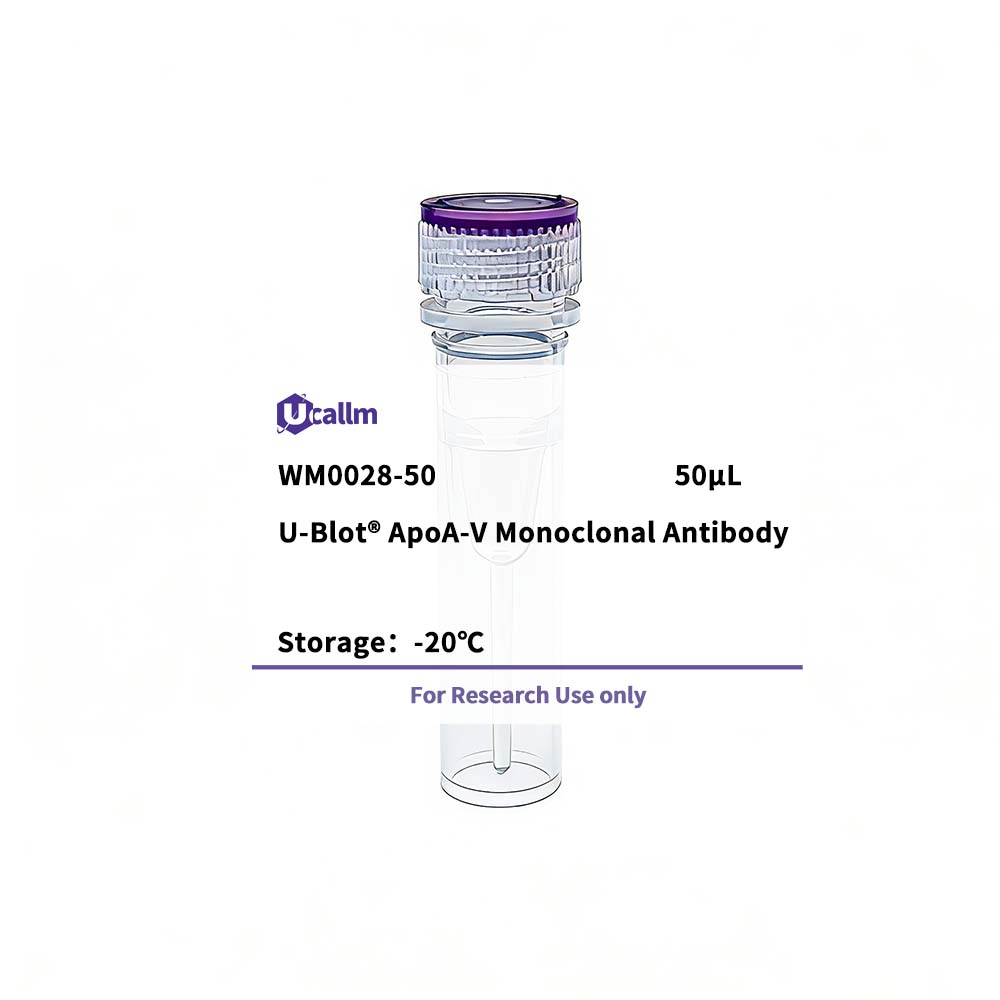
Ucallm_WM0028-50
Price range: $268.00 through $328.00
Product details
Background:
The protein encoded by this gene is an apolipoprotein that plays an important role in regulating the plasma triglyceride levels, a major risk factor for coronary artery disease. It is a component of high density lipoprotein and is highly similar to a rat protein that is upregulated in response to liver injury. Mutations in this gene have been associated with hypertriglyceridemia and hyperlipoproteinemia type 5. This gene is located proximal to the apolipoprotein gene cluster on chromosome 11q23. Alternatively spliced transcript variants encoding the same protein have been identified. [provided by RefSeq, Oct 2009],
Specifications
| Size | 50μL/100μL |
| Target | ApoA-V |
| Reactivity | Human |
| Applications | WB, ELISA |
| MW(Calculated) | 41kD |
| MW(Observed) | |
| Host Species | Mouse |
| Isotype | |
| Conjugate/Modification | Unmodified |
| Recommended Dilution Ratio | WB 1:500-1:2000; ELISA 1:10000; Not yet tested in other applications. |
| Formulation | Liquid in PBS containing 50% glycerol, 0.5% BSA and 0.02% sodium azide. |
| Purification | Affinity purification |
| Storage | -15°C to -25°C/1 year(Do not lower than -25°C) |
| Concentration | |
| Clonality | Monoclonal |
| Clone Number | 10D1 |
| Immunogen | Purified recombinant fragment of human ApoA-V expressed in E. Coli. |
| Specificity | ApoA-V Monoclonal Antibody detects endogenous levels of ApoA-V protein. |
| Gene Name | APOA5 |
| Protein Name | Apolipoprotein A-V |
| Other Name | APOA5; / RAP3; / Apolipoprotein A-V; / Apo-AV; / ApoA-V; / Apolipoprotein A5; / Regeneration-associated protein 3 |
| Species | Human |
| Gene ID | 116519 |
| Uniprot | Q6Q788, |
| Species.1 | Mouse |
| Gene ID.1 | |
| Uniprot.1 | Q8C7G5 |
| Species.2 | |
| Gene ID.2 | |
| Uniprot.2 | |
| Cellular Localization | Secreted . Early endosome . Late endosome . Golgi apparatus, trans-Golgi network . In the presence of SORL1, internalized to early endosomes, sorted in a retrograde fashion to late endosomes, from which a portion is sent to lysosomes and degradation, another portion is sorted to the trans-Golgi network. . |
| Tissue Expression | Liver and plasma. |
| Signaling_pathway | Organismal Systems >> Endocrine system >> PPAR signaling pathway |
| Research Areas | >>PPAR signaling pathway |
| Function | Caution:It is uncertain whether Met-1 or Met-4 is the initiator.,Disease:Defects in APOA5 are a cause of hyperlipoproteinemia type 5 [MIM:144650]. Hyperlipoproteinemia type 5 is characterized by increased amounts of chylomicrons and very low density lipoprotein (VLDL) and decreased low density lipoprotein (LDL) and high density lipoprotein (HDL) in the plasma after a fast. Numerous conditions cause this phenotype, including insulin-dependent diabetes mellitus, contraceptive steroids, alcohol abuse, and glycogen storage disease type 1A (GSD1A) [MIM:232200].,Disease:Defects in APOA5 are a cause of susceptibility to familial hypertriglyceridemia [MIM:145750]. It is a coronary heart disease risk factor. On a regular diet the patient demonstrates increased plasma VLDL. Plasma triglycerides are persistently increased, while plasma cholesterol and phospholipids are usually within normal limits.,Function:Minor apolipoprotein mainly associated with HDL and to a lesser extent with VLDL. May also be associated with chylomicrons. Important determinant of plasma triglyceride (TG) levels by both being a potent stimulator of apo-CII lipoprotein lipase (LPL) TG hydrolysis and a inhibitor of the hepatic VLDL-TG production rate (without affecting the VLDL-apoB production rate) (By similarity). Activates poorly lecithin:cholesterol acyltransferase (LCAT) and does not enhance efflux of cholesterol from macrophages.,induction:Up-regulated by PPARA agonists, which are used clinically to lower serum TG (such as fibrates).,miscellaneous:Induced in early phase of liver regeneration.,polymorphism:Three common alleles are known: allele APOA5*1, APOA5*2 and APOA5*3. The APOA5*2 haplotype, which consists of 3 non-coding SNPs, is present in approximately 16% of Caucasians and is associated with increased plasma triglyceride concentrations. APOA5*3 haplotype is defined by the rare Ser-19-Trp substitution. Together, the APOA5*2 and APOA5*3 haplotypes are found in 25 to 50% of African Americans, Hispanics, and Caucasians.,sequence Caution:Translated as Gln.,similarity:Belongs to the apolipoprotein A1/A4/E family.,subunit:Interacts with GPIHBP1.,tissue specificity:Liver., |
Please login to post questions
Related products





