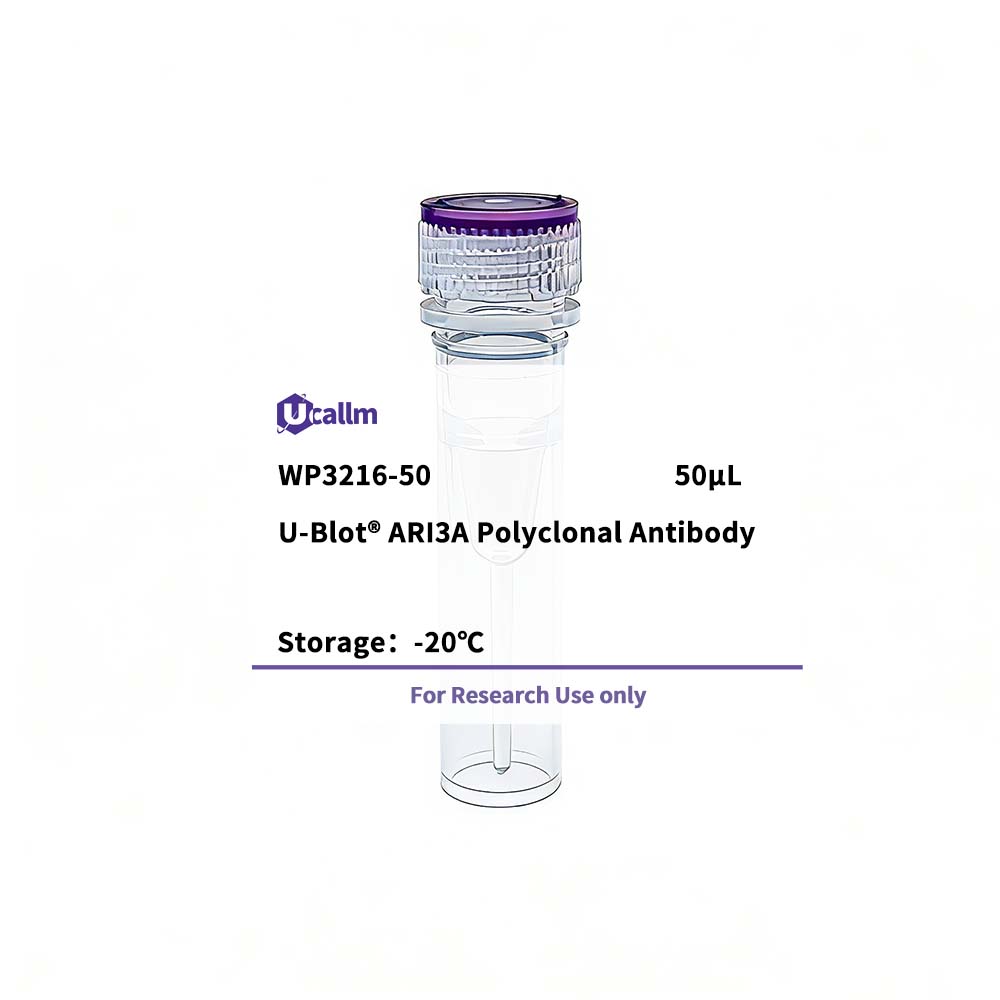
SKU: WP3216 Categories: ,

ARI3A Polyclonal Antibody

Price range: $268.00 through $328.00

SKU: WP3216-100
Enter the quantity you would like, or drag the panel to find the quantity and price that best for you
Bulk QuoteAuthorize OEM & ODM

Product details

Background:

This gene encodes a member of the ARID (AT-rich interaction domain) family of DNA binding proteins. It was found by homology to the Drosophila dead ringer gene, which is important for normal embryogenesis. Other ARID family members have roles in embryonic patterning, cell lineage gene regulation, cell cycle control, transcriptional regulation, and possibly in chromatin structure modification. [provided by RefSeq, Jul 2008],

Specifications

Size50μL/100μL
TargetARI3A
ReactivityHuman, Mouse
ApplicationsWB, ELISA
MW(Calculated)
MW(Observed)65kD
Host SpeciesRabbit
IsotypeIgG
Conjugate/ModificationUnmodified
Recommended Dilution RatioWB 1:500-2000; ELISA 1:5000-20000
FormulationLiquid in PBS containing 50% glycerol,0.5% BSA and 0.02% sodium azide.
PurificationThe antibody was affinity-purified from rabbit antiserum by affinity-chromatography using epitope-specific immunogen.
Storage-15°C to -25°C/1 year(Do not lower than -25°C)
Concentration1 mg/ml
ClonalityPolyclonal
Clone Number
ImmunogenSynthesized peptide derived from part region of human protein AA range: 404-454
SpecificityARI3A Polyclonal Antibody detects endogenous levels of protein.
Gene NameARID3A DRIL1 DRIL3 DRX E2FBP1
Protein NameAT-rich interactive domain-containing protein 3A (ARID domain-containing protein 3A) (B-cell regulator of IgH transcription) (Bright) (Dead ringer-like protein 1) (E2F-binding protein 1)
Other Name
SpeciesHuman
Gene ID1820
UniprotQ99856,
Species.1Mouse
Gene ID.1
Uniprot.1Q62431
Species.2
Gene ID.2
Uniprot.2
Cellular LocalizationNucleus . Cytoplasm . Shuttles between nucleus and cytoplasm.
Tissue ExpressionWidely expressed, with highest expression in skeletal muscle, thalamus, and colon.
Signaling_pathway
Research Areas
FunctionFunction:Transcription factor which may be involved in the control of cell cycle progression by the RB1/E2F1 pathway and in B-cell differentiation.,induction:By TP53 following DNA damage.,similarity:Contains 1 ARID domain.,similarity:Contains 1 NAP (nucleosome assembly protein) domain.,subcellular location:Shuttles between nucleus and cytoplasm.,subunit:Homodimer. Heterodimer with ARID3B. Interacts with E2F1. Interacts with GTF2I and BTK.,tissue specificity:Widely expressed, with highest expression in skeletal muscle, thalamus, and colon.,
Please login to post questions
Back to Top
Product has been added to your cart
