

ASK 1 Polyclonal Antibody
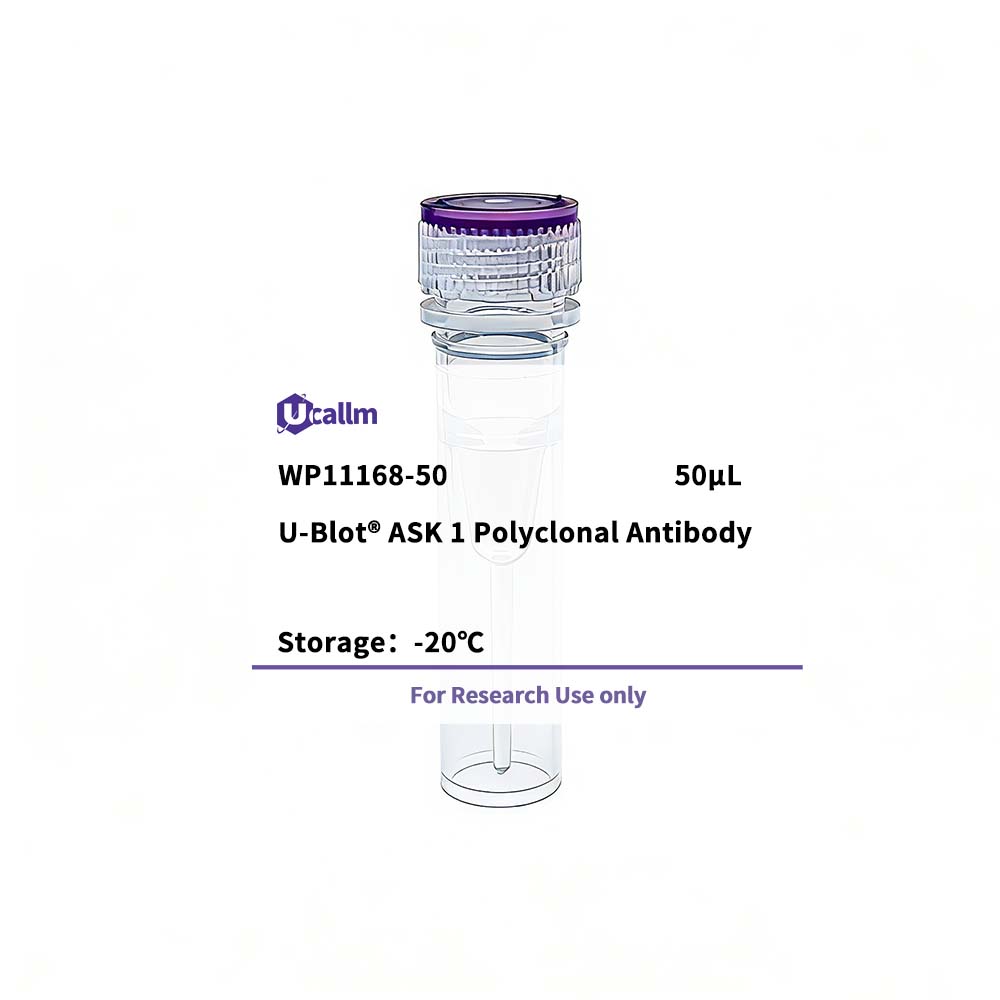
Ucallm_WP11168-50
Price range: $268.00 through $328.00
Product details
Background:
Mitogen-activated protein kinase (MAPK) signaling cascades include MAPK or extracellular signal-regulated kinase (ERK), MAPK kinase (MKK or MEK), and MAPK kinase kinase (MAPKKK or MEKK). MAPKK kinase/MEKK phosphorylates and activates its downstream protein kinase, MAPK kinase/MEK, which in turn activates MAPK. The kinases of these signaling cascades are highly conserved, and homologs exist in yeast, Drosophila, and mammalian cells. MAPKKK5 contains 1, 374 amino acids with all 11 kinase subdomains. Northern blot analysis shows that MAPKKK5 transcript is abundantly expressed in human heart and pancreas. The MAPKKK5 protein phosphorylates and activates MKK4 (aliases SERK1, MAPKK4) in vitro, and activates c-Jun N-terminal kinase (JNK)/stress-activated protein kinase (SAPK) during transient expression in COS and 293 cells; MAPKKK5 does not activate MAPK/ERK. [provided by Re
Specifications
| Size | 50μL/100μL |
| Target | ASK1 |
| Reactivity | Human, Mouse, Rat |
| Applications | WB, IHC, IF, ELISA |
| MW(Calculated) | |
| MW(Observed) | 155kD |
| Host Species | Rabbit |
| Isotype | IgG |
| Conjugate/Modification | Unmodified |
| Recommended Dilution Ratio | WB 1:500-1:2000; IHC 1:100-1:300; ELISA 1:20000; IF 1:50-200 / Note: For IHC, we suggest antigen retrieval with TE buffer pH 9.0 (Cat#WT1004) |
| Formulation | Liquid in PBS containing 50% glycerol, 0.5% BSA and 0.02% sodium azide. |
| Purification | The antibody was affinity-purified from rabbit antiserum by affinity-chromatography using epitope-specific immunogen. |
| Storage | -15°C to -25°C/1 year(Do not lower than -25°C) |
| Concentration | 1 mg/ml |
| Clonality | Polyclonal |
| Clone Number | |
| Immunogen | The antiserum was produced against synthesized peptide derived from human ASK1. AA range:932-981 |
| Specificity | ASK 1 Polyclonal Antibody detects endogenous levels of ASK 1 protein. |
| Gene Name | MAP3K5 |
| Protein Name | Mitogen-activated protein kinase kinase kinase 5 |
| Other Name | MAP3K5; / ASK1; / MAPKKK5; / MEKK5; / Mitogen-activated protein kinase kinase kinase 5; / Apoptosis signal-regulating kinase 1; / ASK-1; / MAPK/ERK kinase kinase 5; / MEK kinase 5; / MEKK 5 |
| Species | Human |
| Gene ID | 4217 |
| Uniprot | Q99683, |
| Species.1 | Mouse |
| Gene ID.1 | 26408 |
| Uniprot.1 | O35099 |
| Species.2 | |
| Gene ID.2 | |
| Uniprot.2 | |
| Cellular Localization | Cytoplasm . Endoplasmic reticulum. Interaction with 14-3-3 proteins alters the distribution of MAP3K5/ASK1 and restricts it to the perinuclear endoplasmic reticulum region. |
| Tissue Expression | Abundantly expressed in heart and pancreas. |
| Signaling_pathway | Cellular Processes >> Cell growth and death >> Apoptosis;Cellular Processes >> Cellular community - eukaryotes >> Tight junction;Organismal Systems >> Nervous system >> Neurotrophin signaling pathway;Human Diseases >> Neurodegenerative disease >> Alzheimer disease;Human Diseases >> Neurodegenerative disease >> Parkinson disease;Human Diseases >> Neurodegenerative disease >> Amyotrophic lateral sclerosis;Human Diseases >> Neurodegenerative disease >> Huntington disease;Human Diseases >> Neurodegenerative disease >> Spinocerebellar ataxia;Human Diseases >> Neurodegenerative disease >> Pathways of neurodegeneration - multiple diseases;Environmental Information Processing >> Signal transduction >> MAPK signaling pathway;Environmental Information Processing >> Signal transduction >> TNF signaling pathway;Environmental Information Processing >> Signal transduction >> Sphingolipid signaling pathway |
| Research Areas | >>Platinum drug resistance; / >>MAPK signaling pathway; / >>Sphingolipid signaling pathway; / >>Protein processing in endoplasmic reticulum; / >>Apoptosis; / >>Tight junction; / >>TNF signaling pathway; / >>Thermogenesis; / >>Neurotrophin signaling pathway; / >>Non-alcoholic fatty liver disease; / >>Alcoholic liver disease; / >>Alzheimer disease; / >>Parkinson disease; / >>Amyotrophic lateral sclerosis; / >>Huntington disease; / >>Spinocerebellar ataxia; / >>Pathways of neurodegeneration - multiple diseases; / >>Chemical carcinogenesis - reactive oxygen species; / >>Lipid and atherosclerosis; / >>Fluid shear stress and atherosclerosis |
| Function | Catalytic activity:ATP + a protein = ADP + a phosphoprotein.,cofactor:Magnesium.,enzyme regulation:Contains an N-terminal autoinhibitory domain. Activated by phosphorylation at Thr-838, inhibited by phosphorylation at Ser-966 and Ser-1033. Binds to, and stabilizes MAP3K6 and is activated by MAP3K6 by phosphorylation on Thr-838.,Function:Component of a protein kinase signal transduction cascade. Phosphorylates and activates MAP2K4 and MAP2K6, which in turn activate the JNK and p38 MAP kinases, respectively. Overexpression induces apoptotic cell death.,induction:By TNF-alpha. Inhibited by HIV-1 Nef.,similarity:Belongs to the protein kinase superfamily.,similarity:Belongs to the protein kinase superfamily. STE Ser/Thr protein kinase family. MAP kinase kinase kinase subfamily.,similarity:Contains 1 protein kinase domain.,subunit:Homodimer when inactive. Binds both upstream activators and downstream substrates in multimolecular complexes. Associates with and inhibited by HIV-1 Nef. Interacts with DAB2IP and PPM1L.,tissue specificity:Abundantly expressed in heart and pancreas., |
Please login to post questions
Related products



