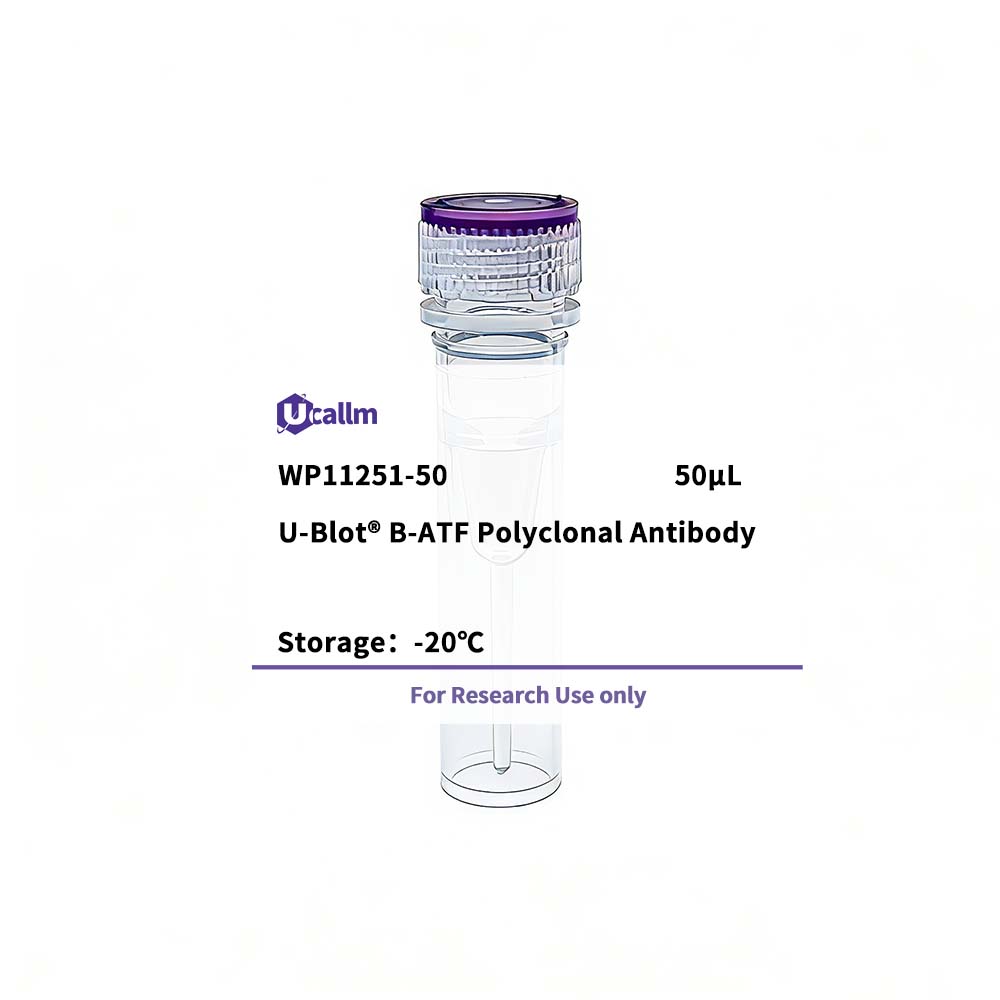
SKU: WP11251 Categories: ,

B-ATF Polyclonal Antibody

Price range: $268.00 through $328.00

SKU: WP11251-100
Enter the quantity you would like, or drag the panel to find the quantity and price that best for you
Bulk QuoteAuthorize OEM & ODM

Product details

Background:

The protein encoded by this gene is a nuclear basic leucine zipper protein that belongs to the AP-1/ATF superfamily of transcription factors. The leucine zipper of this protein mediates dimerization with members of the Jun family of proteins. This protein is thought to be a negative regulator of AP-1/ATF transcriptional events. [provided by RefSeq, Jul 2008],

Specifications

Size50μL/100μL
TargetB-ATF
ReactivityHuman, Mouse
ApplicationsIHC, IF, ELISA
MW(Calculated)14kD
MW(Observed)
Host SpeciesRabbit
IsotypeIgG
Conjugate/ModificationUnmodified
Recommended Dilution RatioIHC 1:100-1:300; ELISA 1:5000; IF 1:50-200 / Note: For IHC, we suggest antigen retrieval with TE buffer pH 9.0 (Cat#WT1004)
FormulationLiquid in PBS containing 50% glycerol, 0.5% BSA and 0.02% sodium azide.
PurificationThe antibody was affinity-purified from rabbit antiserum by affinity-chromatography using epitope-specific immunogen.
Storage-15°C to -25°C/1 year(Do not lower than -25°C)
Concentration1 mg/ml
ClonalityPolyclonal
Clone Number
ImmunogenThe antiserum was produced against synthesized peptide derived from human BATF. AA range:10-59
SpecificityB-ATF Polyclonal Antibody detects endogenous levels of B-ATF protein.
Gene NameBATF
Protein NameBasic leucine zipper transcriptional factor ATF-like
Other NameBATF; / Basic leucine zipper transcriptional factor ATF-like; / B-cell-activating transcription factor; / B-ATF; / SF-HT-activated gene 2 protein; / SFA-2
SpeciesHuman
Gene ID10538
UniprotQ16520,
Species.1Mouse
Gene ID.153314
Uniprot.1O35284
Species.2
Gene ID.2
Uniprot.2
Cellular LocalizationNucleus . Cytoplasm . Present in the nucleus and cytoplasm, but shows increased nuclear translocation after activation of T-cells. .
Tissue ExpressionExpressed at highest levels in lung, and at lower levels in placenta, liver, kidney, spleen, and peripheral blood. Detected in SW480 colorectal cancer cell line and several hematopoietic tumor cell lines, including Raji Burkitt's lymphoma. Strongly expressed in mature B- and T-lymphocytes. Also expressed in moderate levels in lymph node and appendix and at low levels in thymus and bone marrow (PubMed:10777209).
Signaling_pathwayHuman Diseases >> Cancer: overview >> PD-L1 expression and PD-1 checkpoint pathway in cancer
Research Areas>>PD-L1 expression and PD-1 checkpoint pathway in cancer
FunctionFunction:Functions as a negative regulator of AP-1 mediated transcription by binding to Jun proteins. Jun/B-ATF heterodimers bind DNA preferentially at the 12-O-tetradecanoylphorbol-13-acetate response element (TRE) (consensus: 5'-TGA[CG]TCA-3') and weaker at the cAMP-responsive region (CRE) (consensus: 5'-GTGACGT[AC][AG]-3'), but are transcriptionally inert.,PTM:Phosphorylated.,similarity:Belongs to the bZIP family.,similarity:Contains 1 bZIP domain.,subunit:Forms heterodimers with JUN, JUNB and JUND. Also interacts with IFI35.,tissue specificity:Expressed at highest levels in lung, and at lower levels in placenta, liver, kidney, spleen, and peripheral blood. Detected in SW480 colorectal cancer cell line and several hematopoietic tumor cell lines, including Raji Burkitt's lymphoma. Strongly expressed in mature B- and T-lymphocytes. According to PubMed:10777209 also expressed in moderate levels in lymph node and appendix and at low levels in thymus and bone marrow.,
Please login to post questions
Back to Top
Product has been added to your cart
