

BMPER Polyclonal Antibody
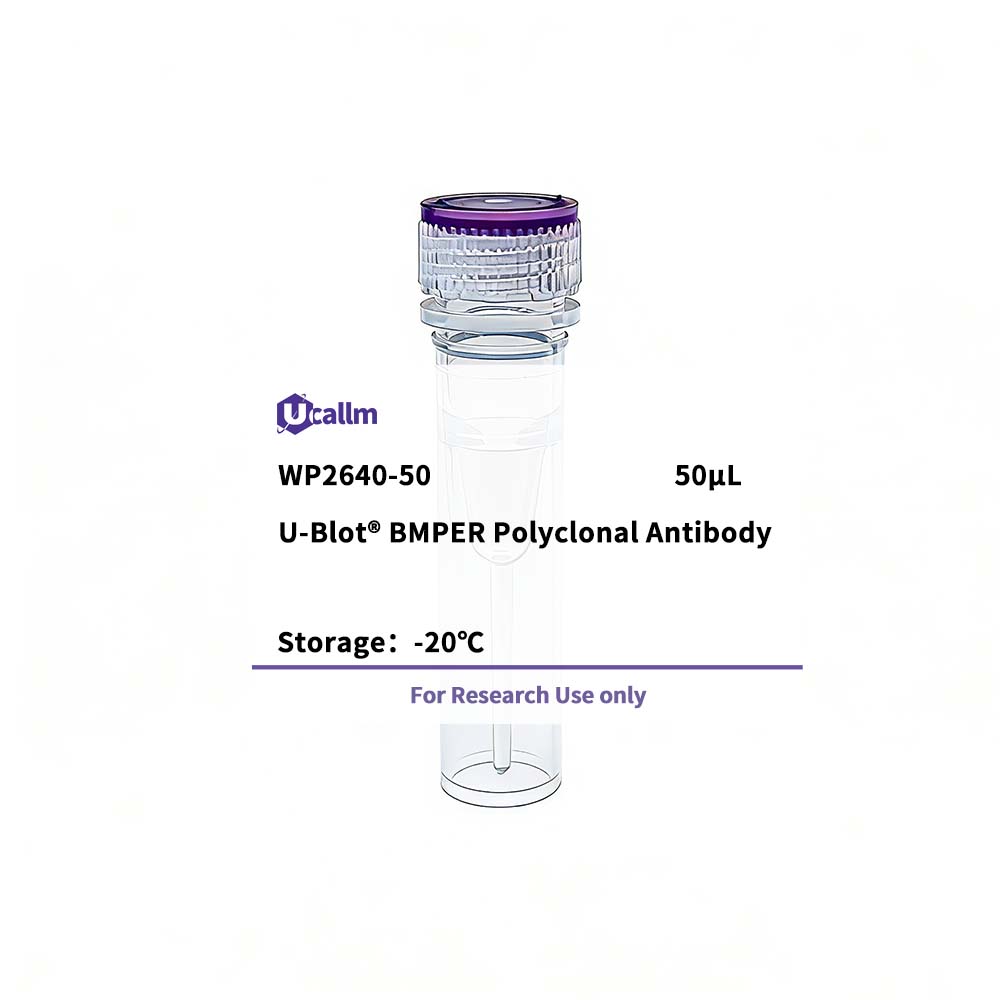
Ucallm_WP2640-50
Price range: $268.00 through $328.00
Product details
Background:
This gene encodes a secreted protein that interacts with, and inhibits bone morphogenetic protein (BMP) function. It has been shown to inhibit BMP2- and BMP4-dependent osteoblast differentiation and BMP-dependent differentiation of the chondrogenic cells. Mutations in this gene are associated with a lethal skeletal disorder, diaphanospondylodysostosis. [provided by RefSeq, Dec 2011],
Specifications
| Size | 50μL/100μL |
| Target | BMPER |
| Reactivity | Human, Mouse |
| Applications | WB, ELISA |
| MW(Calculated) | |
| MW(Observed) | 75kD |
| Host Species | Rabbit |
| Isotype | IgG |
| Conjugate/Modification | Unmodified |
| Recommended Dilution Ratio | WB 1:500-2000; ELISA 1:5000-20000 |
| Formulation | Liquid in PBS containing 50% glycerol,0.5% BSA and 0.02% sodium azide. |
| Purification | The antibody was affinity-purified from rabbit antiserum by affinity-chromatography using epitope-specific immunogen. |
| Storage | -15°C to -25°C/1 year(Do not lower than -25°C) |
| Concentration | 1 mg/ml |
| Clonality | Polyclonal |
| Clone Number | |
| Immunogen | Synthesized peptide derived from human protein . at AA range: 440-520 |
| Specificity | BMPER Polyclonal Antibody detects endogenous levels of protein. |
| Gene Name | BMPER KIAA1965 |
| Protein Name | BMP-binding endothelial regulator protein (Bone morphogenetic protein-binding endothelial cell precursor-derived regulator) (Protein crossveinless-2) (hCV2) |
| Other Name | |
| Species | Human |
| Gene ID | 168667 |
| Uniprot | Q8N8U9, |
| Species.1 | Mouse |
| Gene ID.1 | |
| Uniprot.1 | Q8CJ69 |
| Species.2 | |
| Gene ID.2 | |
| Uniprot.2 | |
| Cellular Localization | Secreted . |
| Tissue Expression | Highly expressed in lung, and brain and also in primary chondrocytes. |
| Signaling_pathway | |
| Research Areas | |
| Function | Function:Inhibitor of bone morphogenetic protein (BMP) function, it may regulate BMP responsiveness of osteoblasts and chondrocytes.,similarity:Contains 1 TIL (trypsin inhibitory-like) domain.,similarity:Contains 1 VWFD domain.,similarity:Contains 5 VWFC domains.,subunit:Interacts with BMP4.,tissue specificity:Highly expressed in lung, and brain and also in primary chondrocytes., |
Please login to post questions
Related products





