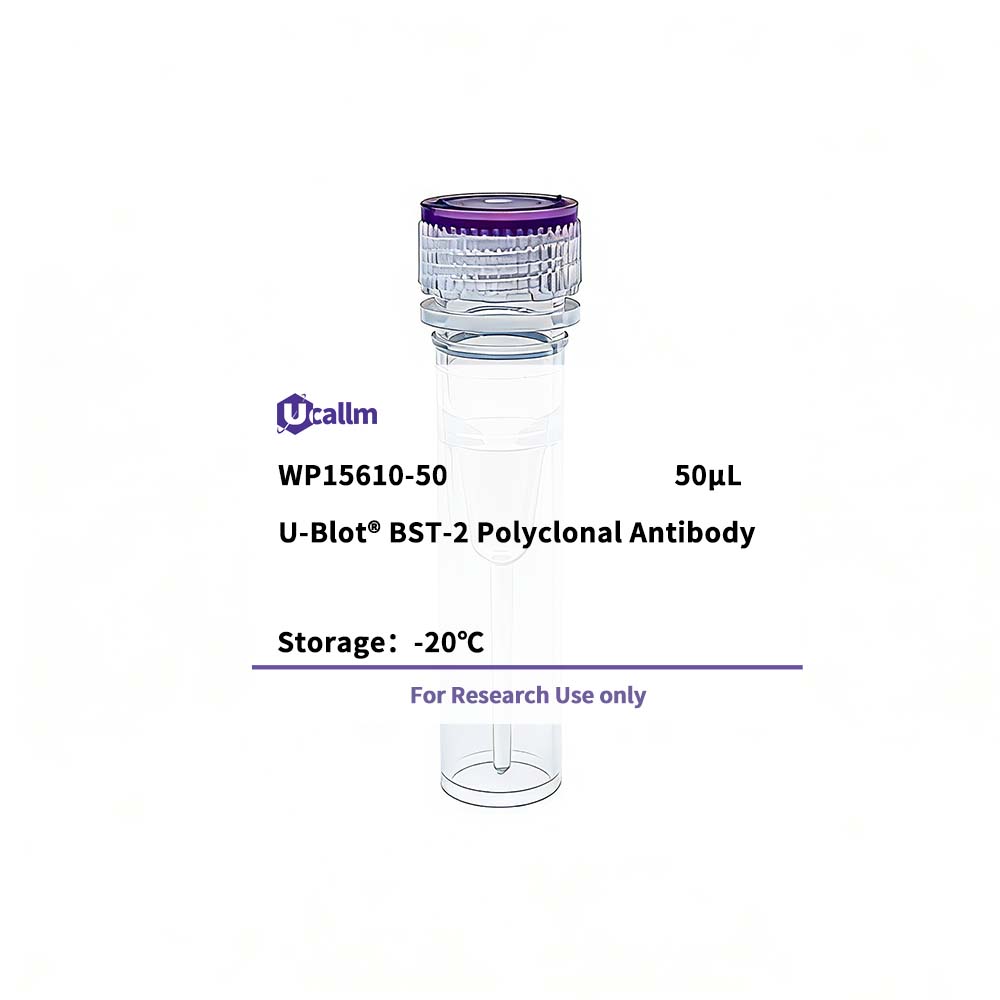
SKU: WP15610 Categories: ,

BST-2 Polyclonal Antibody

Price range: $268.00 through $328.00

SKU: WP15610-100
Enter the quantity you would like, or drag the panel to find the quantity and price that best for you
Bulk QuoteAuthorize OEM & ODM

Product details

Background:

Bone marrow stromal cells are involved in the growth and development of B-cells. The specific function of the protein encoded by the bone marrow stromal cell antigen 2 is undetermined; however, this protein may play a role in pre-B-cell growth and in rheumatoid arthritis. [provided by RefSeq, Jul 2008],

Specifications

Size50μL/100μL
TargetBST-2
ReactivityHuman, Mouse, Rat
ApplicationsWB, IHC, IF, ELISA
MW(Calculated)
MW(Observed)20kD
Host SpeciesRabbit
IsotypeIgG
Conjugate/ModificationUnmodified
Recommended Dilution RatioWB 1:500-1:2000; IHC: 1:100-1:300; ELISA 1:10000; IF 1:50-200 / Note: For IHC, we suggest antigen retrieval with TE buffer pH 9.0 (Cat#WT1004)
FormulationLiquid in PBS containing 50% glycerol, 0.5% BSA and 0.02% sodium azide.
PurificationThe antibody was affinity-purified from rabbit antiserum by affinity-chromatography using epitope-specific immunogen.
Storage-15°C to -25°C/1 year(Do not lower than -25°C)
Concentration1 mg/ml
ClonalityPolyclonal
Clone Number
ImmunogenThe antiserum was produced against synthesized peptide derived from the Internal region of human BST2. AA range:101-150
SpecificityBST-2 Polyclonal Antibody detects endogenous levels of BST-2 protein.
Gene NameBST2
Protein NameBone marrow stromal antigen 2
Other NameBST2; / Bone marrow stromal antigen 2; / BST-2; / HM1.24 antigen; / Tetherin; / CD317
SpeciesHuman
Gene ID684
UniprotQ10589,
Species.1Mouse
Gene ID.1
Uniprot.1Q8R2Q8
Species.2
Gene ID.2
Uniprot.2
Cellular LocalizationGolgi apparatus, trans-Golgi network. Cell membrane; Single-pass type II membrane protein. Cell membrane; Lipid-anchor, GPI-anchor . Membrane raft. Cytoplasm. Apical cell membrane . Shuttles between the cell membrane, where it is present predominantly in membrane/lipid rafts, and the trans-Golgi network. Forms a complex with MMP14 and localizes to the cytoplasm.; Golgi apparatus, trans-Golgi network . Late endosome . (Microbial infection) HIV-1 VPU and HIV-2 ENV can target it to the trans-Golgi network thus sequestering it away from virus assembly sites on the cell membrane. Targeted to late endosomes upon KSHV infection and subsequent ubiquitination. .
Tissue ExpressionPredominantly expressed in liver, lung, heart and placenta. Lower levels in pancreas, kidney, skeletal muscle and brain. Overexpressed in multiple myeloma cells. Highly expressed during B-cell development, from pro-B precursors to plasma cells. Highly expressed on T-cells, monocytes, NK cells and dendritic cells (at protein level).
Signaling_pathway
Research Areas>>Viral life cycle - HIV-1; / >>Herpes simplex virus 1 infection; / >>Human immunodeficiency virus 1 infection
FunctionDisease:May play a role in B-cell activation in rheumatoid arthritis (RA).,Function:May be involved in the sorting of secreted proteins (By similarity). May be involved in pre-B-cell growth. Antiretroviral defense protein, that blocks release of retrovirus from the cell surface. Depleted unpon HIV-1 infection by viral VPU protein through 20S proteasome degradation.,induction:During B-cell activation (at protein level), or by interferon alpha as part of entiviral state cellular program.,subunit:Homodimer.,tissue specificity:Predominantly expressed in liver, lung, heart and placenta. Lower levels in pancreas, kidney, skeletal muscle and brain. Overexpressed in multiple myeloma cells. Highly expressed during B-cell development, from pro-B precursors to plasma cells. Highy expressed on T-cells, monocytes, NK cells and dendritic cells (at protein level).,
Please login to post questions
Back to Top
Product has been added to your cart
