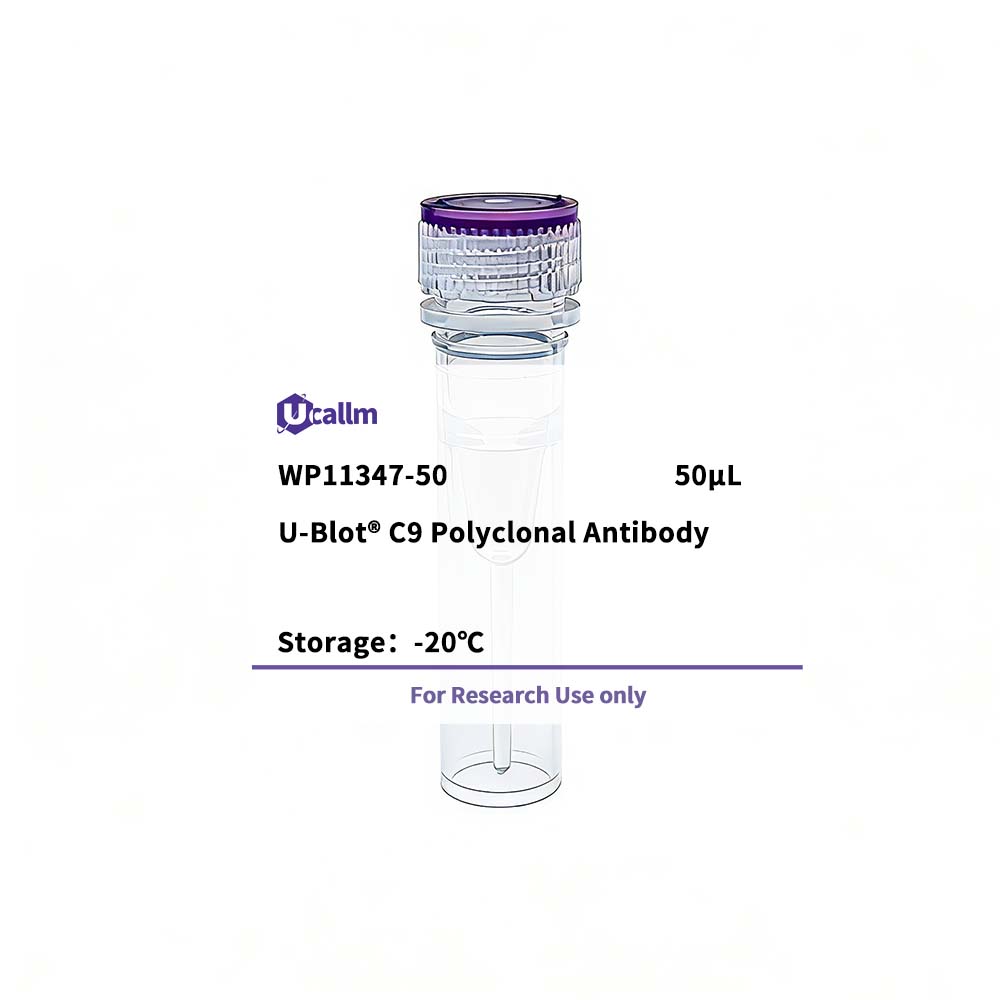
SKU: WP11347 Categories: ,

C9 Polyclonal Antibody

Price range: $268.00 through $328.00

SKU: WP11347-100
Enter the quantity you would like, or drag the panel to find the quantity and price that best for you
Bulk QuoteAuthorize OEM & ODM

Product details

Background:

This gene encodes the final component of the complement system. It participates in the formation of the Membrane Attack Complex (MAC). The MAC assembles on bacterial membranes to form a pore, permitting disruption of bacterial membrane organization. Mutations in this gene cause component C9 deficiency. [provided by RefSeq, Feb 2009],

Specifications

Size50μL/100μL
TargetC9
ReactivityHuman, Mouse, Rat
ApplicationsWB, ELISA
MW(Calculated)
MW(Observed)70kD
Host SpeciesRabbit
IsotypeIgG
Conjugate/ModificationUnmodified
Recommended Dilution RatioWB 1:500-1:2000; ELISA 1:40000; Not yet tested in other applications.
FormulationLiquid in PBS containing 50% glycerol, 0.5% BSA and 0.02% sodium azide.
PurificationThe antibody was affinity-purified from rabbit antiserum by affinity-chromatography using epitope-specific immunogen.
Storage-15°C to -25°C/1 year(Do not lower than -25°C)
Concentration1 mg/ml
ClonalityPolyclonal
Clone Number
ImmunogenThe antiserum was produced against synthesized peptide derived from human C9. AA range:181-230
SpecificityC9 Polyclonal Antibody detects endogenous levels of C9 protein.
Gene NameC9
Protein NameComplement component C9
Other NameC9; / Complement component C9
SpeciesHuman
Gene ID735
UniprotP02748,
Species.1Mouse
Gene ID.1
Uniprot.1P06683
Species.2
Gene ID.2
Uniprot.2
Cellular LocalizationSecreted . Target cell membrane; Multi-pass membrane protein . Secreted as soluble monomer. Oligomerizes at target membranes, forming a pre-pore. A conformation change then leads to the formation of a 100 Angstrom diameter pore. .
Tissue ExpressionPlasma (at protein level).
Signaling_pathwayCellular Processes >> Cell motility >> Regulation of actin cytoskeleton;Organismal Systems >> Immune system >> Complement and coagulation cascades;Human Diseases >> Immune disease >> Systemic lupus erythematosus;Human Diseases >> Neurodegenerative disease >> Prion disease
Research Areas>>Complement and coagulation cascades; / >>Prion disease; / >>Amoebiasis; / >>Coronavirus disease - COVID-19; / >>Systemic lupus erythematosus
FunctionDisease:Defects in C9 are a cause of component C9 deficiency (C9D) [MIM:120940]. Patients with C9D suffer from recurrent bacterial infections, predominantly from Neisseria meningitidis.,Function:C9 is the final component of the complement system to be added in the assembly of the membrane attack complex. It is able to enter lipid bilayers, forming transmembrane channels.,online information:C9 mutation db,PTM:Thrombin cleaves factor C9 to produce C9a and C9b.,similarity:Belongs to the complement C6/C7/C8/C9 family.,similarity:Contains 1 EGF-like domain.,similarity:Contains 1 LDL-receptor class A domain.,similarity:Contains 1 MACPF domain.,similarity:Contains 1 TSP type-1 domain.,
Please login to post questions
Back to Top
Product has been added to your cart