


U-Blot® CD36 Rabbit mAb
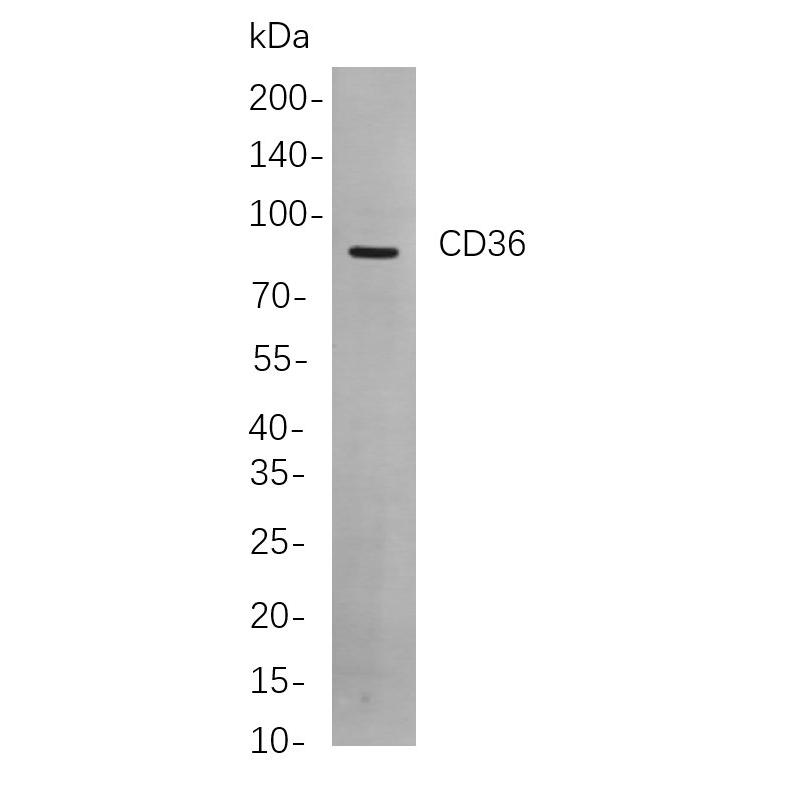
WR4248 Western blot analysis of lysates from Mouse spleen cells, using CD36 Rabbit mAb. The HRP-conjugated Goat anti-Rabbit IgG antibody (WS0002) was used to detect the antibody.
Price range: $268.00 through $328.00
Product details
Background:The protein encoded by this gene is the fourth major glycoprotein of the platelet surface and serves as a receptor for thrombospondin in platelets and various cell lines. Since thrombospondins are widely distributed proteins involved in a variety of adhesive processes, this protein may have important functions as a cell adhesion molecule. It binds to collagen, thrombospondin, anionic phospholipids and oxidized LDL. It directly mediates cytoadherence of Plasmodium falciparum parasitized erythrocytes and it binds long chain fatty acids and may function in the transport and/or as a regulator of fatty acid transport. Mutations in this gene cause platelet glycoprotein deficiency. Multiple alternatively spliced transcript variants have been found for this gene. [provided by RefSeq, Feb 2014],
Specifications
| Size | 50μL/100μL |
| Target | CD36 |
| Reactivity | Human, Mouse, Rat, Tilapia |
| Applications | WB, IHC, IF, ELISA |
| MW(Calculated) | 53kD |
| MW(Observed) | 90kD |
| Host Species | Rabbit |
| Isotype | IgG,Kappa |
| Conjugate/Modification | Unmodified |
| Recommended Dilution Ratio | IHC 1:1000-1:4000; WB 1:1000-1:5000; IF 1:200-1:1000; ELISA 1:5000-1:20000; / Note: For IHC, we suggest antigen retrieval with TE buffer pH 9.0 (Cat#WT1004) |
| Formulation | PBS, 50% glycerol, 0.05% Proclin 300, 0.05%BSA |
| Purification | Recombinant Antibody expressed in animal component-free (ACF) media, purified via Protein A affinity chromatography. |
| Storage | -15°C to -25°C/1 year(Do not lower than -25°C) |
| Concentration | |
| Clonality | Monoclonal |
| Clone Number | RM0434R |
| Immunogen | The specific immunogen used to produce this antibody is proprietary information. |
| Specificity | Endogenous |
| Gene Name | CD36 |
| Protein Name | Platelet glycoprotein 4 |
| Other Name | CD36; / GP3B; / GP4; / Platelet glycoprotein 4; / Fatty acid translocase; / FAT; / Glycoprotein IIIb; / GPIIIB; / Leukocyte differentiation antigen CD36; / PAS IV; / PAS-4; / Platelet collagen receptor; / Platelet glycoprotein IV; / GPIV; / Thrombospondin receptor; / CD36 |
| Species | Human |
| Gene ID | 948 |
| Uniprot | P16671, |
| Species.1 | Mouse |
| Gene ID.1 | 12491 |
| Uniprot.1 | Q08857, |
| Species.2 | Rat |
| Gene ID.2 | |
| Uniprot.2 | Q07969 |
| Cellular Localization | Membrane |
| Tissue Expression | Adipocyte,Liver,Mammary gland,Milk,Placenta,Platelet,Skeletal muscle, |
| Signaling_pathway | Cellular Processes >> Transport and catabolism >> Phagosome;Organismal Systems >> Immune system >> Hematopoietic cell lineage;Organismal Systems >> Endocrine system >> Adipocytokine signaling pathway;Organismal Systems >> Endocrine system >> PPAR signaling pathway;Environmental Information Processing >> Signal transduction >> AMPK signaling pathway;Environmental Information Processing >> Signaling molecules and interaction >> ECM-receptor interaction |
| Research Areas | >>PPAR signaling pathway; / >>Phagosome; / >>AMPK signaling pathway; / >>ECM-receptor interaction; / >>Hematopoietic cell lineage; / >>Adipocytokine signaling pathway; / >>Insulin resistance; / >>Fat digestion and absorption; / >>Cholesterol metabolism; / >>Malaria; / >>Diabetic cardiomyopathy; / >>Lipid and atherosclerosis |
| Function | Disease:Defects in CD36 are the cause of platelet glycoprotein IV deficiency [MIM:608404]; also known as CD36 deficiency. Platelet glycoprotein IV deficiency can be divided into 2 subgroups. The type I phenotype is characterized by platelets and monocytes/macrophages exhibiting complete CD36 deficiency. The type II phenotype lacks the surface expression of CD36 in platelets, but expression in monocytes/macrophages is near normal.,Disease:Genetic variations in CD36 are associated with susceptibility to coronary heart disease type 7 (CHDS7) [MIM:610938].,Function:Seems to have numerous potential physiological functions. Binds to collagen, thrombospondin, anionic phospholipids and oxidized LDL. May function as a cell adhesion molecule. Directly mediates cytoadherence of Plasmodium falciparum parasitized erythrocytes. Binds long chain fatty acids and may function in the transport and/or as a regulator of fatty acid transport.,online information:CD36 entry,polymorphism:Genetic variation in CD36 influences the severity and outcome of malaria infection.,PTM:N-glycosylated and O-glycosylated with a ratio of 2:1.,similarity:Belongs to the CD36 family., |
Please login to post questions
Related products




