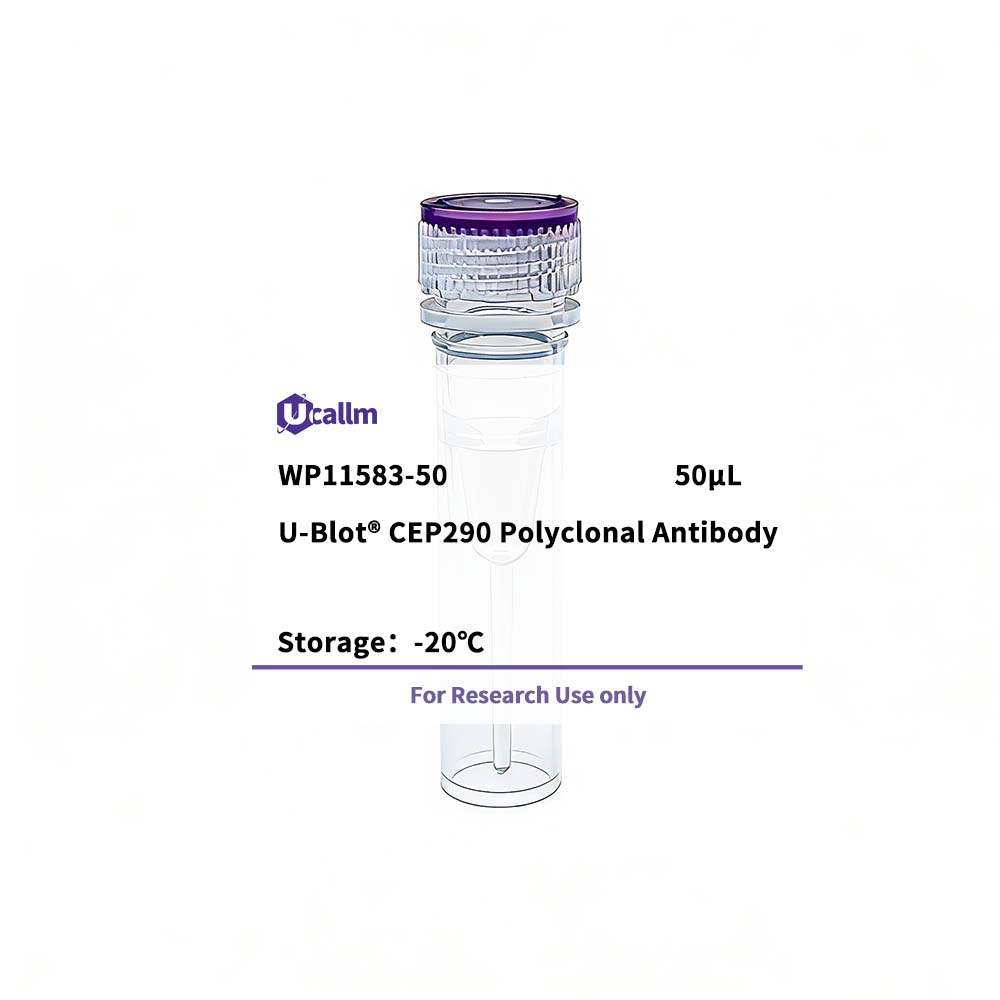
SKU: WP11583 Categories: ,

CEP290 Polyclonal Antibody

Price range: $268.00 through $328.00

SKU: WP11583-100
Enter the quantity you would like, or drag the panel to find the quantity and price that best for you
Bulk QuoteAuthorize OEM & ODM

Product details

Background:

centrosomal protein 290(CEP290) Homo sapiens This gene encodes a protein with 13 putative coiled-coil domains, a region with homology to SMC chromosome segregation ATPases, six KID motifs, three tropomyosin homology domains and an ATP/GTP binding site motif A. The protein is localized to the centrosome and cilia and has sites for N-glycosylation, tyrosine sulfation, phosphorylation, N-myristoylation, and amidation. Mutations in this gene have been associated with Joubert syndrome and nephronophthisis and the presence of antibodies against this protein is associated with several forms of cancer. [provided by RefSeq, Jul 2008],

Specifications

Size50μL/100μL
TargetCEP290
ReactivityHuman, Mouse
ApplicationsWB, ELISA
MW(Calculated)
MW(Observed)290kD
Host SpeciesRabbit
IsotypeIgG
Conjugate/ModificationUnmodified
Recommended Dilution RatioWB 1:500-1:2000; ELISA 1:20000; Not yet tested in other applications.
FormulationLiquid in PBS containing 50% glycerol, 0.5% BSA and 0.02% sodium azide.
PurificationThe antibody was affinity-purified from rabbit antiserum by affinity-chromatography using epitope-specific immunogen.
Storage-15°C to -25°C/1 year(Do not lower than -25°C)
Concentration1 mg/ml
ClonalityPolyclonal
Clone Number
ImmunogenThe antiserum was produced against synthesized peptide derived from human CEP290. AA range:771-820
SpecificityCEP290 Polyclonal Antibody detects endogenous levels of CEP290 protein.
Gene NameCEP290
Protein NameCentrosomal protein of 290 kDa
Other NameCEP290; / BBS14; / KIAA0373; / NPHP6; / Centrosomal protein of 290 kDa; / Cep290; / Bardet-Biedl syndrome 14 protein; / Cancer/testis antigen 87; / CT87; / Nephrocystin-6; / Tumor antigen se2-2
SpeciesHuman
Gene ID80184
UniprotO15078,
Species.1Mouse
Gene ID.1216274
Uniprot.1Q6A078
Species.2
Gene ID.2
Uniprot.2
Cellular LocalizationCytoplasm, cytoskeleton, microtubule organizing center, centrosome . Cytoplasm, cytoskeleton, microtubule organizing center, centrosome, centriolar satellite . Nucleus . Cell projection, cilium . Cytoplasm, cytoskeleton, cilium basal body . Cytoplasm, cytoskeleton, microtubule organizing center, centrosome, centriole . Cytoplasmic vesicle . Displaced from centriolar satellites in response to cellular stress, such as ultraviolet light (UV) radiation or heat shock (PubMed:24121310). Found in the connecting cilium of photoreceptor cells, base of cilium in kidney intramedullary collecting duct cells (By similarity). Localizes at the transition zone, a region between the basal body and the ciliary axoneme (PubMed:23943788). Localization at the ciliary transition zone as well as at centriolar satellites is BBsome-dependent (PubMed:23943788). .
Tissue ExpressionUbiquitous. Expressed strongly in placenta and weakly in brain.
Signaling_pathway
Research Areas
FunctionDisease:Antibodies against CEP290 are present in sera from patients with cutaneous T-cell lymphomas, but not in the healthy control population.,Disease:Defects in CEP290 are a cause of Joubert syndrome type 5 (JBTS5) [MIM:610188]. Joubert syndrome is an autosomal recessive disease characterized by cerebellar vermis hypoplasia with prominent superior cerebellar peduncles (the 'molar tooth sign' on axial magnetic resonance imaging), psychomotor delay, hypotonia, ataxia, oculomotor apraxia and neonatal breathing abnormalities. JBTS5 shares the neurologic and neuroradiologic features of Joubert syndrome together with severe retinal dystrophy and/or progressive renal failure characterized by nephronophthisis.,Disease:Defects in CEP290 are a cause of Senior-Loken syndrome type 6 (SLSN6) [MIM:610189]. Senior-Loken syndrome is also known as juvenile nephronophthisis with Leber amaurosis. It is an autosomal recessive renal-retinal disorder, characterized by progressive wasting of the filtering unit of the kidney, with or without medullary cystic renal disease, and progressive eye disease.,Disease:Defects in CEP290 are the cause of Leber congenital amaurosis type 10 (LCA10) [MIM:611755]. LCA designates a clinically and genetically heterogeneous group of childhood retinal degenerations, generally inherited in an autosomal recessive manner. Affected infants have little or no retinal photoreceptor function as tested by electroretinography. LCA represents the most common genetic cause of congenital visual impairment in infants and children.,Disease:Defects in CEP290 are the cause of Meckel syndrome type 4 (MKS4) [MIM:611134]. MKS4 is an autosomal recessive disorder characterized by a combination of renal cysts and variably associated features including developmental anomalies of the central nervous system (typically encephalocele), hepatic ductal dysplasia and cysts, and polydactyly.,Function:Activates ATF4-mediated transcription. Required for the correct localization of ciliary and phototransduction proteins in retinal photoreceptor cells; may play a role in ciliary transport processes.,sequence Caution:Contaminating sequence. Potential poly-A sequence.,subcellular location:Connecting cilium of photoreceptor cells, base of cilium in kidney intramedullary collecting duct cells.,subunit:Interacts with ATF4 via its N-terminal region. Part of selected centrosomal and microtubule-associated protein complexes. Interacts with CC2D2A.,tissue specificity:Ubiquitous. Expressed strongly in placenta and weakly in brain.,
Please login to post questions
Back to Top
Product has been added to your cart
