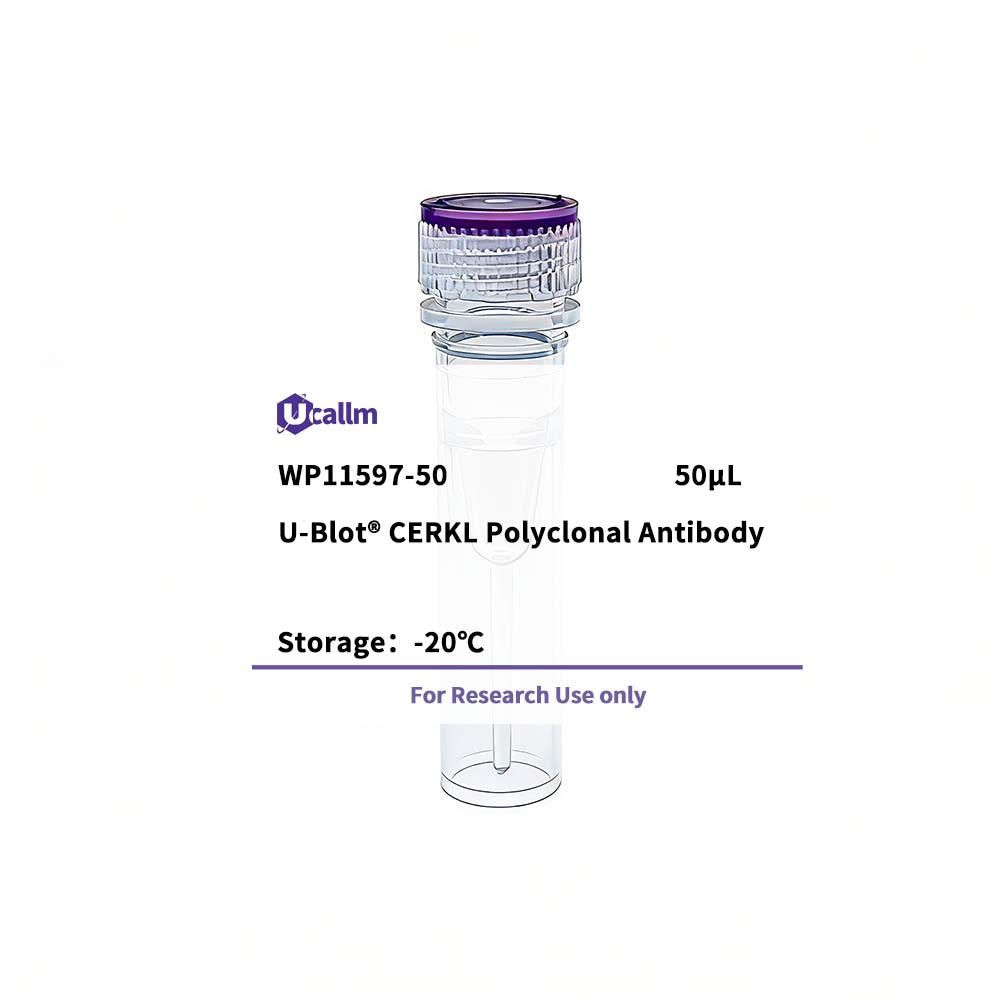
SKU: WP11597 Categories: ,

CERKL Polyclonal Antibody

Price range: $268.00 through $328.00

SKU: WP11597-100
Enter the quantity you would like, or drag the panel to find the quantity and price that best for you
Bulk QuoteAuthorize OEM & ODM

Product details

Background:

This gene was initially identified as a locus (RP26) associated with an autosomal recessive form of retinitis pigmentosa (arRP) disease. This gene encodes a protein with ceramide kinase-like domains, however, the protein does not phosphorylate ceramide and its target substrate is currently unknown. This protein may be a negative regulator of apoptosis in photoreceptor cells. Mutations in this gene cause a form of retinitis pigmentosa characterized by autosomal recessive cone and rod dystrophy (arCRD). Alternative splicing of this gene results in multiple transcript variants encoding different isoforms and non-coding transcripts.[provided by RefSeq, May 2010],

Specifications

Size50μL/100μL
TargetCERKL
ReactivityHuman
ApplicationsWB, IHC, IF, ELISA
MW(Calculated)
MW(Observed)63kD
Host SpeciesRabbit
IsotypeIgG
Conjugate/ModificationUnmodified
Recommended Dilution RatioWB 1:500-1:2000; IHC 1:100-1:300; ELISA 1:20000; IF 1:50-200 / Note: For IHC, we suggest antigen retrieval with TE buffer pH 9.0 (Cat#WT1004)
FormulationLiquid in PBS containing 50% glycerol, 0.5% BSA and 0.02% sodium azide.
PurificationThe antibody was affinity-purified from rabbit antiserum by affinity-chromatography using epitope-specific immunogen.
Storage-15°C to -25°C/1 year(Do not lower than -25°C)
Concentration1 mg/ml
ClonalityPolyclonal
Clone Number
ImmunogenThe antiserum was produced against synthesized peptide derived from human CERKL. AA range:341-390
SpecificityCERKL Polyclonal Antibody detects endogenous levels of CERKL protein.
Gene NameCERKL
Protein NameCeramide kinase-like protein
Other NameCERKL; / Ceramide kinase-like protein
SpeciesHuman
Gene ID375298
UniprotQ49MI3
Species.1
Gene ID.1
Uniprot.1
Species.2
Gene ID.2
Uniprot.2
Cellular LocalizationCytoplasm. Nucleus, nucleolus. Enriched in nucleoli. May shuttle between nucleus and cytoplasm. Isoform 5 is not enriched in the nucleoli.; [Isoform 2]: Cytoplasm. Nucleus, nucleolus. Golgi apparatus, trans-Golgi network. Endoplasmic reticulum.
Tissue ExpressionIsoform 1 and isoform 2 are expressed in adult retina, liver and pancreas as well as in fetal brain, lung and kidney. Isoform 3 is expressed in adult retina as well as in fetal lung and liver. Isoform 4 is expressed in adult retina, lung and kidney as well as in fetal lung and liver. Moderately expressed in retina, kidney, lung, testis, trachea, and pancreas. Weakly expressed in brain, placenta and liver.
Signaling_pathway
Research Areas
Functiondevelopmental stage:Expressed in fetal lung, kidney and brain.,Disease:Defects in CERKL are the cause of retinitis pigmentosa type 26 (RP26) [MIM:608380]. RP leads to degeneration of retinal photoreceptor cells. Patients typically have night vision blindness and loss of midperipheral visual field. As their condition progresses, they lose their far peripheral visual field and eventually central vision as well. RP26 inheritance is autosomal recessive.,Function:Has no detectable ceramide-kinase activity.,PTM:Phosphorylated on serine residues.,sequence Caution:Wrong choice of CDS.,similarity:Contains 1 DAGKc domain.,subcellular location:Enriched in nucleoli. May shuttle between nucleus and cytoplasm. Isoform 5 is not enriched in the nucleoli.,tissue specificity:Moderately expressed in retina, kidney, lung, testis, trachea, and pancreas. Weakly expressed in brain, placenta and liver.,
Please login to post questions
Back to Top
Product has been added to your cart

