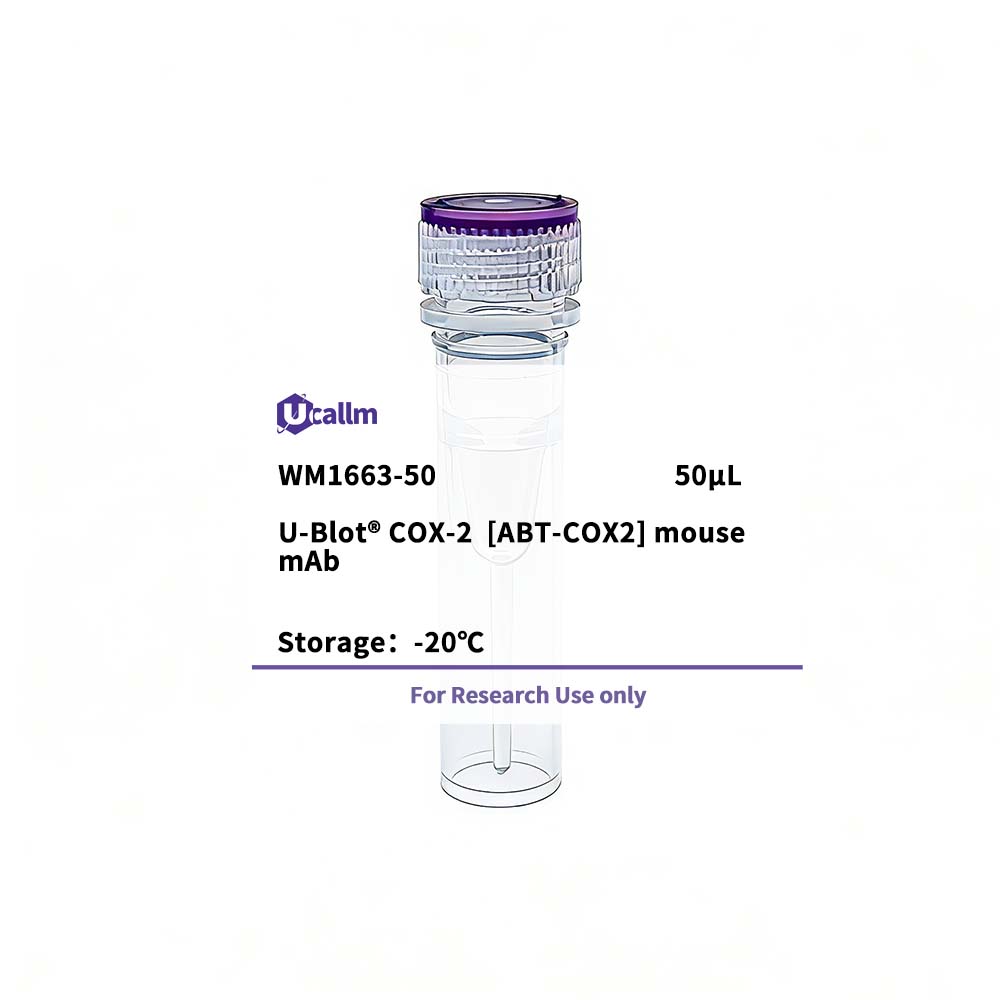
SKU: WM1663 Categories: ,

COX-2 [ABT-COX2] mouse mAb

Price range: $268.00 through $328.00

SKU: WM1663-50
Enter the quantity you would like, or drag the panel to find the quantity and price that best for you
Bulk QuoteAuthorize OEM & ODM

Product details

Background:
Prostaglandin-endoperoxide synthase (PTGS), also known as cyclooxygenase, is the key enzyme in prostaglandin biosynthesis, and acts both as a dioxygenase and as a peroxidase. There are two isozymes of PTGS: a constitutive PTGS1 and an inducible PTGS2, which differ in their regulation of expression and tissue distribution. This gene encodes the inducible isozyme. It is regulated by specific stimulatory events, suggesting that it is responsible for the prostanoid biosynthesis involved in inflammation and mitogenesis. [provided by RefSeq, Feb 2009],

Specifications

Size50μL/100μL
TargetCOX2
ReactivityHuman
ApplicationsIHC, ELISA
MW(Calculated)69kD
MW(Observed)70kD
Host SpeciesMouse
IsotypeIgG2b,Kappa
Conjugate/ModificationUnmodified
Recommended Dilution RatioIHC 1:200-400; ELISA 1:500-5000 / Note: For IHC, we suggest antigen retrieval with TE buffer pH 9.0 (Cat#WT1004)
FormulationPBS, 50% glycerol, 0.05% Proclin 300, 0.05%BSA
PurificationThe antibody was affinity-purified from ascites by affinity-chromatography using specific immunogen.
Storage-15°C to -25°C/1 year(Do not lower than -25°C)
Concentration
ClonalityMonoclonal
Clone NumberRMM-COX2
ImmunogenSynthesized peptide derived from human COX-2 (cyclooxygenase-2) AA range: 500-604
SpecificityThe antibody can specifically recognize human COX-2 protein.
Gene NamePTGS2 COX2
Protein NameProstaglandin G/H synthase 2 (Cyclooxygenase-2) (COX-2) (PHS II) (Prostaglandin H2 synthase 2) (PGH synthase 2) (PGHS-2) (Prostaglandin-endoperoxide synthase 2)
Other Name
SpeciesHuman
Gene ID5743
UniprotP35354
Species.1
Gene ID.1
Uniprot.1
Species.2
Gene ID.2
Uniprot.2
Cellular LocalizationCytoplasmic
Tissue ExpressionEndothelial cell,Epidermal keratinocytes in primary culture,Lung,Pe
Signaling_pathwayOrganismal Systems >> Immune system >> IL-17 signaling pathway;Organismal Systems >> Endocrine system >> Oxytocin signaling pathway;Human Diseases >> Cancer: overview >> Pathways in cancer;Human Diseases >> Cancer: overview >> MicroRNAs in cancer;Human Diseases >> Cancer: specific types >> Small cell lung cancer;Human Diseases >> Neurodegenerative disease >> Alzheimer disease;Human Diseases >> Neurodegenerative disease >> Pathways of neurodegeneration - multiple diseases;Environmental Information Processing >> Signal transduction >> VEGF signaling pathway;Environmental Information Processing >> Signal transduction >> NF-kappa B signaling pathway;Environmental Information Processing >> Signal transduction >> TNF signaling pathway
Research Areas>>Arachidonic acid metabolism; / >>Metabolic pathways; / >>NF-kappa B signaling pathway; / >>VEGF signaling pathway; / >>C-type lectin receptor signaling pathway; / >>IL-17 signaling pathway; / >>TNF signaling pathway; / >>Retrograde endocannabinoid signaling; / >>Serotonergic synapse; / >>Ovarian steroidogenesis; / >>Oxytocin signaling pathway; / >>Regulation of lipolysis in adipocytes; / >>Alzheimer disease; / >>Pathways of neurodegeneration - multiple diseases; / >>Leishmaniasis; / >>Human cytomegalovirus infection; / >>Human papillomavirus infection; / >>Kaposi sarcoma-associated herpesvirus infection; / >>Pathways in cancer; / >>Chemical carcinogenesis - DNA adducts; / >>MicroRNAs in cancer; / >>Small cell lung cancer
FunctionCatalytic activity:Arachidonate + AH(2) + 2 O(2) = prostaglandin H(2) + A + H(2)O.,cofactor:Binds 1 heme B (iron-protoporphyrin IX) group per subunit.,Disease:Likely to play a role in inflammatory diseases such as rheumatoid arthritis.,Function:May have a role as a major mediator of inflammation and/or a role for prostanoid signaling in activity-dependent plasticity.,induction:By cytokines and mitogens.,miscellaneous:This enzyme acts both as a dioxygenase and as a peroxidase.,miscellaneous:This enzyme is the target of nonsteroidal anti-inflammatory drugs such as aspirin.,pathway:Lipid metabolism; prostaglandin biosynthesis.,similarity:Belongs to the prostaglandin G/H synthase family.,similarity:Contains 1 EGF-like domain.,subunit:Homodimer.,
Please login to post questions
Back to Top
Product has been added to your cart
