


CXCR-3 Polyclonal Antibody
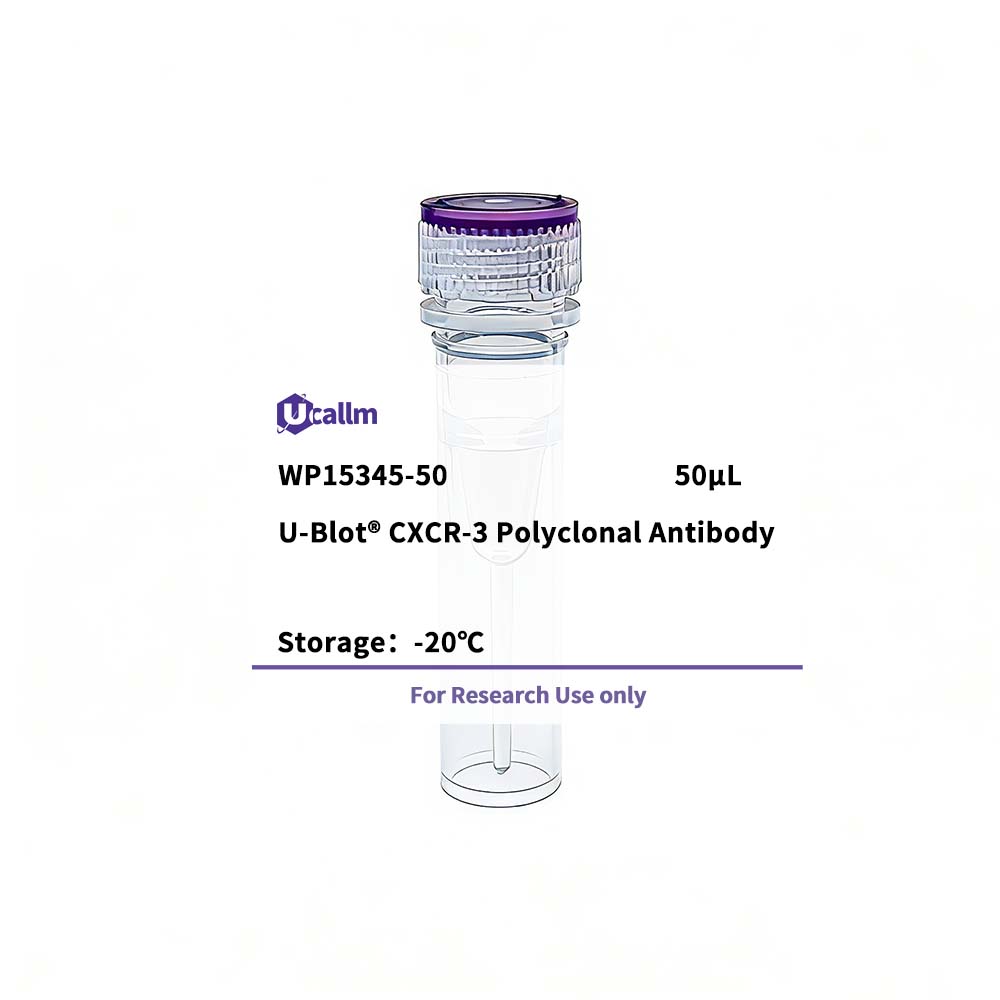
Ucallm_WP15345-50
Price range: $268.00 through $328.00
Product details
Background:
C-X-C motif chemokine receptor 3(CXCR3) Homo sapiens This gene encodes a G protein-coupled receptor with selectivity for three chemokines, termed CXCL9/Mig (monokine induced by interferon-g), CXCL10/IP10 (interferon-g-inducible 10 kDa protein) and CXCL11/I-TAC (interferon-inducible T cell a-chemoattractant). Binding of chemokines to this protein induces cellular responses that are involved in leukocyte traffic, most notably integrin activation, cytoskeletal changes and chemotactic migration. Alternatively spliced transcript variants encoding different isoforms have been found for this gene. One of the isoforms (CXCR3-B) shows high affinity binding to chemokine, CXCL4/PF4 (PMID:12782716). [provided by RefSeq, Jun 2011],
Specifications
| Size | 50μL/100μL |
| Target | CD183 |
| Reactivity | Human, Rat, Mouse, Pig, Chicken |
| Applications | WB, IHC, IF, ELISA |
| MW(Calculated) | |
| MW(Observed) | 37kD |
| Host Species | Rabbit |
| Isotype | IgG |
| Conjugate/Modification | Unmodified |
| Recommended Dilution Ratio | WB 1:500-1:2000; IHC: 1:100-300; ELISA 1:20000; IF 1:50-200 / Note: For IHC, we suggest antigen retrieval with TE buffer pH 9.0 (Cat#WT1004) |
| Formulation | Liquid in PBS containing 50% glycerol, 0.5% BSA and 0.02% sodium azide. |
| Purification | The antibody was affinity-purified from rabbit antiserum by affinity-chromatography using epitope-specific immunogen. |
| Storage | -15°C to -25°C/1 year(Do not lower than -25°C) |
| Concentration | 1 mg/ml |
| Clonality | Polyclonal |
| Clone Number | |
| Immunogen | The antiserum was produced against synthesized peptide derived from the Internal region of human CXCR3. AA range:161-210 |
| Specificity | CXCR-3 Polyclonal Antibody detects endogenous levels of CXCR-3 protein. |
| Gene Name | CXCR3 |
| Protein Name | C-X-C chemokine receptor type 3 |
| Other Name | CXCR3; / GPR9; / C-X-C chemokine receptor type 3; / CXC-R3; / CXCR-3; / CKR-L2; / G protein-coupled receptor 9; / Interferon-inducible protein 10 receptor; / IP-10 receptor; / CD183 |
| Species | Human |
| Gene ID | 2833 |
| Uniprot | P49682, |
| Species.1 | Mouse |
| Gene ID.1 | 12766 |
| Uniprot.1 | O88410, |
| Species.2 | Rat |
| Gene ID.2 | 84475 |
| Uniprot.2 | Q9JII9 |
| Cellular Localization | [Isoform 1]: Cell membrane; Multi-pass membrane protein .; [Isoform 2]: Cell membrane; Multi-pass membrane protein . |
| Tissue Expression | Isoform 1 and isoform 2 are mainly expressed in heart, kidney, liver and skeletal muscle. Isoform 1 is also expressed in placenta. Isoform 2 is expressed in endothelial cells. Expressed in T-cells (at protein level). |
| Signaling_pathway | Organismal Systems >> Immune system >> Chemokine signaling pathway;Environmental Information Processing >> Signaling molecules and interaction >> Cytokine-cytokine receptor interaction;Environmental Information Processing >> Signaling molecules and interaction >> Viral protein interaction with cytokine and cytokine receptor |
| Research Areas | >>Cytokine-cytokine receptor interaction; / >>Viral protein interaction with cytokine and cytokine receptor; / >>Chemokine signaling pathway |
| Function | Function:Receptor for CXCL9, CXCL10 and CXCL11 and mediates the proliferation of human mesangial cells (HMC). Isoform 2 is a receptor for CXCL4 and also mediates the inhibitory activities of CXCL9, CXCL10 and CXCL11 on the growth of human microvascular endothelial cells (HMVEC). Isoform 2 may play a role in angiogenesis. Isoform 3 mediates activity of CXCL11.,online information:CXC chemokine receptors entry,similarity:Belongs to the G-protein coupled receptor 1 family.,tissue specificity:Isoform 1 and isoform 2 are mainly expressed in heart, kidney, liver and skeletal muscle. Isoform 1 is also expressed in placenta., |
Please login to post questions
Related products



