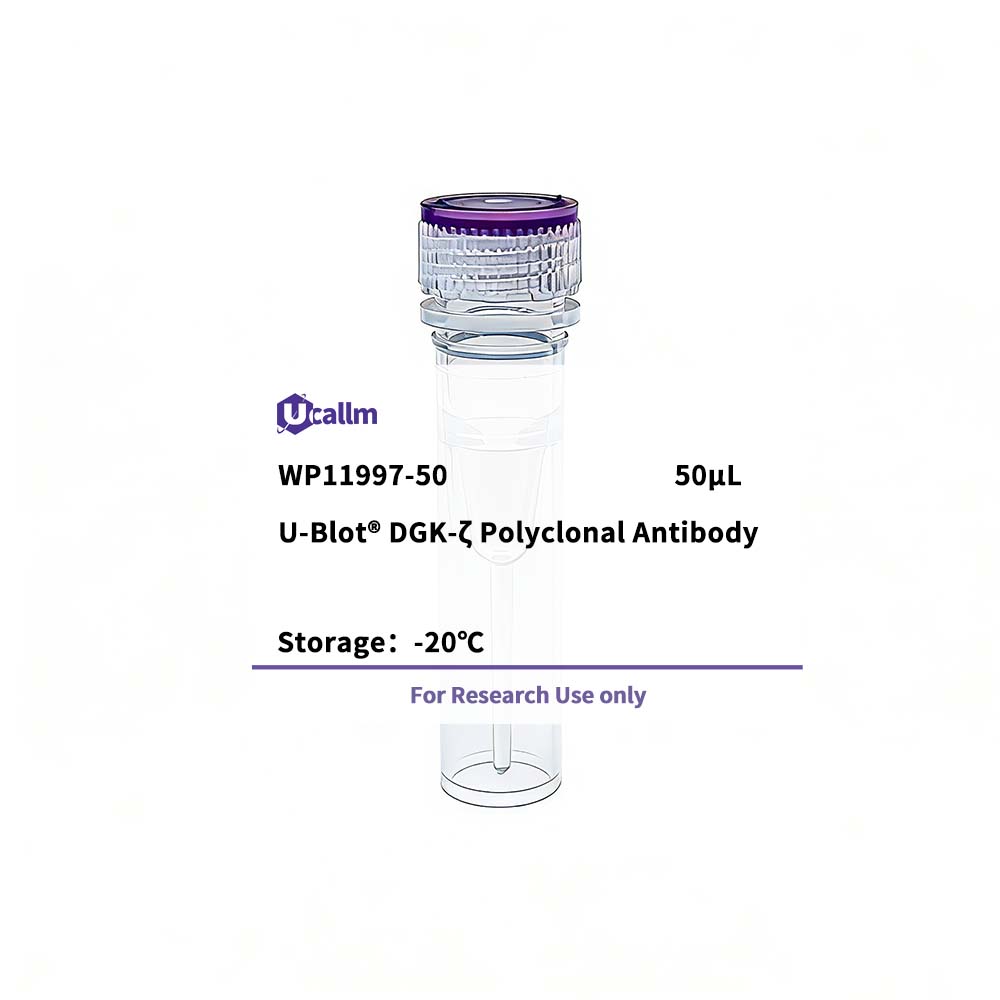
SKU: WP11997 Categories: ,

DGK-ζ Polyclonal Antibody

Price range: $268.00 through $328.00

SKU: WP11997-100
Enter the quantity you would like, or drag the panel to find the quantity and price that best for you
Bulk QuoteAuthorize OEM & ODM

Product details

Background:

The protein encoded by this gene belongs to the eukaryotic diacylglycerol kinase family. It may attenuate protein kinase C activity by regulating diacylglycerol levels in intracellular signaling cascade and signal transduction. Alternative splicing occurs at this locus and multiple transcript variants encoding distinct isoforms have been identified. [provided by RefSeq, Nov 2010],


Specifications

Size50μL/100μL
TargetDGK-ζ
ReactivityHuman, Mouse, Rat
ApplicationsIHC, IF, ELISA
MW(Calculated)124kD
MW(Observed)
Host SpeciesRabbit
IsotypeIgG
Conjugate/ModificationUnmodified
Recommended Dilution RatioIHC 1:100-1:300; ELISA 1:20000; IF 1:50-200 / Note: For IHC, we suggest antigen retrieval with TE buffer pH 9.0 (Cat#WT1004)
FormulationLiquid in PBS containing 50% glycerol, 0.5% BSA and 0.02% sodium azide.
PurificationThe antibody was affinity-purified from rabbit antiserum by affinity-chromatography using epitope-specific immunogen.
Storage-15°C to -25°C/1 year(Do not lower than -25°C)
Concentration1 mg/ml
ClonalityPolyclonal
Clone Number
ImmunogenThe antiserum was produced against synthesized peptide derived from human DGKZ. AA range:601-650
SpecificityDGK-ζ Polyclonal Antibody detects endogenous levels of DGK-ζ protein.
Gene NameDGKZ
Protein NameDiacylglycerol kinase zeta
Other NameDGKZ; / DAGK6; / Diacylglycerol kinase zeta; / DAG kinase zeta; / Diglyceride kinase zeta; / DGK-zeta
SpeciesHuman
Gene ID8525
UniprotQ13574,
Species.1Mouse
Gene ID.1
Uniprot.1Q80UP3
Species.2
Gene ID.2
Uniprot.2
Cellular LocalizationNucleus . Cytoplasm, cytosol . Cell membrane . Cell projection, lamellipodium .
Tissue ExpressionHighest levels in brain, and substantial levels in skeletal muscle, heart, and pancreas.; [Isoform 2]: Predominantly expressed in muscle.
Signaling_pathwayEnvironmental Information Processing >> Signal transduction >> Phospholipase D signaling pathway
Research Areas>>Glycerolipid metabolism; / >>Glycerophospholipid metabolism; / >>Metabolic pathways; / >>Phosphatidylinositol signaling system; / >>Phospholipase D signaling pathway; / >>Choline metabolism in cancer
FunctionCatalytic activity:ATP + 1,2-diacylglycerol = ADP + 1,2-diacyl-sn-glycerol 3-phosphate.,Caution:The sequence shown here is derived from an Ensembl automatic analysis pipeline and should be considered as preliminary data.,Function:Displays a strong preference for 1,2-diacylglycerols over 1,3-diacylglycerols, but lacks substrate specificity among molecular species of long chain diacylglycerols. Isoform 2 but not isoform 1 regulates RASGRP1 activity.,PTM:Phosphorylation of the MARCKS homology domain by PKC reduces nuclear accumulation of DGK-zeta.,similarity:Belongs to the eukaryotic diacylglycerol kinase family.,similarity:Contains 1 DAGKc domain.,similarity:Contains 2 ANK repeats.,similarity:Contains 2 phorbol-ester/DAG-type zinc fingers.,subunit:Interacts with the PDZ domain of the syntrophin SNTG1 and that of SNX27. Isoform 2 forms a signaling complex with RASGRP1 and HRAS.,tissue specificity:Highest levels in brain, and substantial levels in skeletal muscle, heart, and pancreas. Isoform 1 is predominantly expressed in muscle.,
Please login to post questions
Back to Top
Product has been added to your cart
