SKU: WP12011 Categories: ,

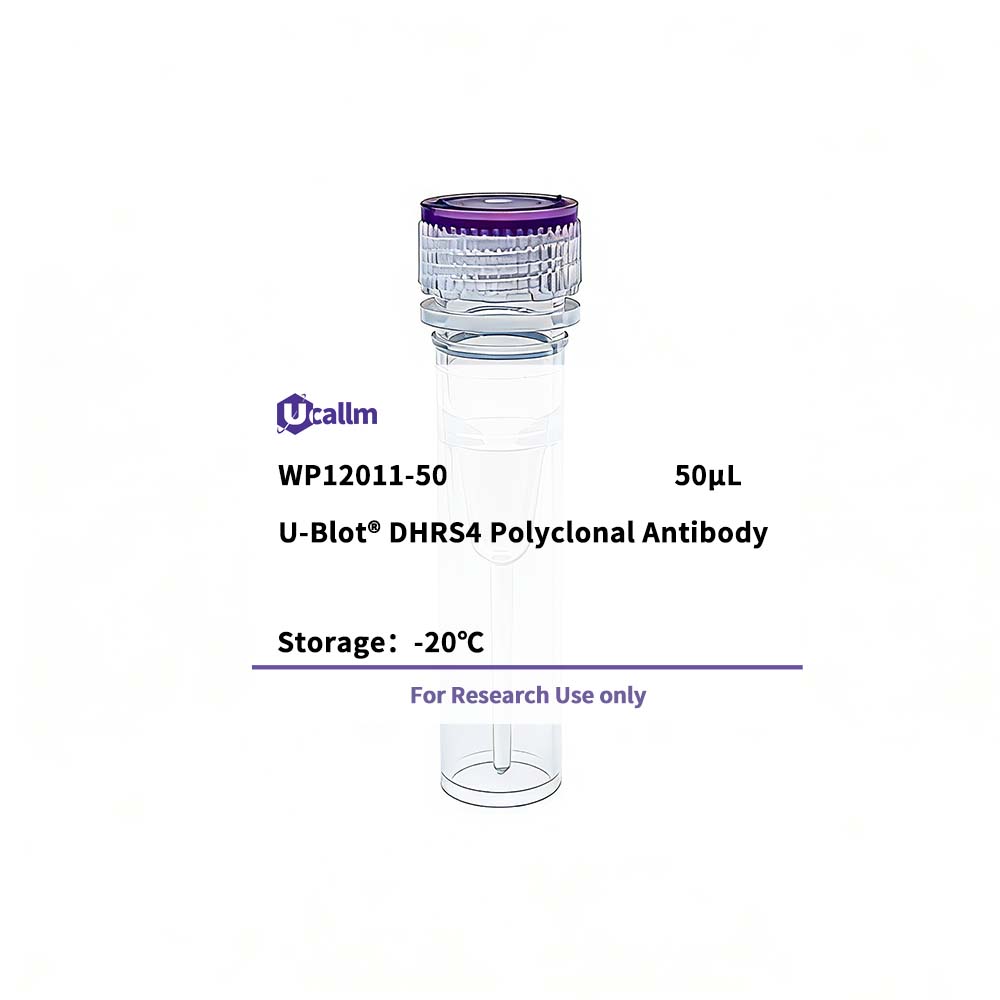
DHRS4 Polyclonal Antibody

Price range: $268.00 through $328.00

SKU: WP12011-100
Enter the quantity you would like, or drag the panel to find the quantity and price that best for you
Bulk QuoteAuthorize OEM & ODM

Product details

Background:

catalytic activity:R-CHOH-R’ + NADP(+) = R-CO-R’ + NADPH., function:Reduces all-trans-retinal and 9-cis retinal. Can also catalyze the oxidation of all-trans-retinol with NADP as co-factor, but with much lower efficiency. Reduces alkyl phenyl ketones and alpha-dicarbonyl compounds with aromatic rings, such as pyrimidine-4-aldehyde, 3-benzoylpyridine, 4-benzoylpyridine, menadione and 4-hexanoylpyridine. Has no activity towards aliphatic aldehydes and ketones., miscellaneous:Inhibited by kaempferol, quercetin, genistein and myristic acid., similarity:Belongs to the short-chain dehydrogenases/reductases (SDR) family., subcellular location:Isoform 1 is peroxisomal, while isoform 4 is not., subunit:Homotetramer., tissue specificity:Isoform 1 is predominantly expressed in normal cervix (at protein level). Isoform 4 is expressed in some neoplastic cervical tissues, but not in normal cervix (at protein level). Isoforms 5 and 6 are expressed in a few neoplastic cervical tissues.,

Specifications

Size50μL/100μL
TargetDHRS4
ReactivityHuman, Mouse, Rat
ApplicationsWB, IHC, IF, ELISA
MW(Calculated)
MW(Observed)32-34kD
Host SpeciesRabbit
IsotypeIgG
Conjugate/ModificationUnmodified
Recommended Dilution RatioWB 1:500-1:2000; IHC 1:100-1:300; ELISA 1:40000; IF 1:50-200 / Note: For IHC, we suggest antigen retrieval with TE buffer pH 9.0 (Cat#WT1004)
FormulationLiquid in PBS containing 50% glycerol, 0.5% BSA and 0.02% sodium azide.
PurificationThe antibody was affinity-purified from rabbit antiserum by affinity-chromatography using epitope-specific immunogen.
Storage-15°C to -25°C/1 year(Do not lower than -25°C)
Concentration1 mg/ml
ClonalityPolyclonal
Clone Number
ImmunogenThe antiserum was produced against synthesized peptide derived from human DHRS4. AA range:191-240
SpecificityDHRS4 Polyclonal Antibody detects endogenous levels of DHRS4 protein.
Gene NameDHRS4
Protein NameDehydrogenase/reductase SDR family member 4
Other NameDHRS4; / Dehydrogenase/reductase SDR family member 4; / NADPH-dependent carbonyl reductase/NADP-retinol dehydrogenase; / CR; / PHCR; / NADPH-dependent retinol dehydrogenase/reductase; / NRDR; / humNRDR; / Peroxisomal short-chain alcohol dehydrogenase; / PSCD
SpeciesHuman
Gene ID10901
UniprotQ9BTZ2,
Species.1Mouse
Gene ID.1
Uniprot.1Q99LB2
Species.2
Gene ID.2
Uniprot.2
Cellular Localization[Isoform 1]: Peroxisome . Isoform 4 is not peroxisomal. .; [Isoform 7]: Nucleus .
Tissue Expression[Isoform 1]: Predominantly expressed in normal cervix (at protein level).; [Isoform 4]: Expressed in some neoplastic cervical tissues, but not in normal cervix (at protein level).; [Isoform 5]: Expressed in a few neoplastic cervical tissues.; [Isoform 6]: Expressed in a few neoplastic cervical tissues.; [Isoform 8]: High expression in liver.
Signaling_pathwayCellular Processes >> Transport and catabolism >> Peroxisome
Research Areas>>Retinol metabolism; / >>Metabolic pathways; / >>Peroxisome
FunctionCatalytic activity:R-CHOH-R' + NADP(+) = R-CO-R' + NADPH.,Function:Reduces all-trans-retinal and 9-cis retinal. Can also catalyze the oxidation of all-trans-retinol with NADP as co-factor, but with much lower efficiency. Reduces alkyl phenyl ketones and alpha-dicarbonyl compounds with aromatic rings, such as pyrimidine-4-aldehyde, 3-benzoylpyridine, 4-benzoylpyridine, menadione and 4-hexanoylpyridine. Has no activity towards aliphatic aldehydes and ketones.,miscellaneous:Inhibited by kaempferol, quercetin, genistein and myristic acid.,similarity:Belongs to the short-chain dehydrogenases/reductases (SDR) family.,subcellular location:Isoform 1 is peroxisomal, while isoform 4 is not.,subunit:Homotetramer.,tissue specificity:Isoform 1 is predominantly expressed in normal cervix (at protein level). Isoform 4 is expressed in some neoplastic cervical tissues, but not in normal cervix (at protein level). Isoforms 5 and 6 are expressed in a few neoplastic cervical tissues.,
Please login to post questions
Back to Top
Product has been added to your cart