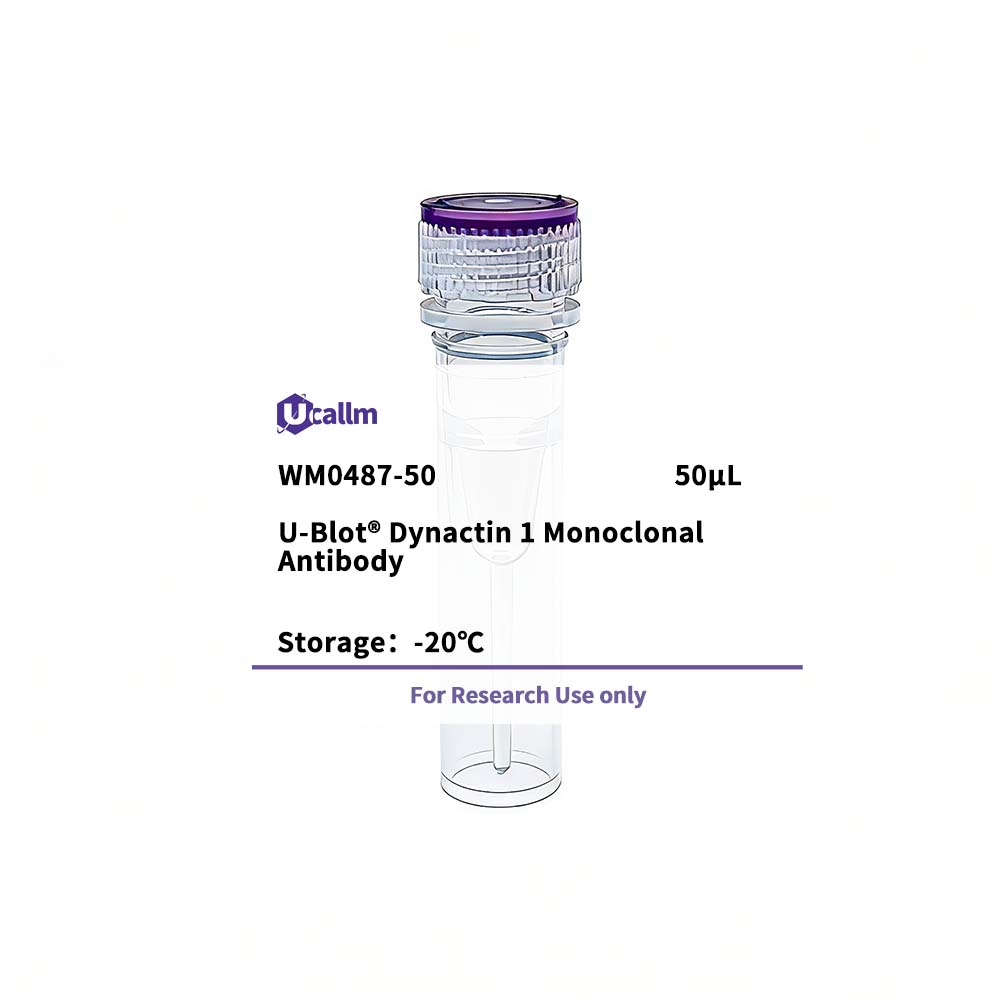
SKU: WM0487 Categories: ,

Dynactin 1 Monoclonal Antibody

Price range: $268.00 through $328.00

SKU: WM0487-50
Enter the quantity you would like, or drag the panel to find the quantity and price that best for you
Bulk QuoteAuthorize OEM & ODM

Product details

Background:
This gene encodes the largest subunit of dynactin, a macromolecular complex consisting of 10 subunits ranging in size from 22 to 150 kD. Dynactin binds to both microtubules and cytoplasmic dynein. Dynactin is involved in a diverse array of cellular functions, including ER-to-Golgi transport, the centripetal movement of lysosomes and endosomes, spindle formation, chromosome movement, nuclear positioning, and axonogenesis. This subunit interacts with dynein intermediate chain by its domains directly binding to dynein and binds to microtubules via a highly conserved glycine-rich cytoskeleton-associated protein (CAP-Gly) domain in its N-terminus. Alternative splicing of this gene results in multiple transcript variants encoding distinct isoforms. Mutations in this gene cause distal hereditary motor neuronopathy type VIIB (HMN7B) which is also known as distal spinal and bulbar muscular atrophy (dSBMA). [


Specifications

Size50μL/100μL
TargetDynactin 1
ReactivityHuman, Mouse, Bovine, Pig
ApplicationsWB, IF
MW(Calculated)142kD
MW(Observed)
Host SpeciesMouse
Isotype
Conjugate/ModificationUnmodified
Recommended Dilution RatioWB 1:1000-1:2000; IF 1:100-1:500; Not yet tested in other applications.
FormulationLiquid in PBS containing 50% glycerol, 0.5% BSA and 0.02% sodium azide.
PurificationAffinity purification
Storage-15°C to -25°C/1 year(Do not lower than -25°C)
Concentration
ClonalityMonoclonal
Clone Number5B2
ImmunogenPurified recombinant human Dynactin 1 protein fragments expressed in E.coli.
SpecificityDynactin 1 Monoclonal Antibody detects endogenous levels of Dynactin 1 protein.
Gene NameDCTN1
Protein NameDynactin subunit 1
Other NameDCTN1; / Dynactin subunit 1; / 150 kDa dynein-associated polypeptide; / DAP-150; / DP-150; / p135; / p150-glued
SpeciesHuman
Gene ID1639
UniprotQ14203,
Species.1Mouse
Gene ID.113191
Uniprot.1O08788
Species.2
Gene ID.2
Uniprot.2
Cellular LocalizationCytoplasm . Cytoplasm, cytoskeleton . Cytoplasm, cytoskeleton, microtubule organizing center, centrosome . Cytoplasm, cytoskeleton, microtubule organizing center, centrosome, centriole . Cytoplasm, cytoskeleton, spindle . Nucleus envelope . Cytoplasm, cell cortex . Localizes to microtubule plus ends (PubMed:17828277, PubMed:22777741, PubMed:25774020). Localizes preferentially to the ends of tyrosinated microtubules (PubMed:26972003). Localization at centrosome is regulated by SLK-dependent phosphorylation (PubMed:23985322). Localizes to centrosome in a PARKDA-dependent manner (PubMed:20719959). Localizes to the subdistal appendage region of the centriole in a KIF3A-dependent manner (PubMed:23386061). PLK1-mediated phosphorylation at Ser-179 is essential for its localization in the nuclear envelope (PubMed:20679239). .
Tissue ExpressionBrain.
Signaling_pathwayHuman Diseases >> Neurodegenerative disease >> Amyotrophic lateral sclerosis;Human Diseases >> Neurodegenerative disease >> Huntington disease;Human Diseases >> Neurodegenerative disease >> Pathways of neurodegeneration - multiple diseases
Research Areas>>Vasopressin-regulated water reabsorption; / >>Amyotrophic lateral sclerosis; / >>Huntington disease; / >>Pathways of neurodegeneration - multiple diseases; / >>Salmonella infection
FunctionDisease:Defects in DCTN1 are the cause of progressive lower motor neuron disease (PLMND) [MIM:607641]. PLMND is a progressive dominant disease that has no sensory symptoms.,Function:Required for the cytoplasmic dynein-driven retrograde movement of vesicles and organelles along microtubules. Dynein-dynactin interaction is a key component of the mechanism of axonal transport of vesicles and organelles.,PTM:Phosphorylated.,similarity:Belongs to the dynactin 150 kDa subunit family.,similarity:Contains 1 CAP-Gly domain.,subunit:Large macromolecular complex of at least 10 components; p150(glued) binds directly to microtubules and to cytoplasmic dynein. Interacts with the C-terminus of MAPRE1, MAPRE2 and MAPRE3.,tissue specificity:Brain.,
Please login to post questions
Back to Top
Product has been added to your cart
