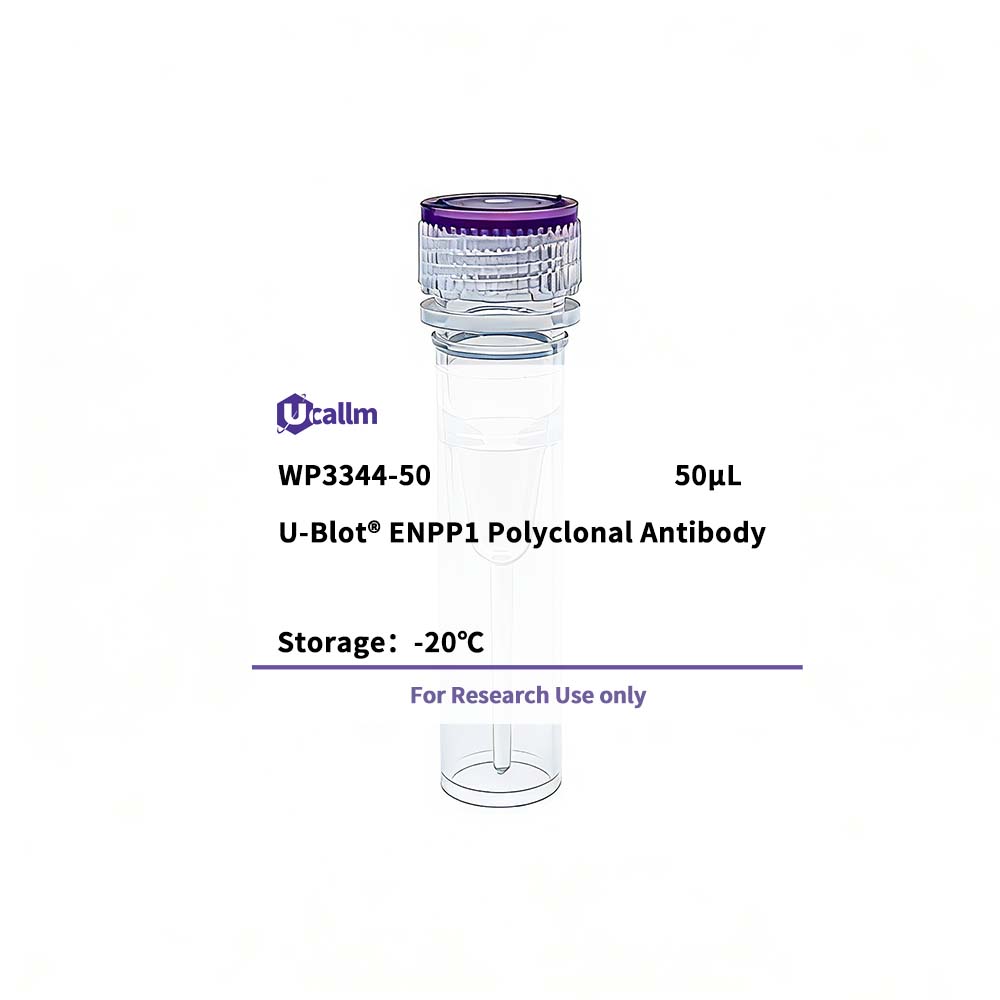
SKU: WP3344 Categories: ,

ENPP1 Polyclonal Antibody

Price range: $268.00 through $328.00

SKU: WP3344-100
Enter the quantity you would like, or drag the panel to find the quantity and price that best for you
Bulk QuoteAuthorize OEM & ODM

Product details

Background:

This gene is a member of the ecto-nucleotide pyrophosphatase/phosphodiesterase (ENPP) family. The encoded protein is a type II transmembrane glycoprotein comprising two identical disulfide-bonded subunits. This protein has broad specificity and cleaves a variety of substrates, including phosphodiester bonds of nucleotides and nucleotide sugars and pyrophosphate bonds of nucleotides and nucleotide sugars. This protein may function to hydrolyze nucleoside 5' triphosphates to their corresponding monophosphates and may also hydrolyze diadenosine polyphosphates. Mutations in this gene have been associated with 'idiopathic' infantile arterial calcification, ossification of the posterior longitudinal ligament of the spine (OPLL), and insulin resistance. [provided by RefSeq, Jul 2008],

Specifications

Size50μL/100μL
TargetENPP1
ReactivityHuman, Mouse, Rat
ApplicationsWB, ELISA
MW(Calculated)
MW(Observed)101kD
Host SpeciesRabbit
IsotypeIgG
Conjugate/ModificationUnmodified
Recommended Dilution RatioWB 1:500-2000; ELISA 1:5000-20000
FormulationLiquid in PBS containing 50% glycerol,0.5% BSA and 0.02% sodium azide.
PurificationThe antibody was affinity-purified from rabbit antiserum by affinity-chromatography using epitope-specific immunogen.
Storage-15°C to -25°C/1 year(Do not lower than -25°C)
Concentration1 mg/ml
ClonalityPolyclonal
Clone Number
ImmunogenSynthesized peptide derived from part region of human protein. AA range: 260-300
SpecificityENPP1 Polyclonal Antibody detects endogenous levels of protein.
Gene NameENPP1 M6S1 NPPS PC1 PDNP1
Protein NameEctonucleotide pyrophosphatase/phosphodiesterase family member 1 (E-NPP 1) (Membrane component chromosome 6 surface marker 1) (Phosphodiesterase I/nucleotide pyrophosphatase 1) (Plasma-cell membrane glycoprotein PC-1) [Includes: Alkaline phosphodiesterase I (EC 3.6.1.9)]
Other Name
SpeciesHuman
Gene ID5167
UniprotP22413,
Species.1Mouse
Gene ID.1
Uniprot.1P06802,
Species.2Rat
Gene ID.2
Uniprot.2Q924C3
Cellular Localization[Ectonucleotide pyrophosphatase/phosphodiesterase family member 1]: Cell membrane; Single-pass type II membrane protein. Basolateral cell membrane; Single-pass type II membrane protein. Targeted to the basolateral membrane in polarized epithelial cells and in hepatocytes, and to matrix vesicles in osteoblasts (PubMed:11598187). In bile duct cells and cancer cells, located to the apical cytoplasmic side (PubMed:11598187). .; [Ectonucleotide pyrophosphatase/phosphodiesterase family member 1, secreted form]: Secreted . Secreted following proteolytic cleavage. .
Tissue ExpressionExpressed in plasma cells and also in a number of non-lymphoid tissues, including the distal convoluted tubule of the kidney, chondrocytes and epididymis (PubMed:9344668). Expressed in melanocytes but not in keratinocytes (PubMed:28964717).
Signaling_pathway
Research Areas>>Purine metabolism; / >>Pyrimidine metabolism; / >>Starch and sucrose metabolism; / >>Riboflavin metabolism; / >>Nicotinate and nicotinamide metabolism; / >>Pantothenate and CoA biosynthesis; / >>Metabolic pathways; / >>Nucleotide metabolism
FunctionCatalytic activity:A dinucleotide + H(2)O = 2 mononucleotides.,Catalytic activity:Hydrolytically removes 5'-nucleotides successively from the 3'-hydroxy termini of 3'-hydroxy-terminated oligonucleotides.,Caution:It is uncertain whether Met-1 or Met-53 is the initiator.,cofactor:Binds 2 divalent metal cations per subunit.,Disease:Defects in ENPP1 are a cause of idiopathic infantile arterial calcification (IIAC) [MIM:208000]; also called generalized arterial calcification of infancy. IIAC is characterized by calcification of the internal elastic lamina of muscular arteries and stenosis due to myointimal proliferation.,Disease:Defects in ENPP1 are a cause of increased susceptibility for ossification of the posterior longitudinal ligament of the spine (OPLL) [MIM:602475]. OPLL is a common form of human myelopathy with a prevalence of as much as 4% in a variety of ethnic groups.,Disease:Defects in ENPP1 are associated with obesity, glucose intolerance, and type II diabetes non-insulin dependent (NIDDM) [MIM:125853].,Domain:The di-leucine motif is required for basolateral targeting in epithelial cells, and for targeting to matrix vesicles derived from mineralizing cells.,enzyme regulation:At low concentrations of ATP, a phosphorylated intermediate is formed which inhibits further hydrolysis.,Function:Involved primarily in ATP hydrolysis at the plasma membrane. Plays a role in regulating pyrophosphate levels, and functions in bone mineralization and soft tissue calcification. In vitro, has a broad specificity, hydrolyzing other nucleoside 5' triphosphates such as GTP, CTP, TTP and UTP to their corresponding monophosphates with release of pyrophosphate and diadenosine polyphosphates, and also 3',5'-cAMP to AMP. May also be involved in the regulation of the availability of nucleotide sugars in the endoplasmic reticulum and Golgi, and the regulation of purinergic signaling. Appears to modulate insulin sensitivity.,PTM:Autophosphorylated as part of the catalytic cycle of phosphodiesterase/pyrophosphatase activity.,PTM:It has been suggested that the active SMB domain may be permitted considerable disulfide bond heterogeneity or variability, thus two alternate disulfide patterns based on 3D structures are described with 1 disulfide bond conserved in both.,PTM:N-glycosylated.,similarity:Belongs to the nucleotide pyrophosphatase/phosphodiesterase family.,similarity:Contains 2 SMB (somatomedin-B) domains.,subcellular location:Targeted to the basolateral membrane in polarized epithelial cells and in hepatocytes, and to matrix vesicles in osteoblasts. In bile duct cells and cancer cells, located to the apical cytoplasmic side.,subunit:Homodimer; disulfide-linked.,tissue specificity:Expressed in plasma cells and also in a number of non-lymphoid tissues, including the distal convoluted tubule of the kidney, chondrocytes and epididymis.,
Please login to post questions
Back to Top
Product has been added to your cart
