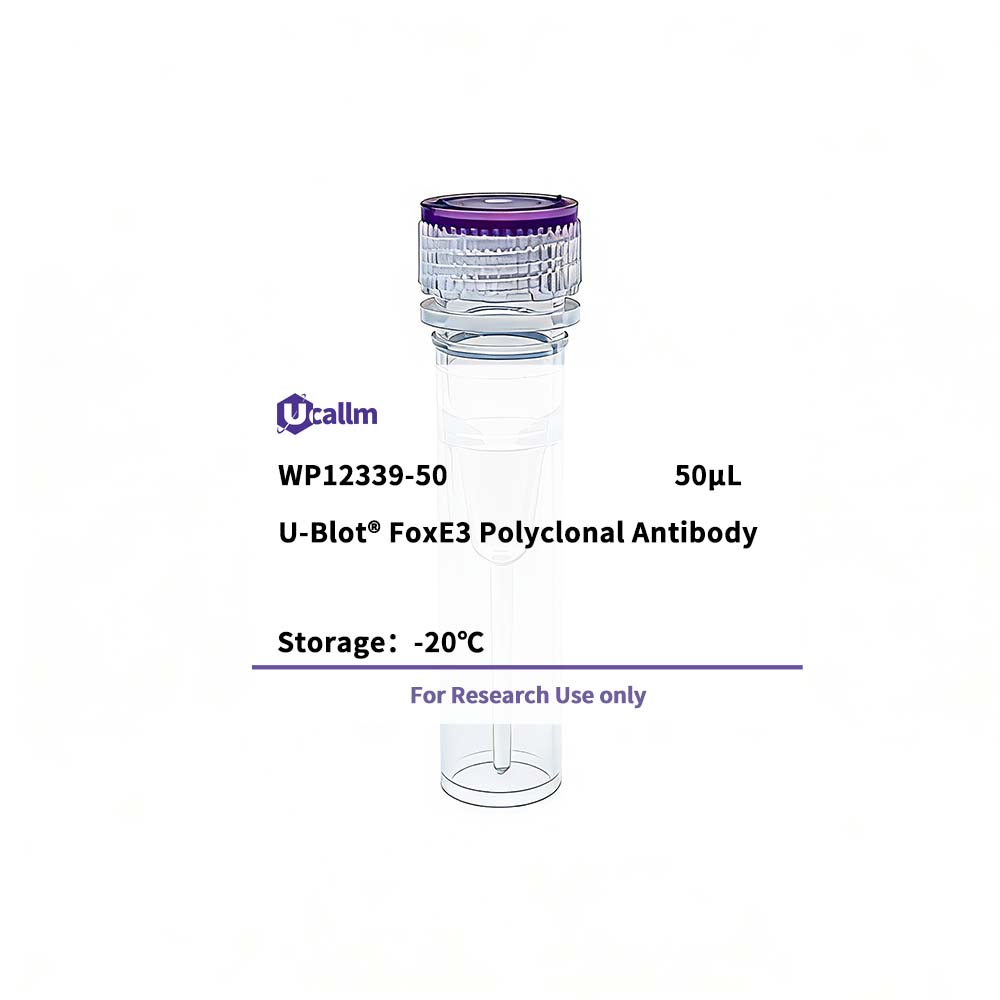
SKU: WP12339 Categories: ,

FoxE3 Polyclonal Antibody

Price range: $268.00 through $328.00

SKU: WP12339-100
Enter the quantity you would like, or drag the panel to find the quantity and price that best for you
Bulk QuoteAuthorize OEM & ODM

Product details

Background:

This intronless gene belongs to the forkhead family of transcription factors, which is characterized by a distinct forkhead domain. The protein encoded functions as a lens-specific transcription factor and plays an important role in vertebrate lens formation. Mutations in this gene are associated with anterior segment mesenchymal dysgenesis and congenital primary aphakia. [provided by RefSeq, Dec 2009],

Specifications

Size50μL/100μL
TargetFoxE3
ReactivityHuman, Mouse, Rat
ApplicationsWB, IHC, IF, ELISA
MW(Calculated)
MW(Observed)33kD
Host SpeciesRabbit
IsotypeIgG
Conjugate/ModificationUnmodified
Recommended Dilution RatioWB 1:500-1:2000; IHC 1:100-1:300; ELISA 1:20000; IF 1:50-200 / Note: For IHC, we suggest antigen retrieval with TE buffer pH 9.0 (Cat#WT1004)
FormulationLiquid in PBS containing 50% glycerol, 0.5% BSA and 0.02% sodium azide.
PurificationThe antibody was affinity-purified from rabbit antiserum by affinity-chromatography using epitope-specific immunogen.
Storage-15°C to -25°C/1 year(Do not lower than -25°C)
Concentration1 mg/ml
ClonalityPolyclonal
Clone Number
ImmunogenThe antiserum was produced against synthesized peptide derived from human FOXE3. AA range:81-130
SpecificityFoxE3 Polyclonal Antibody detects endogenous levels of FoxE3 protein.
Gene NameFOXE3
Protein NameForkhead box protein E3
Other NameFOXE3; / FKHL12; / FREAC8; / Forkhead box protein E3; / Forkhead-related protein FKHL12; / Forkhead-related transcription factor 8; / FREAC-8
SpeciesHuman
Gene ID2301
UniprotQ13461,
Species.1Mouse
Gene ID.130923
Uniprot.1Q9QY14,
Species.2Rat
Gene ID.2
Uniprot.2Q63250
Cellular LocalizationNucleus .
Tissue Expression
Signaling_pathway
Research Areas
FunctionDisease:Defects in FOXE3 are a cause of anterior segment mesenchymal dysgenesis (ASMD) [MIM:107250]; also known as anterior segment ocular dysgenesis (ASOD). ASMD includes all malformations involving the first (corneal endothelium and trabecular meshwork), second (corneal stroma) and third (iris stroma) mesenchymal waves of neural crest. The ASMD phenotype is characterized by corneal opacities with or without iris adhesions in 100%, cataracts of varying severity in 100% and optic-nerve abnormalities in 20% of affected individuals.,Disease:Defects in FOXE3 are a cause of congenital primary aphakia (CPA) [MIM:610256]. Human aphakia is a rare congenital eye disorder in which the lens is missing. It has been histologically subdivided into primary and secondary forms, in accordance with the severity of defects of the ocular tissues, whose development requires the initial presence of a lens. CPA results from an early developmental arrest, around the 4th-5th week of gestation in humans, that prevents the formation of any lens structure and leads to severe secondary ocular defects, including a complete aplasia of the anterior segment of the eye. In contrast, in secondary aphakic eyes, lens induction has occurred, and the lens vesicle has developed to some degree but finally has progressively resorbed perinatally, leading, therefore, to less-severe ocular defects.,similarity:Contains 1 fork-head DNA-binding domain.,
Please login to post questions
Back to Top
Product has been added to your cart

