

G-CSFR Polyclonal Antibody
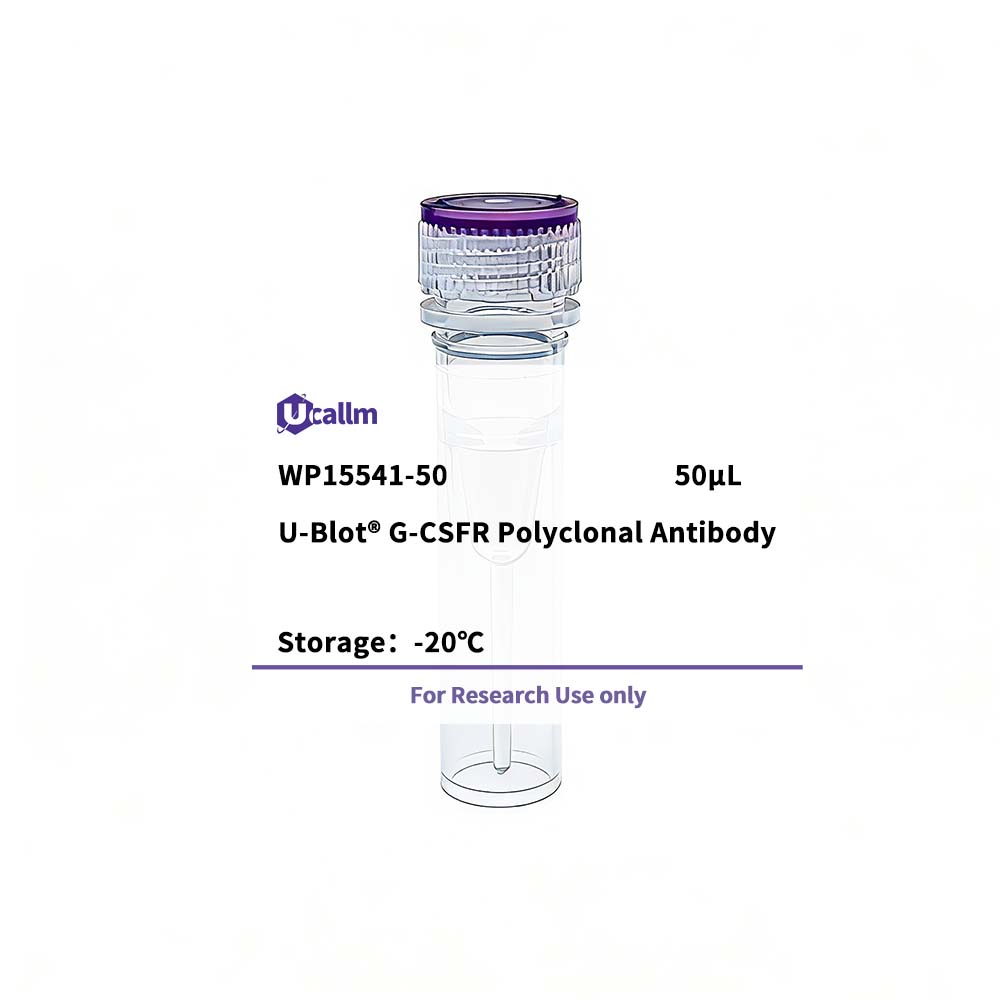
Ucallm_WP15541-50
Price range: $268.00 through $328.00
Product details
Background:
The protein encoded by this gene is the receptor for colony stimulating factor 3, a cytokine that controls the production, differentiation, and function of granulocytes. The encoded protein, which is a member of the family of cytokine receptors, may also function in some cell surface adhesion or recognition processes. Alternatively spliced transcript variants have been described. Mutations in this gene are a cause of Kostmann syndrome, also known as severe congenital neutropenia. [provided by RefSeq, Aug 2010],
Specifications
| Size | 50μL/100μL |
| Target | G-CSFR |
| Reactivity | Human, Mouse |
| Applications | WB, ELISA |
| MW(Calculated) | |
| MW(Observed) | 92kD |
| Host Species | Rabbit |
| Isotype | IgG |
| Conjugate/Modification | Unmodified |
| Recommended Dilution Ratio | WB 1:500-1:2000; ELISA 1:20000; Not yet tested in other applications. |
| Formulation | Liquid in PBS containing 50% glycerol, 0.5% BSA and 0.02% sodium azide. |
| Purification | The antibody was affinity-purified from rabbit antiserum by affinity-chromatography using epitope-specific immunogen. |
| Storage | -15°C to -25°C/1 year(Do not lower than -25°C) |
| Concentration | 1 mg/ml |
| Clonality | Polyclonal |
| Clone Number | |
| Immunogen | The antiserum was produced against synthesized peptide derived from the Internal region of human CSF3R. AA range:321-370 |
| Specificity | G-CSFR Polyclonal Antibody detects endogenous levels of G-CSFR protein. |
| Gene Name | CSF3R |
| Protein Name | Granulocyte colony-stimulating factor receptor |
| Other Name | CSF3R; / GCSFR; / Granulocyte colony-stimulating factor receptor; / G-CSF receptor; / G-CSF-R; / CD114 |
| Species | Human |
| Gene ID | 1441 |
| Uniprot | Q99062, |
| Species.1 | Mouse |
| Gene ID.1 | |
| Uniprot.1 | P40223 |
| Species.2 | |
| Gene ID.2 | |
| Uniprot.2 | |
| Cellular Localization | [Isoform 2]: Secreted .; Cell membrane; Single-pass type I membrane protein . |
| Tissue Expression | One or several isoforms have been found in myelogenous leukemia cell line KG-1, leukemia U-937 cell line, in bone marrow cells, placenta, and peripheral blood granulocytes. Isoform GCSFR-2 is found only in leukemia U-937 cells. Isoform GCSFR-3 is highly expressed in placenta. |
| Signaling_pathway | Organismal Systems >> Immune system >> Hematopoietic cell lineage;Human Diseases >> Cancer: overview >> Pathways in cancer;Environmental Information Processing >> Signal transduction >> JAK-STAT signaling pathway;Environmental Information Processing >> Signal transduction >> PI3K-Akt signaling pathway;Environmental Information Processing >> Signaling molecules and interaction >> Cytokine-cytokine receptor interaction |
| Research Areas | >>Cytokine-cytokine receptor interaction; / >>PI3K-Akt signaling pathway; / >>JAK-STAT signaling pathway; / >>Hematopoietic cell lineage; / >>Pathways in cancer |
| Function | Alternative products:Additional isoforms seem to exist. Experimental confirmation may be lacking for some isoforms,Disease:Defects in CSF3R may be a cause of severe congenital neutropenia (SCN) in some patients.,Domain:The box 1 motif is required for JAK interaction and/or activation.,Domain:The WSXWS motif appears to be necessary for proper protein folding and thereby efficient intracellular transport and cell-surface receptor binding.,Function:Receptor for granulocyte colony-stimulating factor (CSF3). In addition it may function in some adhesion or recognition events at the cell surface.,similarity:Belongs to the type I cytokine receptor family. Type 2 subfamily.,similarity:Contains 1 Ig-like C2-type (immunoglobulin-like) domain.,similarity:Contains 5 fibronectin type-III domains.,subunit:Homodimer. The dimeric receptor binds two CSF3 molecules.,tissue specificity:One or several isoforms have been found in myelogenous leukemia cell line KG-1, leukemia U937 cell line, in bone marrow cells, placenta, and peripheral blood granulocytes. Isoform GCSFR-2 is found only in leukemia U937 cells. Isoform GSCFR-3 is highly expressed in placenta., |
Please login to post questions
Related products





