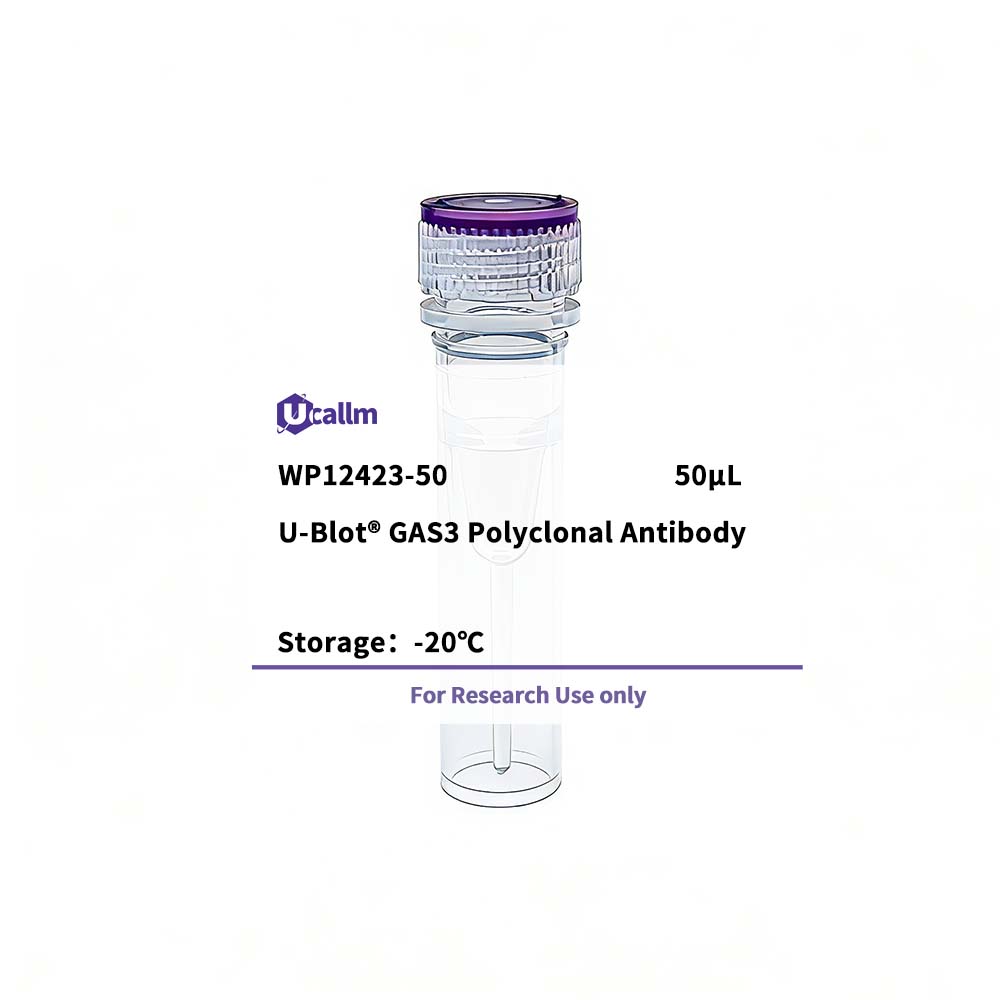
SKU: WP12423 Categories: ,

GAS3 Polyclonal Antibody

Price range: $268.00 through $328.00

SKU: WP12423-100
Enter the quantity you would like, or drag the panel to find the quantity and price that best for you
Bulk QuoteAuthorize OEM & ODM

Product details

Background:

This gene encodes an integral membrane protein that is a major component of myelin in the peripheral nervous system. Studies suggest two alternately used promoters drive tissue-specific expression. Various mutations of this gene are causes of Charcot-Marie-Tooth disease Type IA, Dejerine-Sottas syndrome, and hereditary neuropathy with liability to pressure palsies. Alternative splicing results in multiple transcript variants. [provided by RefSeq, Jul 2013],

Specifications

Size50μL/100μL
TargetGAS3
ReactivityHuman, Mouse, Rat
ApplicationsWB, IHC, IF, ELISA
MW(Calculated)
MW(Observed)22kD
Host SpeciesRabbit
IsotypeIgG
Conjugate/ModificationUnmodified
Recommended Dilution RatioWB 1:500-1:2000; IHC 1:100-1:300; ELISA 1:40000; IF 1:50-200 / Note: For IHC, we suggest antigen retrieval with TE buffer pH 9.0 (Cat#WT1004)
FormulationLiquid in PBS containing 50% glycerol, 0.5% BSA and 0.02% sodium azide.
PurificationThe antibody was affinity-purified from rabbit antiserum by affinity-chromatography using epitope-specific immunogen.
Storage-15°C to -25°C/1 year(Do not lower than -25°C)
Concentration1 mg/ml
ClonalityPolyclonal
Clone Number
ImmunogenThe antiserum was produced against synthesized peptide derived from human PMP22. AA range:111-160
SpecificityGAS3 Polyclonal Antibody detects endogenous levels of GAS3 protein.
Gene NamePMP22
Protein NamePeripheral myelin protein 22
Other NamePMP22; / GAS3; / Peripheral myelin protein 22; / PMP-22; / Growth arrest-specific protein 3; / GAS-3
SpeciesHuman
Gene ID5376
UniprotQ01453,
Species.1Mouse
Gene ID.118858
Uniprot.1P16646,
Species.2Rat
Gene ID.224660
Uniprot.2P25094
Cellular LocalizationCell membrane; Multi-pass membrane protein .
Tissue ExpressionFetal fibroblast,Kidney,Peripheral blood,Peripheral blood leukocyte,Spinal
Signaling_pathway
Research Areas
FunctionDisease:Defects in PMP22 are a cause of Dejerine-Sottas syndrome (DSS) [MIM:145900]; also known as Dejerine-Sottas neuropathy (DSN) or hereditary motor and sensory neuropathy III (HMSN3). DSS is a severe degenerating neuropathy of the demyelinating Charcot-Marie-Tooth disease category, with onset by age 2 years. DSS is characterized by motor and sensory neuropathy with very slow nerve conduction velocities, increased cerebrospinal fluid protein concentrations, hypertrophic nerve changes, delayed age of walking as well as areflexia. There are both autosomal dominant and autosomal recessive forms of Dejerine-Sottas syndrome.,Disease:Defects in PMP22 are a cause of hereditary neuropathy with liability to pressure palsies (HNPP) [MIM:162500]; an autosomal dominant disorder characterized by transient episodes of decreased perception or peripheral nerve palsies after slight traction, compression or minor traumas.,Disease:Defects in PMP22 are the cause of Charcot-Marie-Tooth disease type 1A (CMT1A) [MIM:118220]; also known as hereditary motor and sensory neuropathy IA. CMT1A is a form of Charcot-Marie-Tooth disease, the most common inherited disorder of the peripheral nervous system. Charcot-Marie-Tooth disease is classified in two main groups on the basis of electrophysiologic properties and histopathology: primary peripheral demyelinating neuropathy or CMT1, and primary peripheral axonal neuropathy or CMT2. Neuropathies of the CMT1 group are characterized by severely reduced nerve conduction velocities (less than 38 m/sec), segmental demyelination and remyelination with onion bulb formations on nerve biopsy, slowly progressive distal muscle atrophy and weakness, absent deep tendon reflexes, and hollow feet. CMT1A inheritance is autosomal dominant.,Disease:Defects in PMP22 are the cause of Charcot-Marie-Tooth disease type 1E (CMT1E) [MIM:118300]; also known as Charcot-Marie-Tooth disease and deafness autosomal dominant. CMT1E is an autosomal dominant form of Charcot-Marie-Tooth disease characterized by the association of sensorineural hearing loss with peripheral demyelinating neuropathy.,Disease:Defects in PMP22 may be a cause of inflammatory demyelinating polyneuropathy (IDP) [MIM:139393]. IDP is a putative autoimmune disorder presenting in an acute (AIDP) or chronic form (CIDP). The acute form is also known as Guillain-Barre syndrome.,Function:Might be involved in growth regulation, and in myelinization in the peripheral nervous system.,similarity:Belongs to the PMP-22/EMP/MP20 family.,
Please login to post questions
Back to Top
Product has been added to your cart


