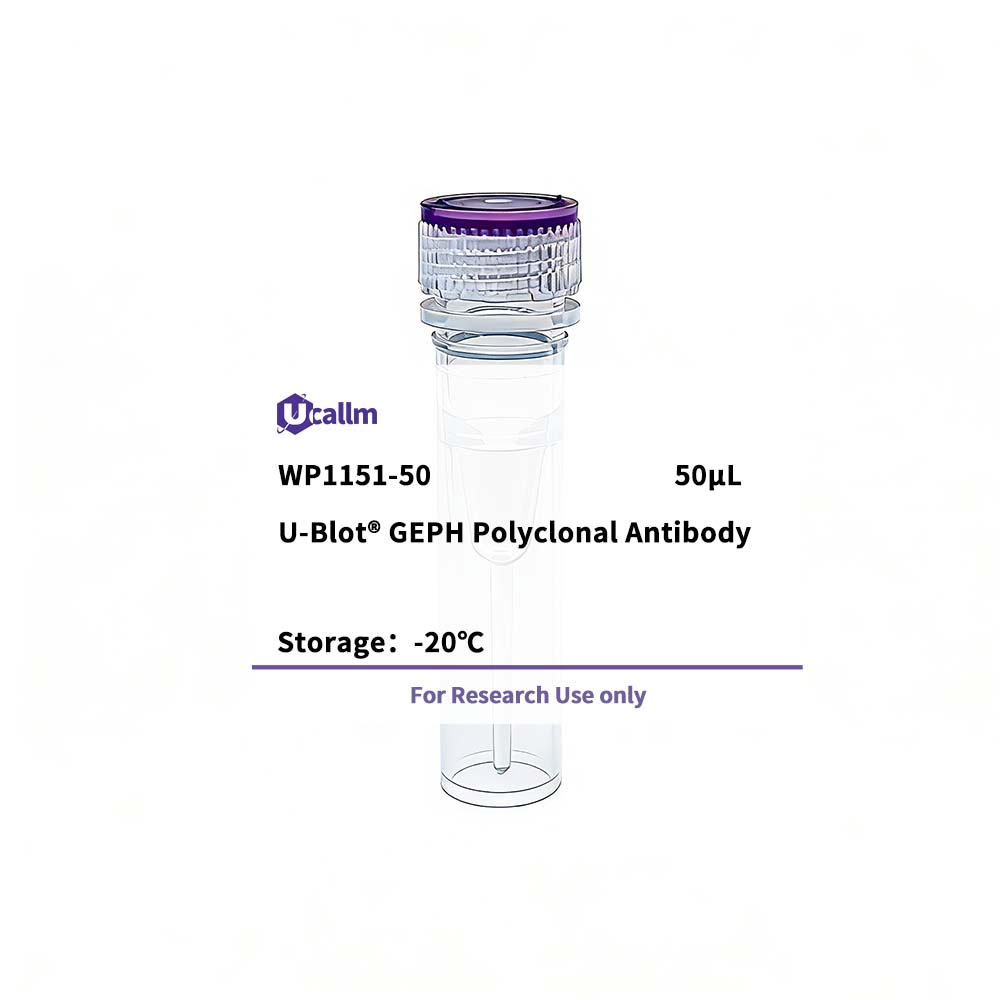
SKU: WP1151 Categories: ,

GEPH Polyclonal Antibody

Price range: $268.00 through $328.00

SKU: WP1151-100
Enter the quantity you would like, or drag the panel to find the quantity and price that best for you
Bulk QuoteAuthorize OEM & ODM

Product details

Background:

This gene encodes a neuronal assembly protein that anchors inhibitory neurotransmitter receptors to the postsynaptic cytoskeleton via high affinity binding to a receptor subunit domain and tubulin dimers. In nonneuronal tissues, the encoded protein is also required for molybdenum cofactor biosynthesis. Mutations in this gene may be associated with the neurological condition hyperplexia and also lead to molybdenum cofactor deficiency. Numerous alternatively spliced transcript variants encoding different isoforms have been described; however, the full-length nature of all transcript variants is not currently known. [provided by RefSeq, Jul 2008],

Specifications

Size50μL/100μL
TargetGEPH
ReactivityHuman, Mouse, Rat
ApplicationsWB, ELISA
MW(Calculated)
MW(Observed)80kD
Host SpeciesRabbit
IsotypeIgG
Conjugate/ModificationUnmodified
Recommended Dilution RatioWB 1:500-2000; ELISA 1:5000-20000
FormulationLiquid in PBS containing 50% glycerol,0.5% BSA and 0.02% sodium azide.
PurificationThe antibody was affinity-purified from rabbit antiserum by affinity-chromatography using epitope-specific immunogen.
Storage-15°C to -25°C/1 year(Do not lower than -25°C)
Concentration1 mg/ml
ClonalityPolyclonal
Clone Number
ImmunogenSynthesized peptide derived from part region of human protein
SpecificityGEPH Polyclonal Antibody detects endogenous levels of protein.
Gene NameGPHN GPH KIAA1385
Protein NameGephyrin [Includes: Molybdopterin adenylyltransferase (MPT adenylyltransferase) (Domain G); Molybdopterin molybdenumtransferase (MPT Mo-transferase) (Domain E)]
Other Name
SpeciesHuman
Gene ID10243
UniprotQ9NQX3,
Species.1Mouse
Gene ID.1
Uniprot.1Q8BUV3,
Species.2Rat
Gene ID.2
Uniprot.2Q03555
Cellular LocalizationCell junction, synapse, postsynaptic cell membrane; Lipid-anchor; Cytoplasmic side . Cell membrane; Lipid-anchor; Cytoplasmic side . Cytoplasm, cytosol . Cytoplasm, cytoskeleton . Cell projection, dendrite . Cell junction, synapse, postsynaptic density . Cytoplasmic face of glycinergic postsynaptic membranes (By similarity). Forms clusters at synapses (PubMed:25025157). .
Tissue ExpressionBrain,Epithelium,Hippocampus,Kidney,Testis,
Signaling_pathway
Research Areas>>Folate biosynthesis; / >>Metabolic pathways; / >>Biosynthesis of cofactors; / >>GABAergic synapse
Functioncofactor:Magnesium.,Disease:Defects in GPHN are a cause of startle disease (STHE) [MIM:149400]; also known as hyperekplexia. STHE is a genetically heterogeneous neurologic disorder characterized by muscular rigidity of central nervous system origin, particularly in the neonatal period, and by an exaggerated startle response to unexpected acoustic or tactile stimuli.,Disease:Defects in GPHN are the cause of molybdenum cofactor deficiency type C (MOCOD type C) [MIM:252150]. MOCOD type C is an autosomal recessive disease which leads to the pleiotropic loss of all molybdoenzyme activities and is characterized by severe neurological damage, neonatal seizures and early childhood death.,Domain:Contains 2 functional domains that are expressed as separate proteins in bacteria. The G-domain adenylates molybdopterin. The E-domain inserts molybdenum into adenylated molybdopterin.,enzyme regulation:Inhibited by copper and tungsten.,Function:Microtubule-associated protein involved in membrane protein-cytoskeleton interactions. It is thought to anchor the inhibitory glycine receptor (GLYR) to subsynaptic microtubules (By similarity). Involved in molybdenum cofactor biosynthesis. Required for molybdenum transfer to molybdopterin. In a first step, copper-molybdopterin is adenylated. Subsequently, molybdate is inserted into adenylated molybdopterin and AMP is released.,pathway:Cofactor biosynthesis; molybdopterin biosynthesis.,similarity:In the C-terminal section; belongs to the moeA family.,similarity:In the N-terminal section; belongs to the moaB/mog family.,subcellular location:Cytoplasmic face of glycinergic postsynaptic membranes.,subunit:Homotrimer. Interacts with GABARAP.,
Please login to post questions
Back to Top
Product has been added to your cart

