SKU: WP3461 Categories: ,

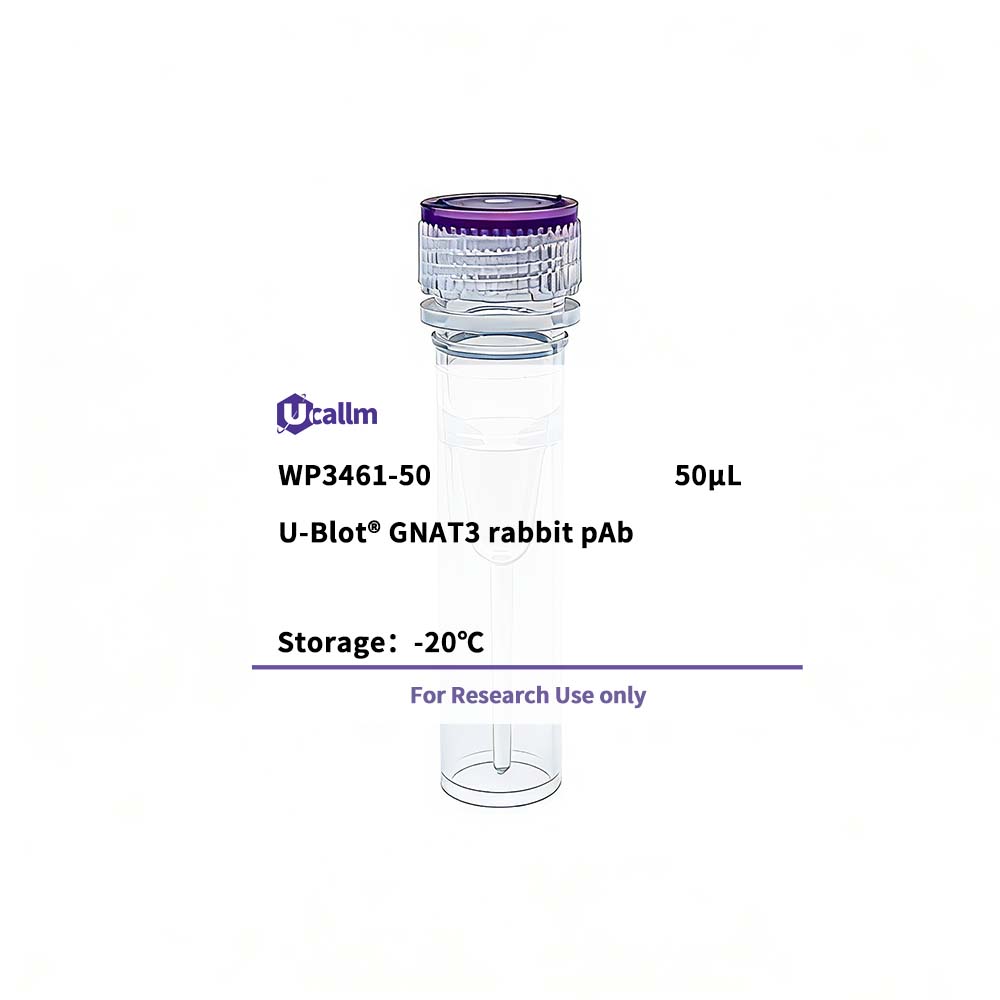
GNAT3 rabbit pAb

Price range: $268.00 through $328.00

SKU: WP3461-100
Enter the quantity you would like, or drag the panel to find the quantity and price that best for you
Bulk QuoteAuthorize OEM & ODM

Product details

Background:

Sweet, bitter, and umami tastes are transmitted from taste receptors by a specific guanine nucleotide binding protein. The protein encoded by this gene is the alpha subunit of this heterotrimeric G protein, which is found not only in the oral epithelium but also in gut tissues. Variations in this gene have been linked to metabolic syndrome. [provided by RefSeq, Dec 2015],

Specifications

Size50μL/100μL
TargetGNAT3
ReactivityHuman, Mouse, Rat
ApplicationsWB
MW(Calculated)
MW(Observed)38kD
Host SpeciesRabbit
IsotypeIgG
Conjugate/ModificationUnmodified
Recommended Dilution RatioWB 1:500-2000
FormulationLiquid in PBS containing 50% glycerol, 0.5% BSA and 0.02% sodium azide.
PurificationThe antibody was affinity-purified from rabbit antiserum by affinity-chromatography using epitope-specific immunogen.
Storage-15°C to -25°C/1 year(Do not lower than -25°C)
Concentration1 mg/ml
ClonalityPolyclonal
Clone Number
ImmunogenSynthesized peptide derived from human GNAT3 AA range: 192-242
SpecificityThis antibody detects endogenous levels of GNAT3 at Human/Mouse/Rat
Gene NameGNAT3
Protein NameGNAT3
Other NameGuanine nucleotide-binding protein G; / t; / subunit alpha-3; / Gustducin alpha-3 chain
SpeciesHuman
Gene ID346562
UniprotA8MTJ3,
Species.1Mouse
Gene ID.1242851
Uniprot.1Q3V3I2,
Species.2Rat
Gene ID.2286924
Uniprot.2P29348
Cellular LocalizationCytoplasm . Dual distribution pattern; plasmalemmal pattern with apical region localization and cytosolic pattern with localization throughout the cytoplasm.
Tissue ExpressionExpressed in taste buds (sensory organs of clustered epithelial cells) of the circumvallate and foliate papillae of the tongue at protein level. Expressed in enteroendocrine L cells of the gut. Detected also in spermatozoa.
Signaling_pathway
Research Areas>>Taste transduction; / >>Carbohydrate digestion and absorption
FunctionFunction:Guanine nucleotide-binding protein (G protein) alpha subunit playing a prominent role in bitter and sweet taste transduction as well as in umami (monosodium glutamate, monopotassium glutamate, and inosine monophosphate) taste transduction. Transduction by this alpha subunit involves coupling of specific cell-surface receptors with a cGMP-phosphodiesterase; Activation of phosphodiesterase lowers intracellular levels of cAMP and cGMP which may open a cyclic nucleotide-suppressible cation channel leading to influx of calcium, ultimately leading to release of neurotransmitter. Indeed, denatonuim and strychnine induce transient reduction in cAMP and cGMP in taste tissue, whereas this decrease is inhibited by GNAT3 antibody. Gustducin heterotrimer transduces response to bitter and sweet compounds via regulation of phosphodiesterase for alpha subunit, as well as via activation of phospholipase C for beta and gamma subunits, with ultimate increase inositol trisphosphate and increase of intracellular Calcium. GNAT3 can functionally couple to taste receptors to transmit intracellular signal: receptor heterodimer TAS1R2/TAS1R3 senses sweetness and TAS1R1/TAS1R3 transduces umami taste, whereas the T2R family GPCRs act as bitter sensors. Functions also as lumenal sugar sensors in the gut to control the expression of the Na+-glucose transporter SGLT1 in response to dietaty sugar, as well as the secretion of Glucagon-like peptide-1, GLP-1 and glucose-dependent insulinotropic polypeptide, GIP. Thus, may modulate the gut capacity to absorb sugars, with implications in malabsorption syndromes and diet-related disorders including diabetes and obesity.,PTM:Potential N-myristoylation may anchor alpha-subunit to the inner surface of plasma membrane.,similarity:Belongs to the G-alpha family. G(i/o/t/z) subfamily.,subcellular location:Dual ditribution pattern; plasmalemmal pattern with apical region localization and cytosolic pattern with localization throughout the cytoplasm.,subunit:G proteins are composed of 3 units; alpha, beta and gamma, respectively GNAT3, GNB1 and GNG13 for Gustducin heterotrimer for bitter taste transduction. The alpha chain contains the guanine nucleotide binding site. Gustducin heterotrimer may also be composed of GNAT3, GNB3 and GNG13.,tissue specificity:Expressed in taste buds (sensory organs of clustered epithelial cells) of the circumvallate and foliate papillae of the tongue at protein level. Expressed in enteroendocrine L cells of the gut. Detected also in spermatozoa.,
Please login to post questions
Back to Top
Product has been added to your cart

